
DCFR Insight 26 / Data Center Strategy + Site Planning
Site StrategyVertical, Underground, Underwater, and Cold-Climate Data Centers
A practical typology decision framework for determining when low-rise, vertical, underground, subsea, or cold-climate data centers create real development value—and when they only move risk somewhere harder to solve.
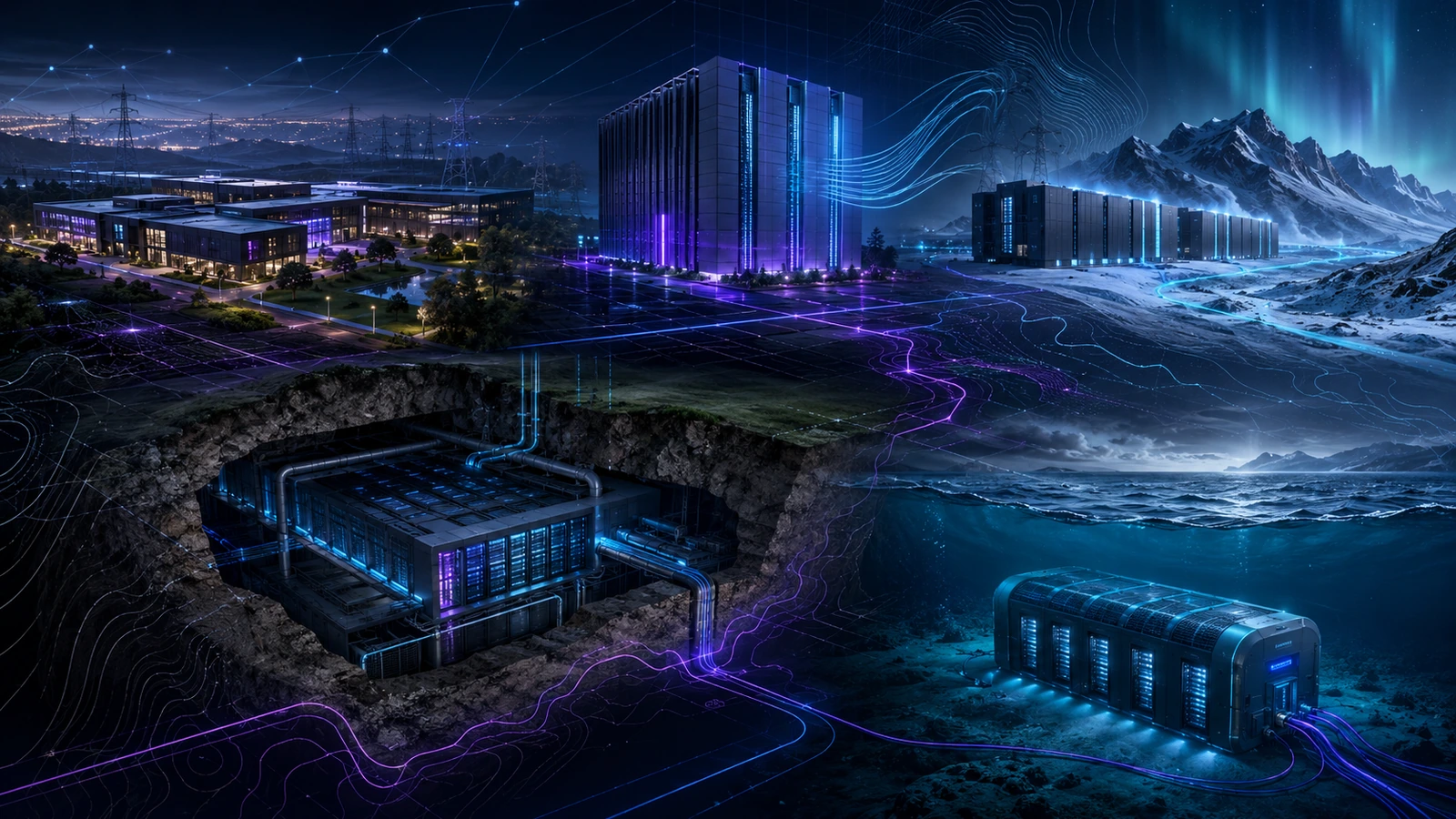
Start With the Constraint You Are Trying to Escape
The wrong way to begin is by asking which data center form is most innovative. The useful question is: what constraint makes the conventional low-rise campus insufficient? If the problem is land scarcity, verticality may help. If the problem is physical security or an existing hardened asset, underground reuse may help. If the opportunity is a highly controlled, sealed modular system near a suitable coast, subsea deployment may be worth investigating. If cooling energy is a dominant concern and infrastructure is otherwise strong, a cool climate may improve the operating case. Every unconventional form should therefore begin with a named constraint, a measurable benefit, and a threshold at which the benefit exceeds the added capital, operational, approval, and replacement complexity.
Do not select an unconventional typology because it is possible. Select it only when it solves a quantified development problem better than the low-rise baseline.
Use the Low-Rise Campus as the Baseline Case
Low-rise remains the reference case because heavy Information Technology (IT), electrical, battery, and mechanical loads can be supported directly, major equipment can remain accessible from grade, and independent utility paths can be separated horizontally. Transformer yards, generators, cooling equipment, loading, fuel systems, fire access, and replacement routes can be organized around the building rather than stacked through it. Phasing is also straightforward: additional capacity can often be delivered by repeating proven modules. Any alternative should therefore be compared against the low-rise case for delivered megawatts, construction duration, infrastructure length, redundancy, maintainability, replacement logistics, land consumed, approval risk, and whole-life cost—not just megawatts per acre.
Vertical Data Centers: Land Efficiency Is Purchased With Infrastructure Complexity
Verticality can be rational where land value, parcel scarcity, network proximity, or an urban zoning condition is strong enough to pay for the consequences. Stacking data halls changes the architecture of power, cooling, structure, fire protection, life safety, and replacement. High-capacity electrical risers become critical distribution assets. Cooling loops and controls must work over elevation and longer distribution paths. Concentrated floor loads repeat vertically. Firefighter access, smoke control, compartmentation, egress, hazardous systems, battery strategy, and emergency power become more interdependent. Large equipment can no longer be assumed to roll directly from a truck to its final position. The design must reserve freight-elevator capacity, lifting zones, removable façade panels, roof or side-wall hoist points, rigging paths, and replacement clearances before the building envelope is fixed.
The important metric is not floors added. It is usable IT capacity gained after the vertical distribution, life-safety, structural, and replacement penalties are counted.
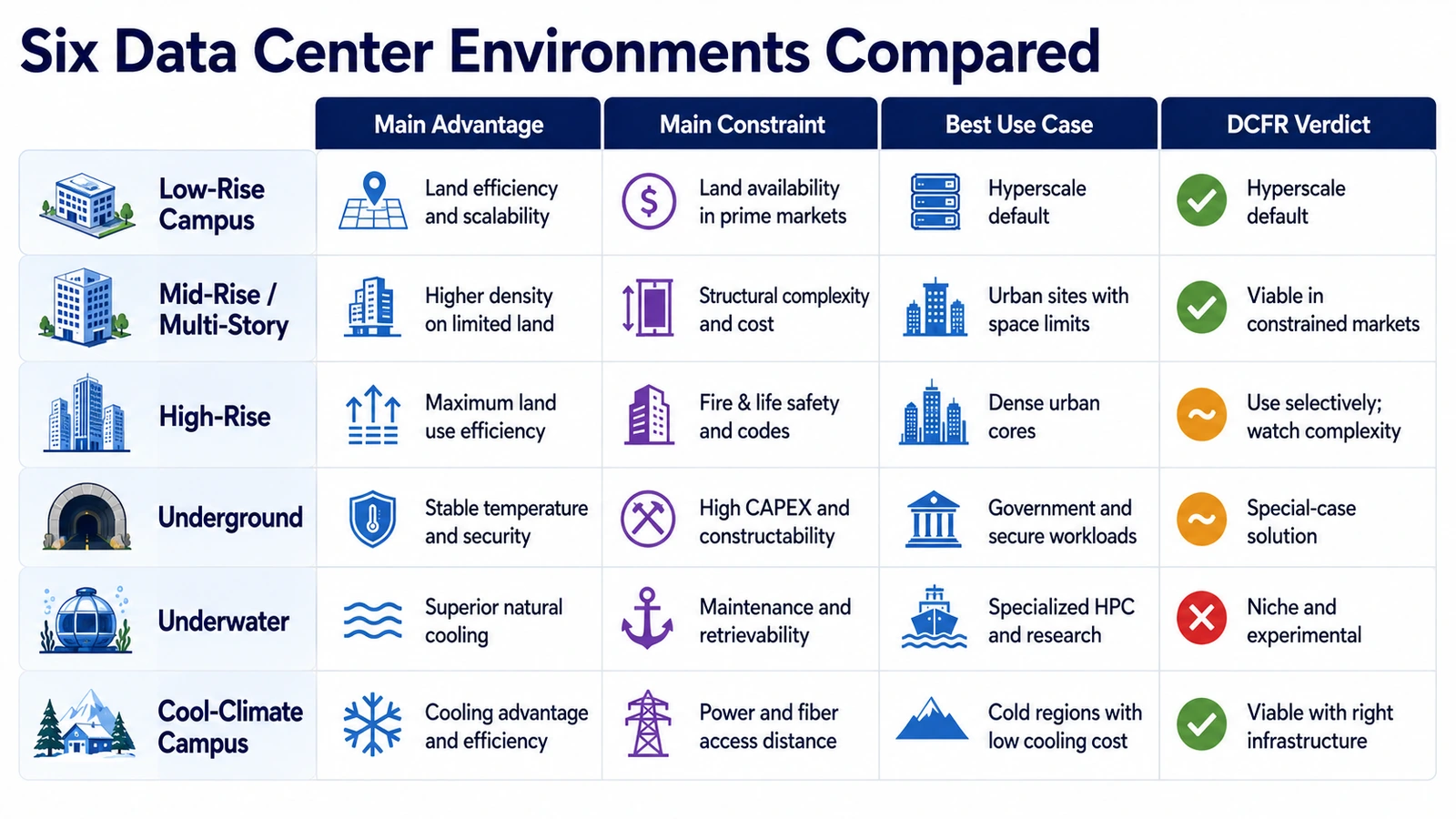
Typology Decision Matrix
| Typology | Use when | Reject or pause when | Critical proof |
|---|---|---|---|
| Low-rise campus | Land and utility geometry support repeatable horizontal capacity | Land constraint or location value makes horizontal expansion uneconomic | Complete site-fit, utility, cooling, access, and phasing plan |
| Multi-story / vertical | Land value, latency, or urban location clearly justifies stacking | Replacement, structure, risers, or life safety cannot be resolved cleanly | Vertical infrastructure and equipment-replacement strategy |
| Underground reuse | Existing mine, cavern, or hardened asset provides favorable geometry | Water, access, smoke control, or equipment logistics dominate | Geotechnical, hydrogeologic, life-safety, and logistics confirmation |
| Purpose-built underground | Exceptional land/security constraint and unusually favorable geology | Excavation and permanent water-control systems erase the benefit | Excavation quantity, groundwater, waterproofing, and access basis |
| Underwater / subsea | Specialized modular, sealed, long unattended operating model is viable | Conventional field maintenance or rapid component access is required | Marine deployment, retrieval, power/fiber, approval, and refresh model |
| Cold-climate campus | Power, fiber, logistics, and permitting are strong and climate improves annual cooling | Remote location weakens time to power, labor, access, or network resilience | Hourly thermal model plus infrastructure and logistics evidence |
A Practical Vertical Feasibility Gate
Before a multi-story concept proceeds, test it against a short list of hard questions. If the team cannot answer them at concept stage, height is being treated as a rendering decision instead of an infrastructure decision.
- 1
Prove the land-value case
Quantify the acreage saved and the financial or strategic value of that saved land. If the avoided land cost or location advantage is modest, the stacked scheme may not justify its premium.
- 2
Define the structural load path
Establish planning loads, vibration criteria, floor-to-floor height, equipment zones, and the structural grid before assuming conventional commercial-building framing will work.
- 3
Map vertical power and cooling distribution
Show primary electrical risers, redundant routes, coolant or chilled-water distribution, isolation strategy, leak containment, maintenance access, and how one floor can be serviced without creating unacceptable risk to another.
- 4
Design major-equipment replacement before façade design
Identify the heaviest and largest replaceable components, their route from public road to final position, required doors or panels, crane or hoist zones, freight-elevator capacity, and temporary laydown locations.
- 5
Test fire and life safety vertically
Coordinate fire access, egress, compartmentation, smoke control, hazardous-system locations, emergency power, firefighter movement, and Authority Having Jurisdiction review as one vertical strategy.
- 6
Compare operational interruption risk
Determine whether maintenance or replacement on one level can threaten distribution paths, structure, water systems, or access serving other live levels.
Underground Data Centers: Separate Adaptive Reuse From New Excavation
Underground facilities can work exceptionally well when favorable underground volume already exists. Lefdal Mine Data Centers and Green Mountain's SVG-Rennesøy facility demonstrate the value of reusing mines or hardened underground assets where geometry, access, rock conditions, power, and cooling align. That is fundamentally different from deciding to excavate a new hyperscale campus because surface land is expensive. New excavation makes geology, groundwater, waterproofing, permanent drainage, smoke exhaust, emergency egress, fire-department access, equipment shafts, cable routing, construction ventilation, and long-term moisture management primary infrastructure systems. The development team should price and schedule those systems before assigning any value to land saved above grade.
Underground becomes compelling when the site provides a favorable underground asset—not merely because the concept sounds secure or visually unobtrusive.
Underground Kill Criteria Should Be Identified Early
A planning-grade underground screen should immediately flag uncontrolled groundwater, unfavorable or highly variable rock, inadequate shaft or portal geometry, no credible smoke-control concept, impractical emergency access, impossible transformer or cooling-equipment replacement, excessive excavation volume, difficult spoil handling, uncertain waterproofing maintainability, or a construction sequence that requires too much specialized temporary work. These are not reasons to reject underground development automatically; they are reasons to stop treating the subsurface as free space. If the site only becomes viable by assuming optimistic geology or perfect waterproofing, the feasibility conclusion is weak.
Underwater: Understand What Project Natick Proved—and What It Did Not
Microsoft's Project Natick demonstrated that a sealed subsea data center could operate successfully for roughly two years and reported a server failure rate about one-eighth that of a comparable land-based control group. The important design lesson is the potential value of a stable sealed environment, fewer human interventions, modular factory assembly, and long unattended operating cycles. It does not prove that hyperscale terrestrial campuses should simply move offshore. A commercial subsea system still needs reliable power and fiber, marine deployment, retrieval, corrosion management, environmental and maritime approvals, vessel access, spare strategy, failure response, refresh planning, and a business model that accepts replacement by module rather than conventional field repair. Subsea is therefore best treated as a specialized operating architecture, not a universal real-estate solution.
The transferable lesson is industrialized, lights-out operation—not 'put every data center in the ocean.'
Climate Is a System Architecture, Not a Weather Statistic
Vertical, underground, and subsea describe physical typologies; cold, hot-arid, hot-humid, and temperate-coastal describe operating environments. Treating them as one list hides the most valuable combinations. A stronger feasibility study first selects the physical form, then applies a climate architecture that controls heat rejection, water, moisture, corrosion, hazards, logistics, and heat reuse. The innovation comes from the interaction between those systems—not from an unusual building form or a favorable annual-average temperature alone.
Select the typology and climate response as two linked decisions, then prove that their advantages reinforce rather than cancel one another.
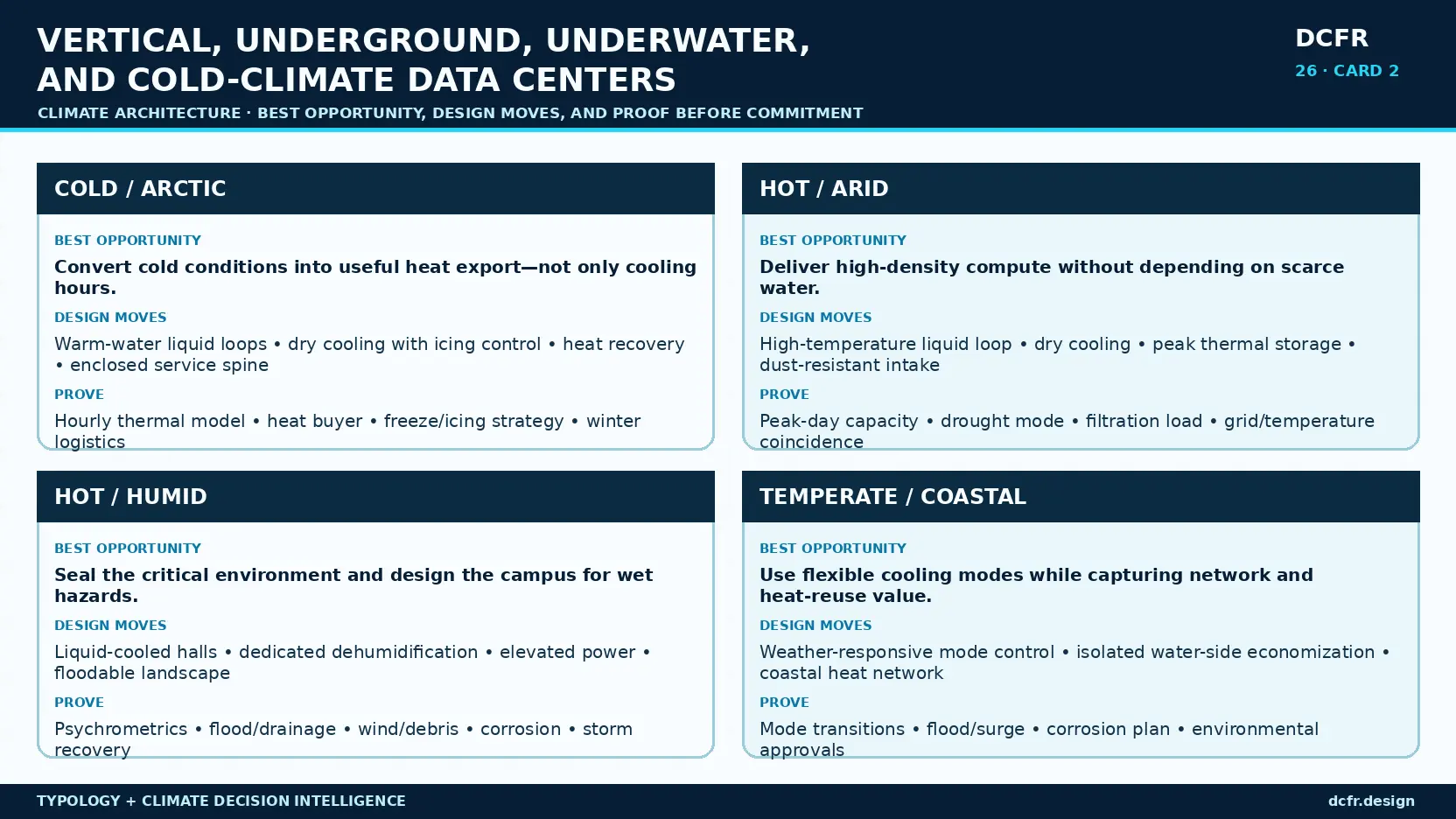
Cold and Arctic: Export Useful Heat, Not Just Cooling Hours
Low ambient temperatures can extend dry-cooling or economization hours, but remote delivery, icing, snow, freeze protection, equipment ratings, labor depth, spare-parts access, and time to power can erase that advantage. High-density liquid cooling changes the opportunity: heat collected near the chip can leave the building at a temperature useful to district heating, greenhouses, aquaculture, snow-melt systems, or industrial processes. Promising ideas include warm-water loops, dry coolers with active icing detection and defrost modes, enclosed service spines, thermal storage that aligns supply with heat demand, and factory-built modules that reduce winter field labor. Prove the concept with an hourly thermal model, a real heat-offtake profile, snow-drift and icing analysis, freeze philosophy, winter commissioning plan, and resilient power, fiber, labor, and spares strategy.
Cold becomes a strategic advantage when the project monetizes usable heat and remains operable through the hardest winter week.
Hot-Arid: Maximize Compute Without Making Water the Hidden Dependency
Hot-arid regions may offer land, solar resources, and development speed, yet high design temperatures and water scarcity can make evaporative cooling politically and operationally fragile. The strongest response is liquid-first: elevated coolant temperatures improve dry-cooler effectiveness, limited hybrid assist can be reserved for exceptional hours, and thermal storage can shift peak rejection rather than oversizing every component. Solar-reflective roofs, shaded equipment zones, staged dust filtration, workload scheduling around coincident grid and thermal peaks, and reclaimed-water readiness can add resilience without making uncertain water supply essential to day-one capacity. Prove peak-day IT capacity, drought mode, filtration maintenance burden, grid-temperature coincidence, and the legal reliability of every water source.
Design the normal operating case to survive without scarce water; treat water-assisted cooling as a controlled exception, not a permanent assumption.
Hot-Humid and Tropical: Seal the Critical Environment and Design for Wet Hazards
High humidity reduces airside economization and increases condensation and corrosion risk. Tropical locations can add intense rainfall, flooding, wind-driven rain, cyclone debris, salt exposure, and periods when outdoor maintenance is unsafe. Liquid-cooled halls with small, tightly controlled air volumes reduce dependence on outside air; dedicated dehumidification can serve people and service zones without becoming the primary IT heat-removal strategy. Elevate electrical distribution, protect fuel and battery systems, reserve floodable landscape and redundant drainage, pressure-equalize rainscreens, specify corrosion zones, and create a storm mode that secures exposed equipment while maintaining critical capacity through access disruption. Prove psychrometrics, condensation surfaces, flood and drainage performance, wind and debris criteria, corrosion class, storm access, and post-event recovery.
In humid climates, control moisture at the system boundary and assume the campus must remain safe when the exterior cannot be serviced.
Temperate and Coastal: Use Mode Flexibility While Controlling Salt, Surge, and Approval Risk
Temperate sites can switch among economization, dry cooling, hybrid cooling, and mechanical modes; coastal sites may also offer network landings, nearby heat users, or water-side heat exchange. That flexibility is valuable only when controls, environmental approvals, salt exposure, flood and surge, and lifecycle maintenance are explicit. High-value ideas include weather- and carbon-responsive mode selection, closed-loop water-side economization through accessible isolated heat exchangers, elevated critical infrastructure paired with sacrificial flood-storage landscapes, corrosion-zoned material specifications and inspection cycles, and heat-reuse networks serving ports, institutions, housing, or industry. Prove every operating-mode transition, the corrosion maintenance plan, flood and surge basis, environmental discharge pathway, shore access, and full lifecycle cost of protective measures.
Coastal flexibility is an operating asset only when salt, flood, environmental interfaces, and maintenance are designed as permanent systems.
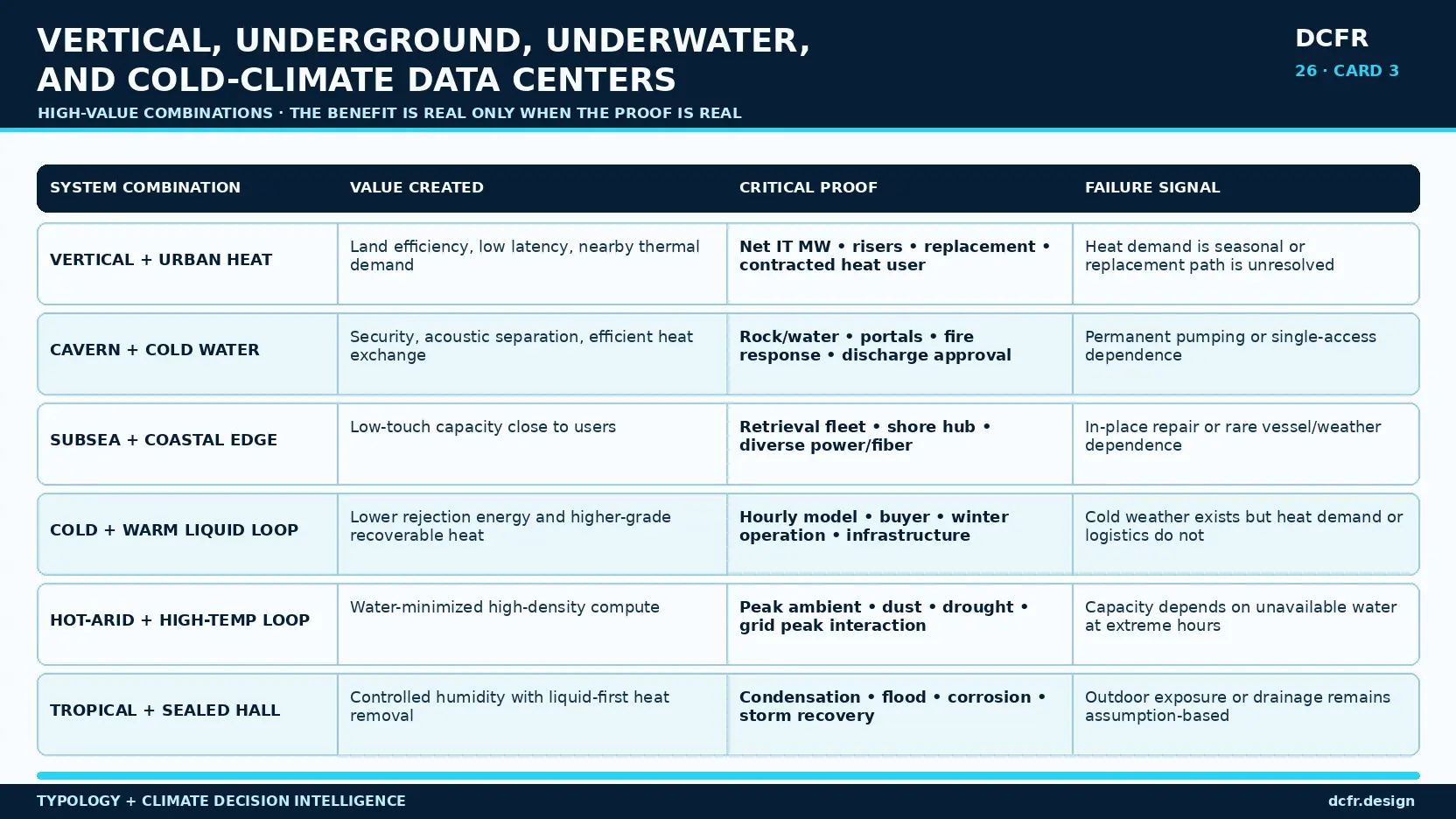
Combine Typology and Climate Only When the Benefits Reinforce One Another
The best concepts do not stack novelty; they connect a physical constraint to a climate advantage and an operating model. A vertical urban facility can pair land efficiency and low latency with a contracted district-heat user. An existing cavern beside cold water can combine security, acoustic separation, and efficient heat exchange. A subsea fleet can serve a coastal edge market if the shore hub, retrieval vessel, diverse power and fiber, and module-refresh plan are credible. A cold-climate campus can export higher-grade heat through a warm liquid loop. A hot-arid campus can deliver water-minimized high-density compute. A tropical campus can use sealed liquid-cooled halls to reduce humidity exposure. Each combination should advance only when the value created, critical proof, failure signal, and decision owner are explicit.
A combination is innovative only when its benefits form a measurable chain from site condition to commissioned capacity and whole-life value.
Compare Typologies on Delivered Capacity, Not Architectural Novelty
Use the same decision basis for every option. First, establish the required IT capacity and availability date. Then compare each typology for net usable IT megawatts, land and vertical-space demand, utility routing, structural intensity, cooling architecture, water exposure, fire and life safety, equipment replacement, construction sequence, permitting, natural hazards, labor, operational maintainability, future expansion, and whole-life cost. Fatal flaws should remain visible instead of disappearing inside a weighted score. An option that produces a high land-efficiency score but has no credible transformer replacement route should not survive simply because its average score is attractive.
Unconventional Typology Evidence Gate
| Question | Evidence required before advancing |
|---|---|
| What constraint is being solved? | Named land, latency, security, climate, or infrastructure constraint with measurable consequence |
| What benefit is gained? | Net land, schedule, energy, resilience, location, or operating benefit compared with low-rise baseline |
| What complexity is introduced? | Structural, MEP, life-safety, access, replacement, marine, geotechnical, or logistics impacts |
| Can major equipment be replaced? | End-to-end path from public road / vessel interface to final installed position |
| Can the option expand? | Protected power, cooling, fiber, access, and construction strategy for future capacity |
| What would reverse the decision? | Explicit assumptions, thresholds, and confirmation items |
The Decision Should Produce a Rejection Record as Well as a Preferred Option
A useful feasibility study records why options were rejected. For a vertical scheme, the reason may be replacement logistics or capital premium. For underground, it may be groundwater or portal geometry. For subsea, it may be service model or marine approvals. For a cold-climate site, it may be time to power or workforce. This decision record prevents teams from reopening eliminated concepts later without new evidence and makes the final recommendation auditable. The output should state the preferred typology, the reason it wins, the assumptions that could reverse the decision, and the confirmations required before design advances.
DCFR Design Principle
There is no universally best environment for a data center. The physically impressive option can be the economically weak option, and the simplest building can be the strongest capacity-delivery solution. The right typology is the one that converts power, connectivity, site conditions, climate, approvals, logistics, operations, replacement, and expansion into reliable capacity with the least unresolved friction.
Choose the typology whose complete delivery system is strongest—not the one with the most dramatic single advantage.
Current Technical Basis — August 2026
Microsoft
Project Natick findingsASHRAE / NEMA / PNNL
AI Data Center Energy Performance Framework resourcesLefdal Mine Data Centers
Lefdal Mine Data CenterGreen Mountain
SVG-Rennesøy Data CenterTechnical basis reviewed August 2026. Cooling technology, equipment capability, vendor qualification, and industry guidance continue to evolve; project decisions should use the latest applicable manufacturer data and professional engineering analysis.
Capacity-delivery review checklist
What to verify before the next release gate.
- State the constraint that makes the low-rise baseline insufficient.
- Compare each typology against the same IT capacity, availability date, and resilience brief.
- Quantify usable capacity gained after structural, MEP, access, and life-safety penalties.
- Show the end-to-end replacement route for the largest maintainable equipment.
- Test construction sequence and future expansion while existing capacity remains operational.
- Identify geotechnical, groundwater, marine, climate, hazard, and permitting confirmation items as applicable.
- Record why rejected typologies failed and what new evidence would be required to reconsider them.
What DCFR would flag
Delivery risks that should be visible early.
DCFR would flag an unconventional typology whose signature advantage is clear but whose replacement, approval, utility, operations, or expansion pathway remains assumption-based.
Professional confirmation required
Items requiring project-specific validation.
Final selection requires project-specific utility, architectural, structural, civil, mechanical, electrical, fire-protection, geotechnical, environmental, acoustic, marine where applicable, cost, schedule, operations, and Authority Having Jurisdiction confirmation.
Final takeaway
THE BEST DATA CENTER ENVIRONMENT IS THE ONE THAT SOLVES A REAL CONSTRAINT WITHOUT CREATING A LARGER UNRESOLVED DELIVERY PROBLEM.
Surface site, code, utility, and delivery risk before it becomes expensive.
DCFR converts early assumptions into planning-grade flags, confirmation registers, and decision-ready feasibility outputs.