
01
Turn vague project information into a structured feasibility process
Organize incomplete client briefs, site information, constraints, assumptions, unknowns, and fragmented project inputs into one clear sequence of reviewable decisions.
Order Toolkit
Use architect-led AI workflows to organize constraints, compare scenarios, expose risk, and improve early-stage decisions.
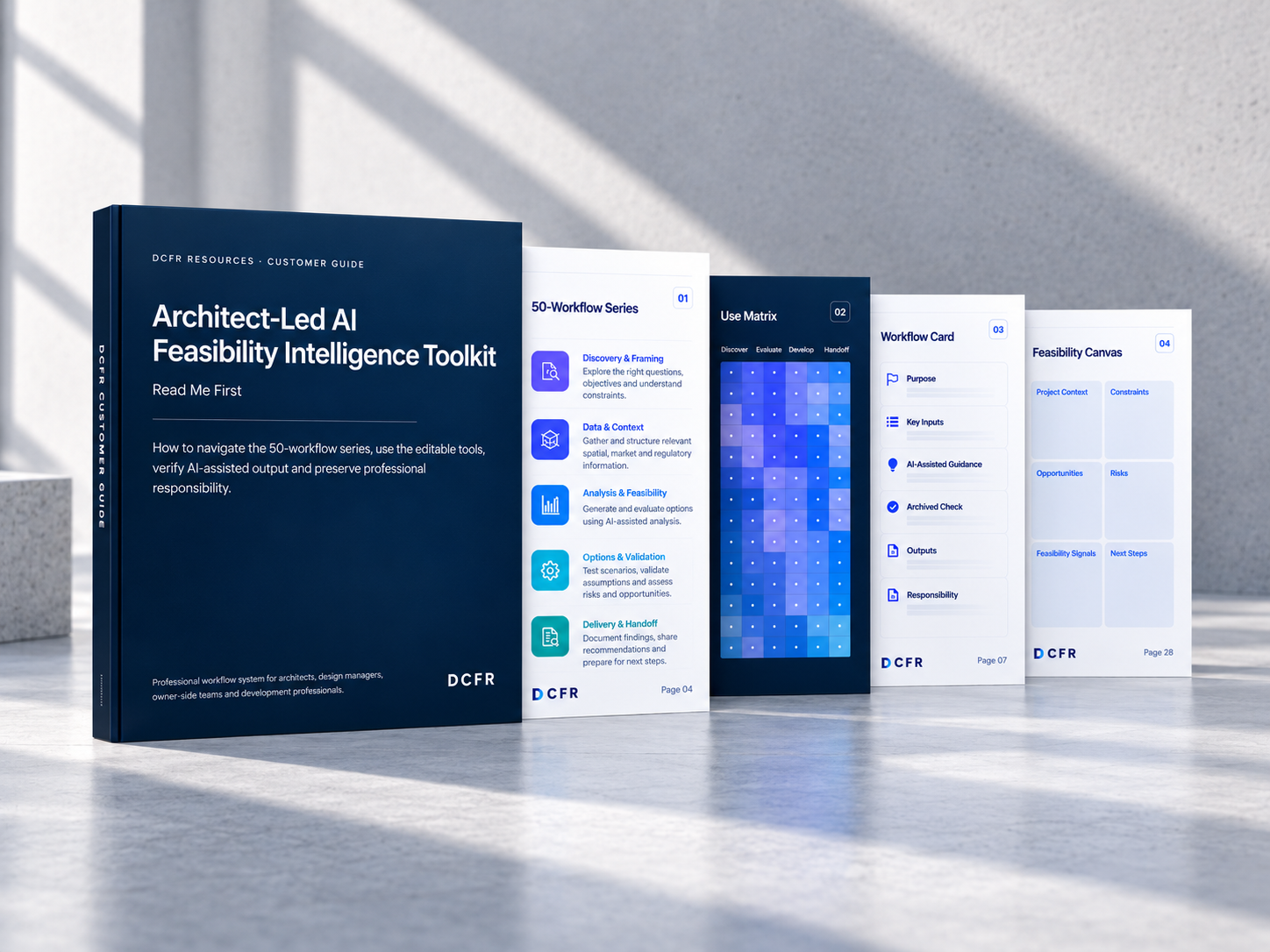
A structured method for turning fragmented early-stage inputs into reviewable project decisions.
Workflows for feasibility, design, technical review, project-type intelligence, decision coordination, and AI governance.
Copy-ready prompts consolidated into a searchable, editable Word document for faster controlled use.
Editable decision-matrix and risk-register tools for option comparison, assumptions, confidence, ownership, deadlines, and residual risk.
Practical examples showing how controlled inputs, bounded AI roles, verification, and professional judgment work together.
Workflows adapted across workplace, data centers, residential, mixed-use, healthcare, logistics, hospitality, and civic/institutional projects.
Release-gate logic that keeps evidence, assumptions, specialist confirmation, and human responsibility visible.
Benefits
Turn complex project information into a clear, structured feasibility process—with AI support, professional discipline, and a defensible decision record.
01
Organize incomplete client briefs, site information, constraints, assumptions, unknowns, and fragmented project inputs into one clear sequence of reviewable decisions.
02
Evaluate alternatives side by side using consistent criteria, assumptions, constraints, and risks, while documenting why one direction is stronger or needs further confirmation.
03
Define where AI can assist, where evidence and source checks are required, and where architect or specialist verification must take over.
04
Surface unresolved assumptions, conflicting inputs, verification gaps, responsible parties, dependencies, and next actions early.
05
Reuse the same coordinated decision structure across data centers, workplace, residential, mixed-use, healthcare, logistics, hospitality, and civic work.
06
Keep assumptions, sources, risks, alternatives, confirmations, ownership, and final decisions visible instead of buried across emails and disconnected prompts.
Evidence · Assumptions · Options · Verification · Decisions
The result
Bring project facts, assumptions, constraints, alternatives, risks, verification requirements, recommendations, and next actions into one structured body of work that can be reviewed, challenged, and carried forward.
15-minute quick start
Start with one decision. Do not begin by uploading an entire project and asking the model to analyze everything.
State one decision, the owner, deadline, criteria, and non-negotiables.
Provide controlled project facts, source identifiers, assumptions, and missing inputs.
Select the workflow, use its structured prompt, and preserve the requested output format.
Check sources, calculations, jurisdiction, assumptions, and specialist boundaries.
Document the human decision, conditions, confidence, owner, and next action.
Project types covered
The method remains consistent, while the users, operating logic, constraints, and required specialists change by project type.
Behavior, attendance, utilization, culture, settings, and post-occupancy measures.
Early questions around site, power, cooling, approvals, resilience, and phasing—without reproducing the proprietary DCFR engine.
Living patterns, privacy, daylight, adaptability, affordability, and unit strategy.
Access, servicing, vertical circulation, ownership, systems, and phasing interfaces.
Clinical, staff, patient, material, and clean/dirty workflows under specialist direction.
Throughput, vehicles, people, materials, loading, storage, and operational movement.
Guest experience, back-of-house operations, service flows, and maintenance.
Public value, governance, accessibility, security, operations, and stewardship.
Who it's for
Best for professionals who need to move faster without losing review discipline or creating false certainty.
Professional-use boundary
The toolkit supports feasibility thinking and professional workflow organization. It does not replace licensed architectural or engineering judgment, legal advice, authority interpretation, specialist review, or stamped deliverables.
The $249 Toolkit is a pre-created collection of downloadable workflows, prompts, matrices, templates, and professional verification tools. The standard purchase does not include consulting, coaching, project-specific analysis, customized deliverables, or human professional review.
The Toolkit is also separate from the proprietary DCFR data-center calculation and report engine.
Keep verified evidence, user input, assumptions, inference, confirmation-required items, calculations, specialist review, and the named human decision owner visible before release.
Architect-Led AI Feasibility Intelligence Toolkit
Complete Toolkit · $249 one-time digital purchase.
Order Toolkit — $249