
DCFR Insight 65 / Delivery + Governance
The Fastest and Most Economical Data Center Delivery Model
There is no universally fastest contract form. The winning model aligns design maturity, market capacity, package strategy, decision speed, long-lead procurement, and risk ownership to the project’s actual constraints.

Optimize the system, not the contract label
Design-build, progressive design-build, construction manager at risk, engineer-procure-construct, multi-prime, and hybrid owner-led models can all succeed. The contract label matters less than when key parties join, what information they receive, which decisions the owner retains, how scope is packaged, how price is established, and who can resolve interfaces quickly. A fast model with weak requirements or slow governance only moves uncertainty into construction, where change is more expensive and energization is exposed.
Create speed through controlled concurrency
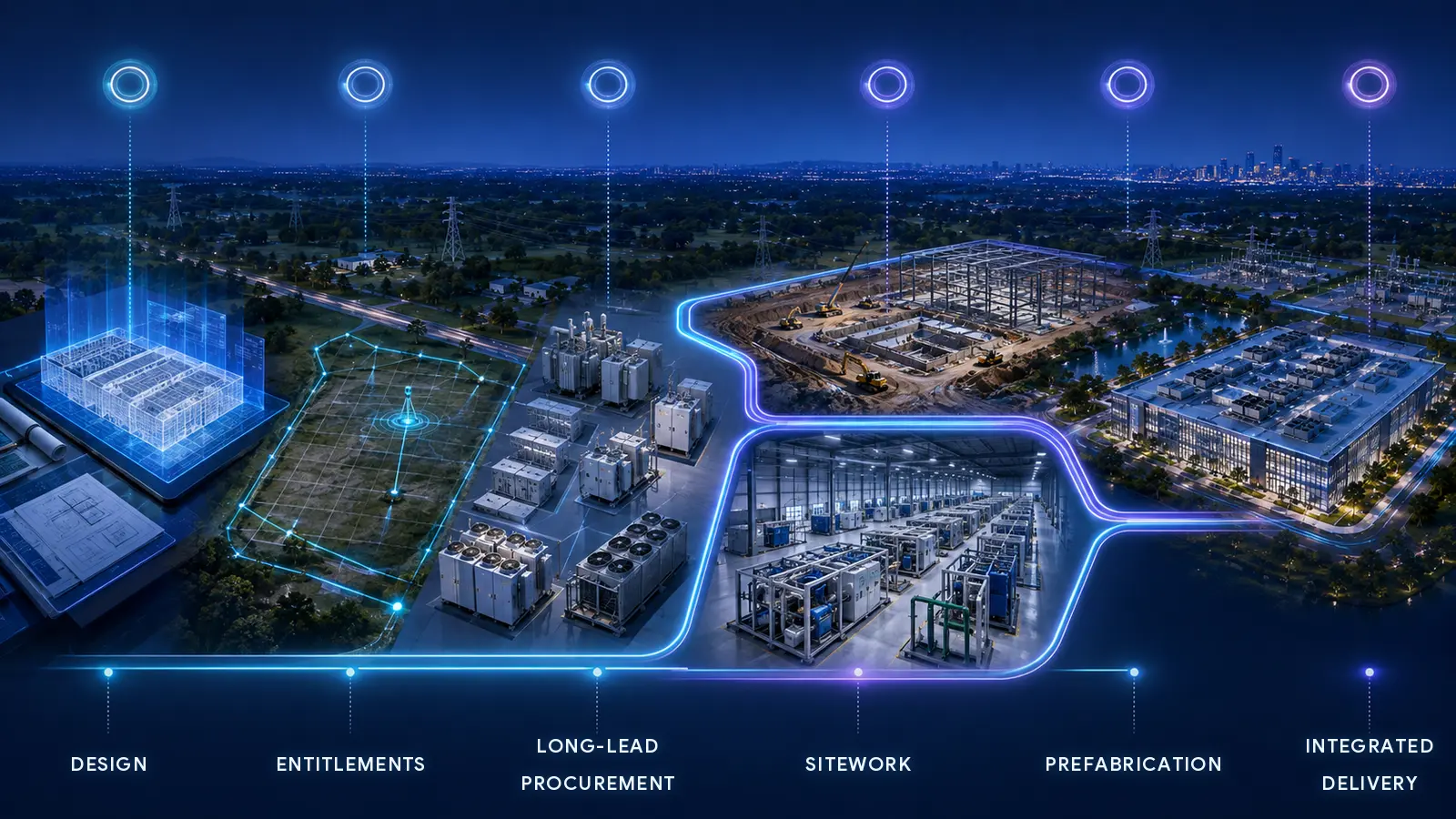
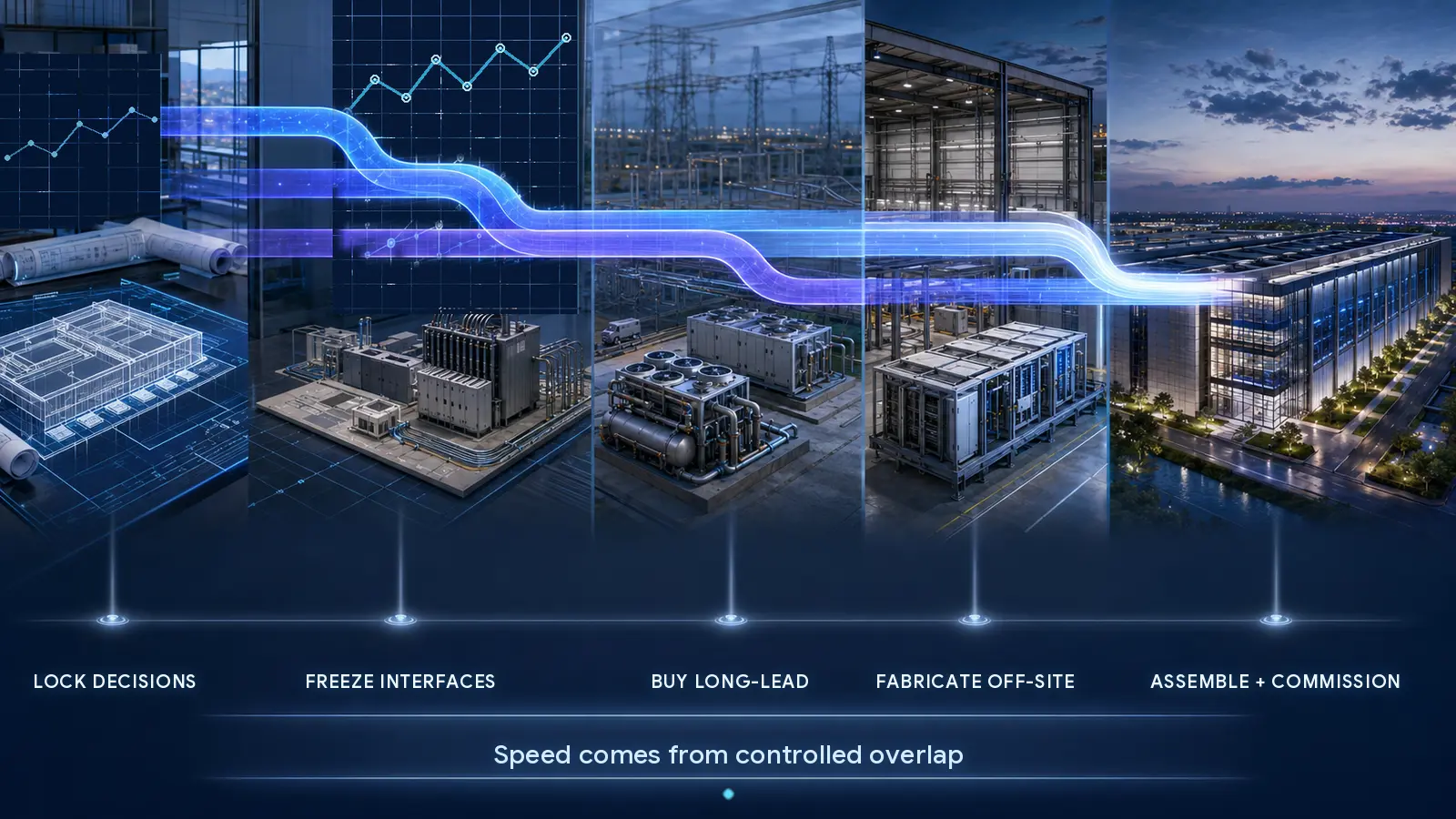
The schedule should deliberately overlap site enabling, design, utility work, long-lead procurement, off-site fabrication, foundations, structure, electrical and mechanical installation, controls integration, and commissioning. But overlap needs release gates. Enabling work can advance from a stable civil basis; foundations can advance from coordinated equipment loads and embeds; equipment can enter manufacture from an approved technical and commercial data sheet. Uncontrolled concurrency is not acceleration—it is deferred rework.
Package work around executable boundaries
Package strategy should follow construction sequence, market capacity, design maturity, long-lead risk, and interface clarity. Common packages include early civil, utility and substation, primary electrical equipment, generation, cooling plant, prefabricated electrical or mechanical assemblies, shell, fit-out, controls, and commissioning support. Every split creates an interface, so the owner must compare the benefit of earlier release or stronger competition against the additional coordination, warranty, schedule, and claims burden.
Match price certainty to definition
A lump-sum number is not certainty if major assumptions, allowances, exclusions, escalation, taxes, logistics, utility scope, testing, temporary works, and owner-furnished equipment remain unresolved. Progressive models can establish the team and advance design before final price, but require open-book cost development, package-level competition, reconciliation rules, contingencies, audit rights, and a clear off-ramp. Fixed-price models work best when scope and interfaces are mature enough for bidders to price rather than insure uncertainty.
Select the model with five owner questions
First, how fixed is the required operating date? Second, how mature and repeatable is the design? Third, where is scarce market capacity—designers, switchgear, generators, cooling equipment, fabricators, or trade labor? Fourth, which risks can the market genuinely control and price? Fifth, can the owner make fast technical and commercial decisions? An owner-led hybrid can be very fast for a mature fleet organization; the same fragmentation can overwhelm an inexperienced sponsor.
Delivery-model screening
| Model | Strong fit | Owner watchpoint |
|---|---|---|
| Progressive design-build | Urgent program, evolving definition, early builder and trade input | Open-book discipline, price conversion, retained owner requirements |
| Design-build | Clear performance brief and capable integrated market | Proposal comparability, design quality, owner decision rights |
| CM at risk | Owner wants design control with early construction input | Package coordination, guaranteed-price assumptions, design-constructor alignment |
| EPC / turnkey | Well-defined boundary and strong single-point integrator | Premium, exclusions, owner changes, commissioning and performance remedies |
| Multi-prime / owner-led | Repeat program with sophisticated owner and established supply chain | Interface risk, staffing, warranties, schedule integration |
Procurement law, financing, local market practice, labor strategy, tax, insurance, and customer requirements may narrow the available choices.
Measure economics as delivered capacity
Compare models on risk-adjusted cost per commissioned megawatt by the required date, not initial contract value alone. Include owner staffing, design, escalation, financing carry, utility and off-site work, procurement deposits, temporary facilities, contingency, change, commissioning, spares, warranty support, energy and water performance, and schedule value. The economical model is the one that produces accepted capacity with the lowest total exposure—not the one that transfers the most risks on paper.
Early screening checklist
What to verify before advancing this site.
- The selected model is tied to operating date, design maturity, market capacity, and owner capability
- Early releases define maturity, scope boundary, assumptions, cancellation, storage, and change authority
- Work packages follow construction logic and have explicit technical, schedule, commercial, and warranty interfaces
- Price development exposes allowances, exclusions, escalation, contingency, temporary work, and owner costs
- Risk is assigned to the party that can control it, with measurable relief and remedy
- Model comparisons use risk-adjusted cost per commissioned megawatt by the required date
What DCFR would flag
Risks surfaced at the screening stage.
DCFR would flag a delivery strategy chosen because its label sounds fast, while the owner’s requirements, package interfaces, long-lead releases, price basis, decision rights, commissioning boundary, and retained risks remain undefined.
Professional confirmation required
Items requiring licensed validation.
Confirm procurement authority, licensing, contracting form, insurance, bonding, tax, labor, design responsibility, intellectual property, equipment ownership, price basis, change, delay relief, performance testing, warranties, damages, termination, and dispute provisions with the owner, counsel, insurers, lenders, licensed professionals, delivery partners, vendors, utilities, authorities, commissioning authority, and operator.
Final takeaway
The fastest economical model is a governed system of early integration, executable packages, controlled overlap, transparent cost, and rapid owner decisions—not a contract label.
Screen up to 20 candidate sites before selecting one for the full DCFR report.
Each DCFR Report Package includes a preliminary 20-site comparison PDF / export package plus one selected planning-grade feasibility report.