
DCFR Insight 66 / Delivery + Governance
Data Center Cost Reduction: Standardization, Procurement, and Build Strategy
Durable cost reduction comes from removing avoidable scope, variation, waiting, rework, and risk premiums while protecting capacity, safety, resilience, maintainability, and the operating date.

Begin with the cost of the requirement
The largest savings often come before quantities are measured. Challenge unused redundancy, excessive future-proofing, conservative density assumptions, duplicated spaces, oversized roads and yards, unnecessary architectural variation, fragmented security requirements, and capacity that cannot be energized or sold on the planned date. Every requirement should identify the business outcome, verification method, utilization case, and cost of failure. Removing a requirement is legitimate only when the owner consciously accepts the resulting operational or commercial position.
Build a cost architecture by capacity block
Create a common work breakdown structure that connects dollars to commissioned capacity: land and off-site infrastructure, sitework, shell, primary electrical, backup generation, distribution, cooling, controls, fire and life safety, security, network, fit-out, commissioning, owner costs, escalation, contingency, financing carry, and taxes. Reconcile estimate versions on quantity, rate, productivity, scope, schedule, risk, and currency—not only total variance. Normalize cost per gross megawatt, commissioned IT megawatt, rack, and phase where each measure is useful.
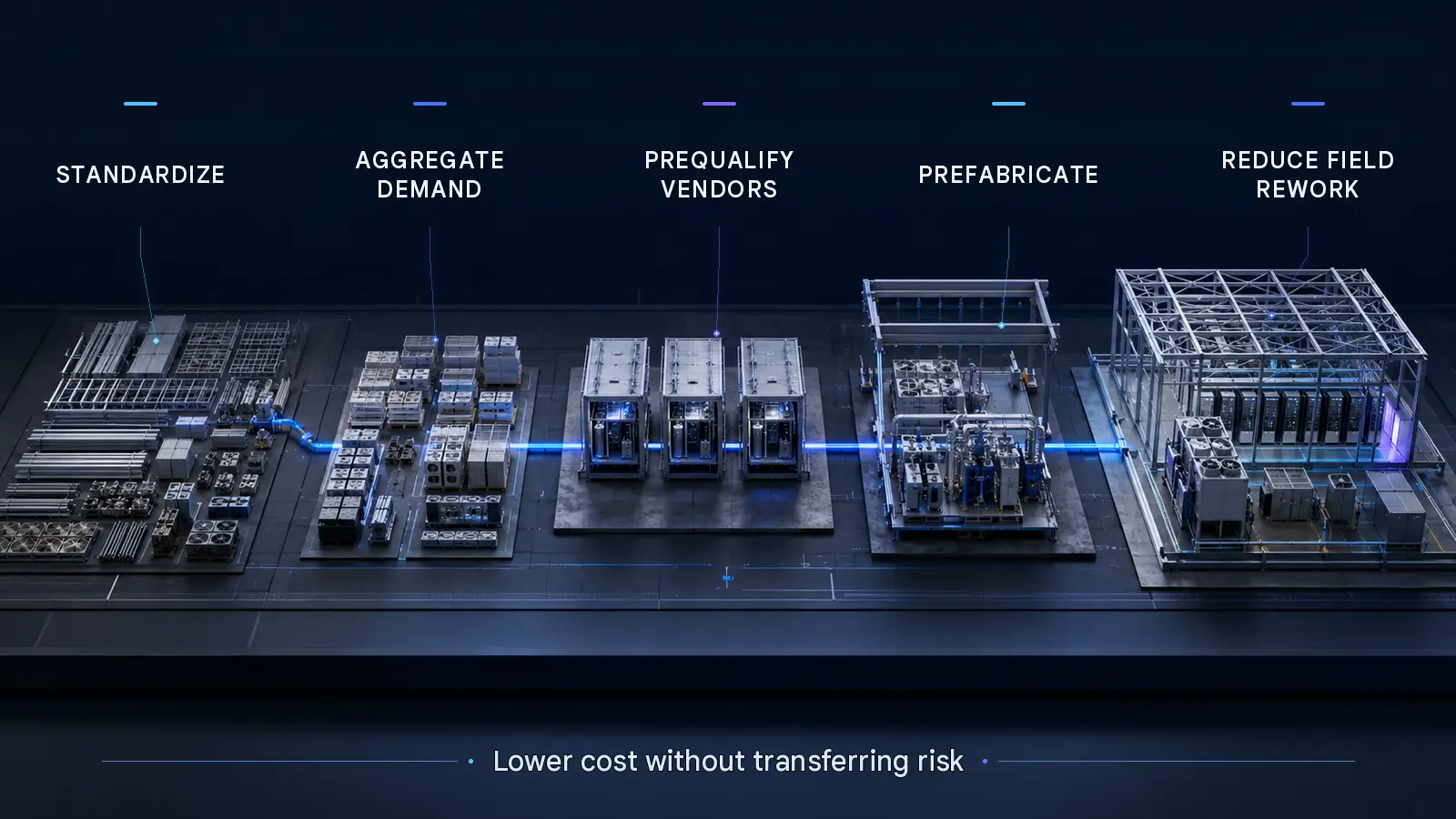
Standardize high-value repeatable decisions
Standardization has the most leverage where repeat volume and interface complexity are high: capacity blocks, electrical one-lines, cooling modules, equipment families, skid footprints, connection points, controls sequences, alarm naming, test scripts, spares, and asset data. Localize climate loads, utility requirements, code, civil design, labor rules, acoustics, emissions, and environmental conditions. A standard that ignores legitimate differences creates expensive exceptions; a standard without purchasing volume creates paperwork rather than leverage.
Procure time, capacity, and commercial clarity
For long-lead equipment, compare more than unit price. Evaluate production slot, approved subcomponents, engineering data date, factory-test capacity, logistics, storage, field service, commissioning support, spares, warranty start, software access, cybersecurity support, and remedies. Use demand forecasts and framework agreements where volume is credible, while preserving qualified alternatives and avoiding a proprietary interface trap. Early purchase can reduce schedule exposure but increases change, cancellation, balance-sheet, storage, and obsolescence risk.
Design the build for flow
Use work packaging, model-based coordination, off-site assembly, repeatable installation details, kitting, logistics zones, constraint removal, and progressive turnover to improve field productivity. Prefabrication is strongest when design freezes early, interfaces repeat, transport is feasible, factory quality is measurable, and site installation is planned. It is weaker when late changes, oversized modules, customs, route permits, limited lifting access, or incomplete testing simply relocate risk from site to factory.
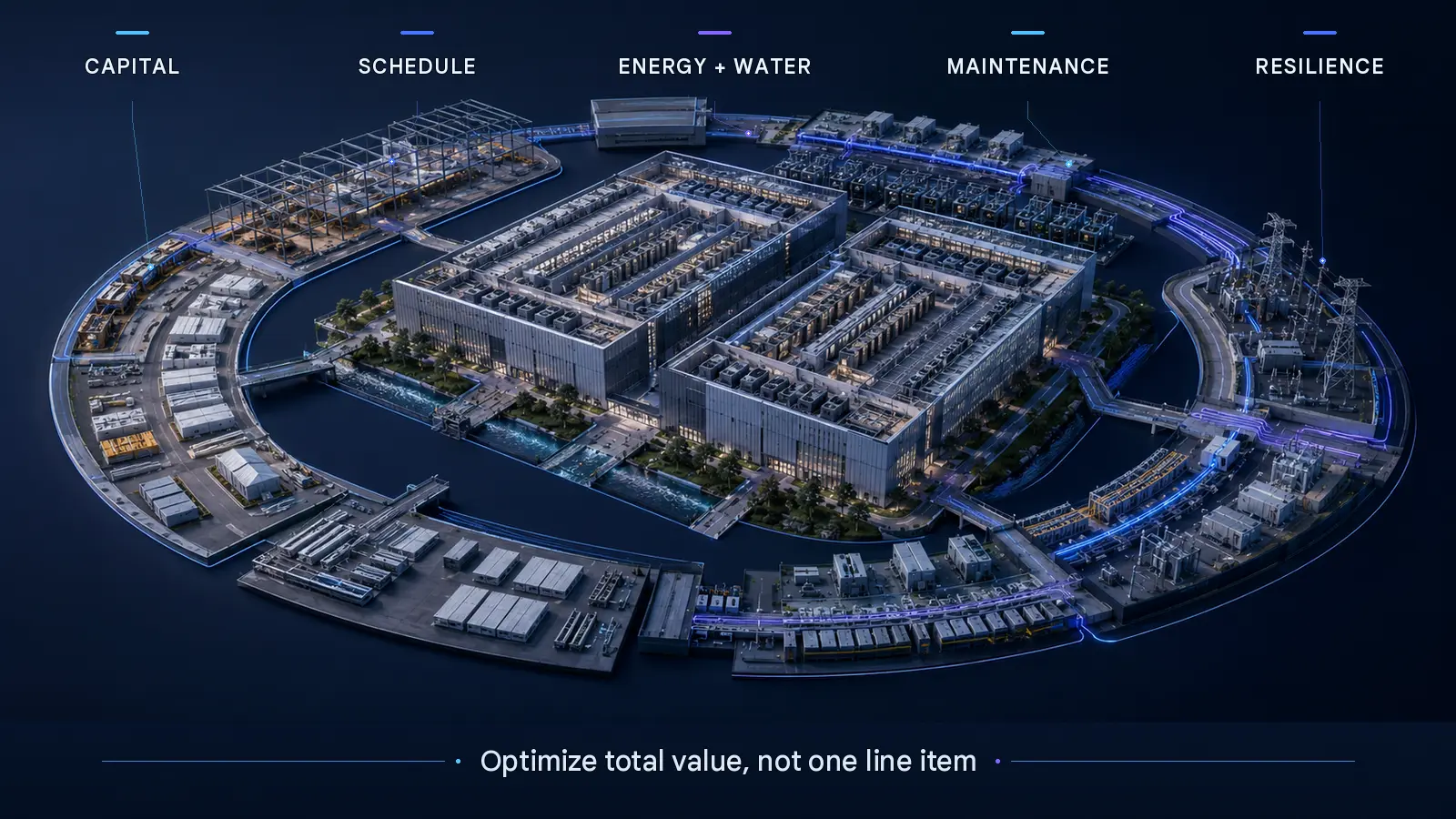
Cost lever decision test
| Lever | Potential value | Required guardrail |
|---|---|---|
| Requirement challenge | Eliminates unnecessary scope at source | Document business outcome and accepted consequence |
| Reference product | Reuses design, procurement, testing, and training | Bounded variants and configuration control |
| Framework procurement | Aggregates demand and production planning | Credible volume, alternates, transparent indexation |
| Prefabrication | Shifts work to controlled repeatable conditions | Frozen interfaces, transport and lift plan, factory acceptance |
| Schedule compression | Reduces carry and accelerates usable capacity | Logic-based plan; no hidden rework or commissioning loss |
| Life-cycle selection | Reduces energy, water, maintenance, and replacement | Common service life, utilization, discount, and risk assumptions |
Project teams should validate savings against the approved baseline and prevent double counting across cost, schedule, and risk registers.
Protect savings through change and operations
Track each saving as a baseline change with owner, evidence, affected requirements, downstream impacts, and verification. Avoid counting procurement discount, estimate reduction, and schedule saving as three benefits when they describe the same decision. After turnover, compare predicted and actual energy, water, maintenance labor, consumables, spares, failures, and usable capacity. A lower first cost that increases outage exposure or operating burden is not a durable saving.
Early screening checklist
What to verify before advancing this site.
- Requirements identify business outcome, utilization, verification, and consequence of removal
- Estimate versions reconcile quantity, rate, productivity, scope, schedule, risk, tax, and escalation
- Standards concentrate on repeatable high-value modules and interfaces while legitimate local conditions remain configurable
- Long-lead bids compare production slot, data, testing, logistics, service, spares, warranty, software, and remedies
- Prefabrication releases include frozen interfaces, transport, lifting, factory testing, storage, and field completion
- Savings are baseline-controlled, not double counted, and checked against operating performance
What DCFR would flag
Risks surfaced at the screening stage.
DCFR would flag a cost-reduction plan built around late line-item cuts while requirements, oversized systems, fragmented interfaces, escalation, owner costs, schedule carry, commissioning, and operating consequences remain outside the analysis.
Professional confirmation required
Items requiring licensed validation.
Confirm scope, quantities, rates, productivity, escalation, tax, contingency, currency, financing, procurement terms, intellectual property, cybersecurity, substitutions, factory and field testing, logistics, labor, code, safety, reliability, maintainability, energy, water, warranties, and life-cycle assumptions with the owner, cost consultant, licensed professionals, contractors, vendors, commissioning authority, operator, counsel, insurers, and lenders.
Final takeaway
The strongest cost program removes waste before it reaches the field, buys scarce capacity intelligently, and protects every saving through commissioning and operations.
Screen up to 20 candidate sites before selecting one for the full DCFR report.
Each DCFR Report Package includes a preliminary 20-site comparison PDF / export package plus one selected planning-grade feasibility report.