
DCFR Insight 67 / Delivery + Governance
Data Center Construction Sequence: Sitework to Energization
Construction should be organized around safe access, permanent systems, turnover boundaries, and energization logic—not around a generic building schedule or visually impressive progress.
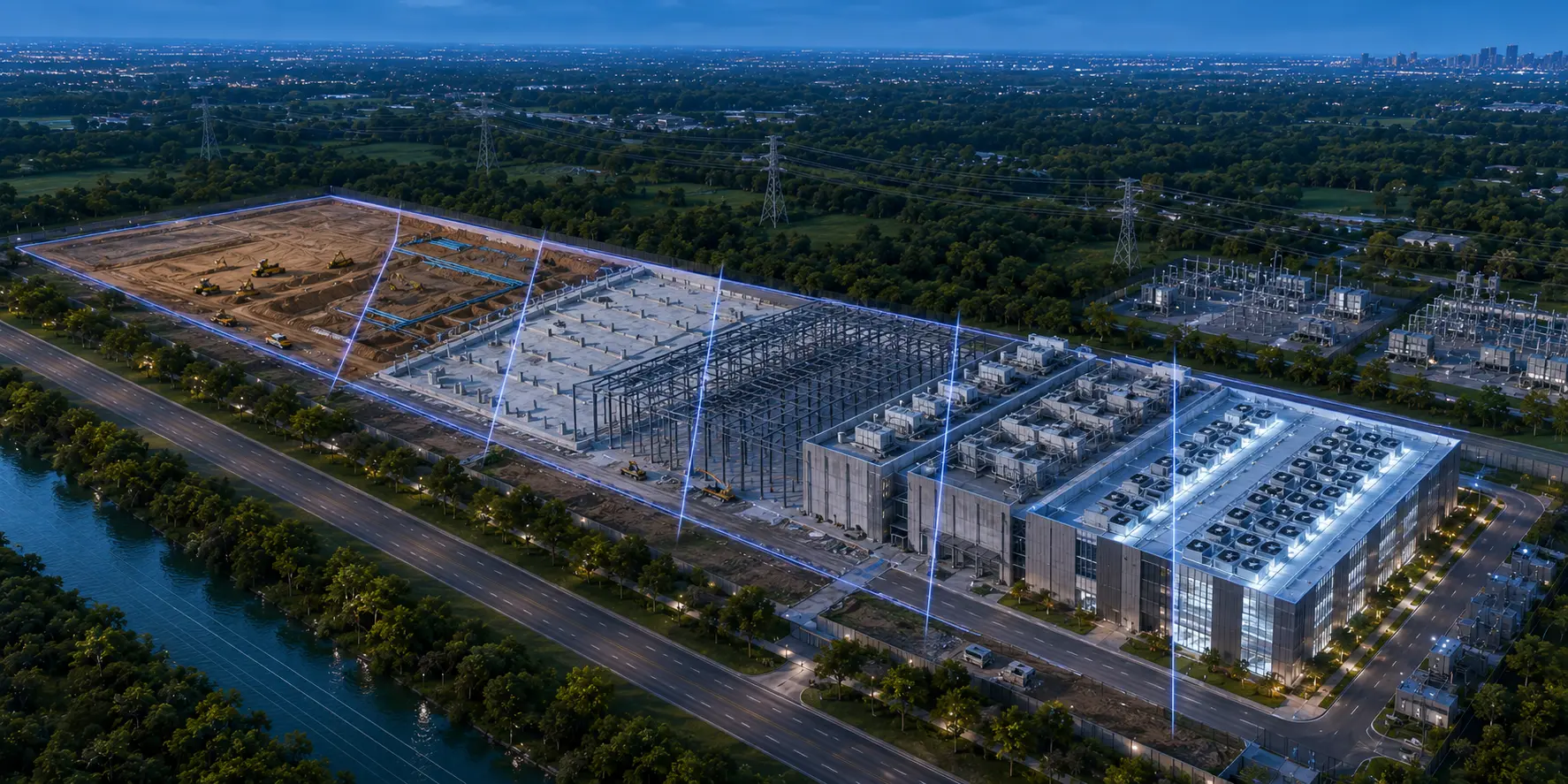
Set the sequence from the permanent operating state
Start with the energized one-line, cooling operating modes, fire and life-safety sequence, controls architecture, network boundary, security zones, and phased customer capacity. Then work backward through integrated testing, functional testing, startup, pre-functional checks, installation completion, equipment setting, structure, underground services, earthwork, and access. This reveals which rooms, feeders, loops, networks, permits, and procedures must become complete together.
Establish the site before production accelerates
Early sitework should create safe logistics and protect the permanent works: survey control, erosion and sediment measures, clearing, demolition, unsuitable-soil removal, mass grading, stormwater routing, dewatering, temporary power and water, haul roads, laydown, worker access, fencing, fire access, crane plans, and buried-utility coordination. Permanent drainage and access should advance early enough to survive severe weather and support heavy equipment without repeated repair.
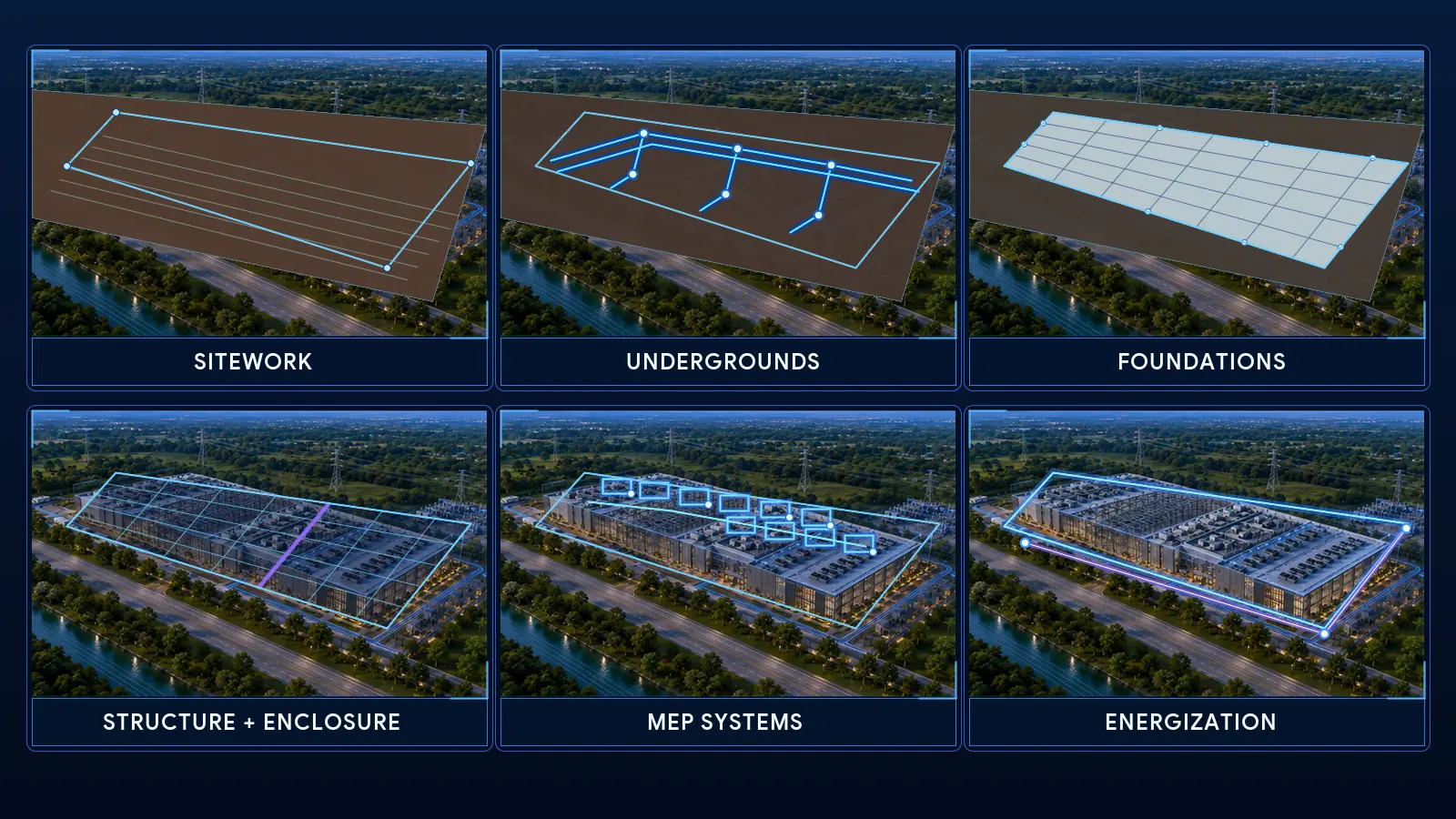
Coordinate underground, foundations, and equipment data
Underground electrical, communications, grounding, fuel, water, sewer, storm, and fire services compete for limited corridors and elevations. Release foundations only after loads, dimensions, embeds, housekeeping pads, clearances, cable and pipe entry points, seismic or wind restraint, maintenance removal paths, and manufacturer tolerances are coordinated. Field fixes at this stage propagate into switchgear lineups, generator yards, cooling modules, busway, controls, and commissioning.
Make buildings weather-tight by system priority
Structure and enclosure sequencing should protect the rooms needed first for permanent equipment and controlled testing. Define dry-in by measurable conditions: roofing and flashings complete, openings sealed, drainage operating, humidity controlled, dust managed, and water intrusion monitored. Permanent equipment should not become the project’s dehumidifier or construction filter. Separate clean, energized, tested zones from active construction through access control, permits, labeling, barriers, and configuration management.
Turn over complete systems progressively
Use system and subsystem boundaries that match commissioning: utility source, substations, medium-voltage lineups, generators, fuel, UPS, batteries, low-voltage distribution, cooling plant, heat rejection, water treatment, controls, fire alarm, suppression, security, and white-space distribution. Each turnover package should include approved submittals, installation records, inspections, torque and pressure records, flushing and cleaning, calibration, point lists, software versions, redlines, open items, and safe operating status.
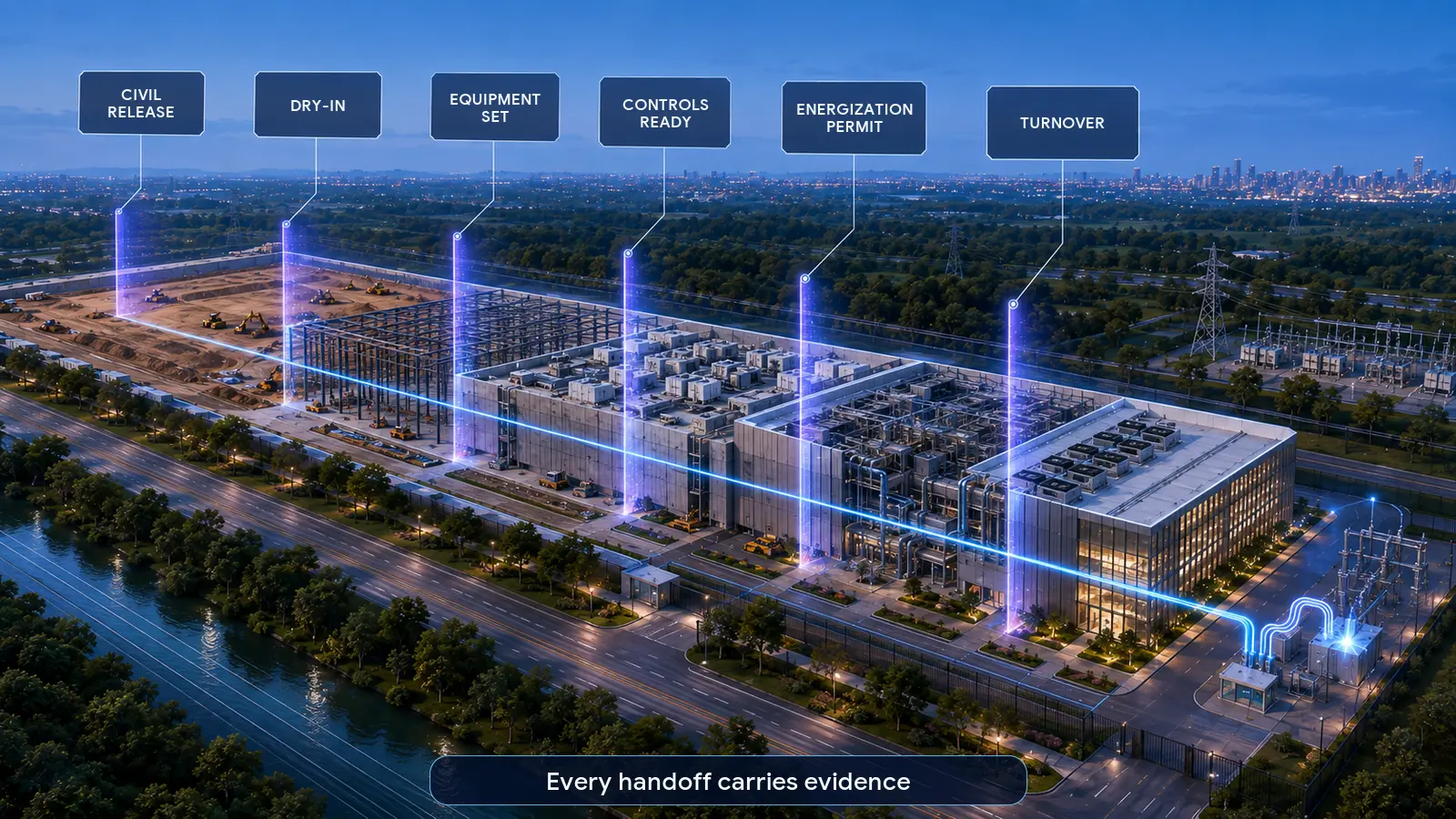
Construction release logic
| Release | Required condition | Evidence |
|---|---|---|
| Mass grading | Control, environmental measures, haul and storm plan active | Survey and inspection records |
| Foundations | Loads, embeds, entries, tolerances, interfaces coordinated | Approved-for-construction package |
| Equipment set | Access, pads, lifting, storage, enclosure, vendor data ready | Setting and preservation plan |
| System turnover | Boundary complete, inspected, cleaned, calibrated, documented | Turnover dossier and open-item classification |
| Energization | Electrical safety, protection, authority, utility, controls, staffing ready | Approved switching and energization permit |
| Integrated testing | Systems stable, scripts approved, risks controlled, witnesses available | Readiness certificate and test plan |
The authority having jurisdiction, serving utility, owner safety program, and equipment manufacturers may require additional release evidence.
Treat energization as a controlled operational event
An energization plan needs approved switching procedures, arc-flash and shock boundaries, protective-device settings, labeling, permits, communications, roles, stop-work authority, emergency response, lockout/tagout transitions, temporary-source removal, and control-room visibility. Construction completion, authority approval, utility permission, equipment readiness, commissioning readiness, and operator acceptance are separate prerequisites. The project is not ready because a date was booked with the utility.
Early screening checklist
What to verify before advancing this site.
- The field sequence is built backward from accepted capacity and integrated test boundaries
- Site logistics protect permanent drainage, access, underground work, equipment routes, and emergency access
- Foundation releases include coordinated loads, embeds, entries, clearances, tolerances, and removal paths
- Dry-in and environmental control are measurable before sensitive equipment is exposed
- Progressive turnover packages contain complete installation, quality, calibration, software, redline, and open-item records
- Energization has approved switching, safety boundaries, protection settings, authority, utility, operator, and emergency readiness
What DCFR would flag
Risks surfaced at the screening stage.
DCFR would flag a schedule driven by area completion and equipment arrival while underground congestion, dry-in, system boundaries, protection settings, controls versions, turnover evidence, operator readiness, and safe energization prerequisites remain unresolved.
Professional confirmation required
Items requiring licensed validation.
Confirm construction means and methods, survey, geotechnical conditions, environmental controls, temporary works, lifting, fire access, inspections, code, electrical safety, protective settings, switching, lockout/tagout, utility permission, equipment startup, controls, commissioning, security, operator readiness, and occupancy with the contractor, licensed professionals, authorities, serving utility, vendors, commissioning authority, safety leadership, fire service, insurer, and owner operator.
Final takeaway
A credible construction sequence does not chase visible progress; it creates complete, safe, testable systems in the order required to energize and operate them.
Screen up to 20 candidate sites before selecting one for the full DCFR report.
Each DCFR Report Package includes a preliminary 20-site comparison PDF / export package plus one selected planning-grade feasibility report.