
DCFR Insight 64 / Delivery + Governance
Turning the Basis of Design into a Repeatable Multi-Site Delivery System
A reference design becomes valuable only when it behaves like a governed product: fixed interfaces, configurable modules, approved variants, traceable decisions, and feedback from construction and operations.

Move beyond a frozen drawing set
A Basis of Design explains how engineering will satisfy the Owner’s Project Requirements. A repeatable delivery system adds configuration rules, performance envelopes, standard details, equipment families, interface-control documents, verification methods, commercial assumptions, and a release process. The objective is not to clone a building regardless of climate or code. It is to reuse the decisions that should remain stable while making necessary differences explicit, bounded, and testable.
Separate the product core from the site shell
Define a stable product core around capacity block, electrical topology, cooling topology, control philosophy, redundancy, maintainability, rack density ranges, white-space module, equipment interfaces, commissioning levels, and operating modes. Surround it with configurable layers for utility voltage, climate, water, seismicity, wind, snow, flood, fire and building code, emissions limits, acoustics, labor market, logistics, and customer fit-out. A site is conforming only when every variable sits inside an approved envelope or follows the deviation process.
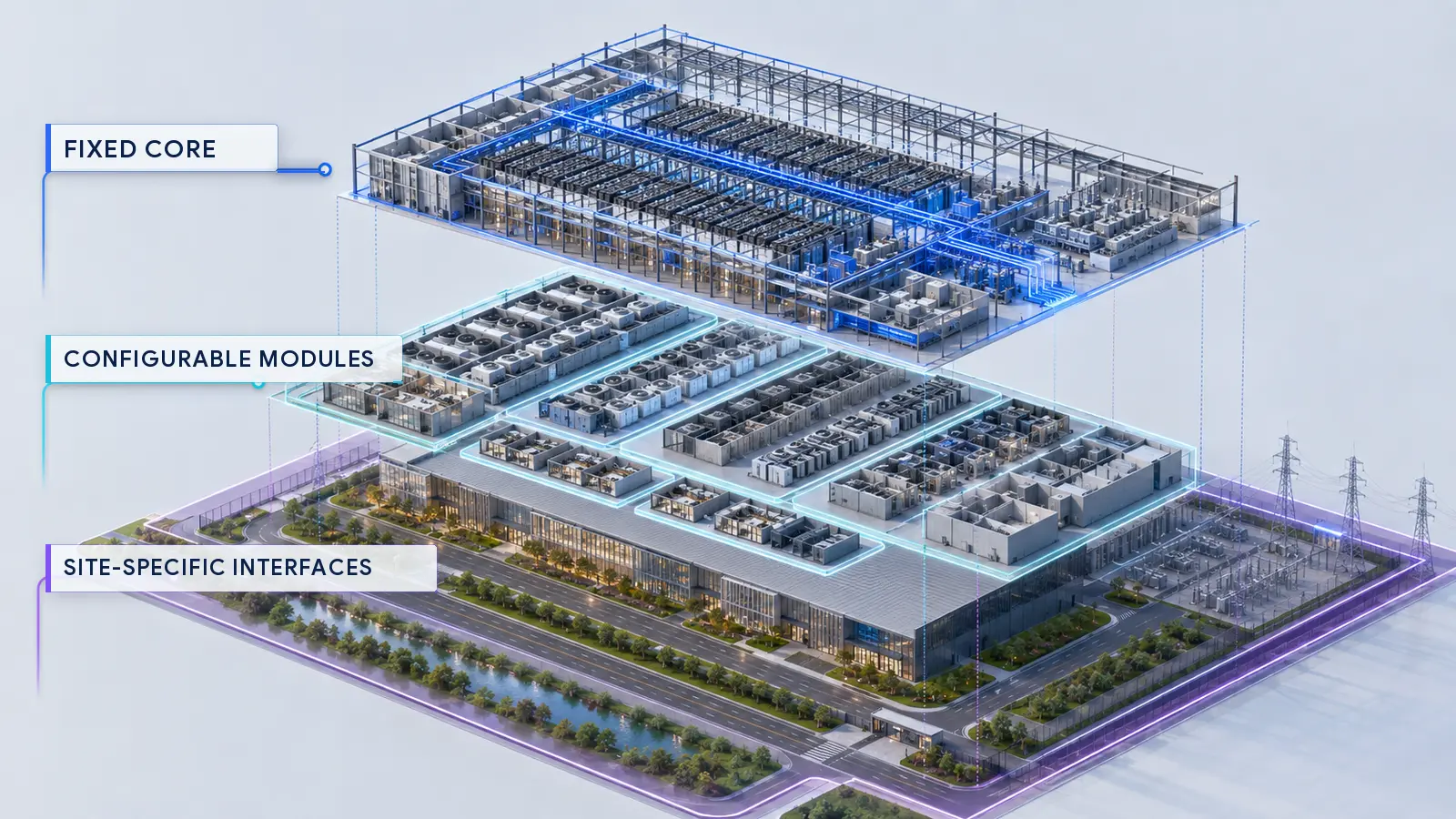
Publish the configuration before design accelerates
At project start, issue a short configuration record that selects the capacity block, density band, utility arrangement, heat-rejection variant, structural and envelope variant, fuel strategy, code basis, security level, phasing, and owner-furnished equipment. Tie each selection to the approved product release and site evidence. This creates an auditable baseline for designers, estimators, procurement teams, fabricators, contractors, commissioning agents, and operators.
Control interfaces more tightly than components
Most repeatability failures occur at boundaries: utility-to-owner substation, generator-to-switchgear, UPS-to-IT busway, cooling plant-to-technology cooling system, controls-to-vendor packages, structure-to-prefabricated modules, and construction-to-operations data. Each interface-control document should define physical connection, ratings, tolerances, protocol, alarm ownership, test responsibility, submittal data, change notification, and acceptance evidence. Teams may optimize within their boundary only if the interface remains intact.
What belongs in the delivery system
| Layer | Controlled content | Primary owner |
|---|---|---|
| Requirements | Capacity, density, resilience, maintainability, safety, energy, water, schedule | Owner product lead |
| Architecture | Topologies, modules, equipment families, control modes, spatial rules | Technical authority |
| Configuration | Approved selections and site variables for one project | Project design manager |
| Interfaces | Ratings, connections, protocols, tolerances, tests, data | Interface owners |
| Verification | Design reviews, factory tests, field tests, integrated scenarios | Commissioning authority |
| Release | Version, applicability, changes, migration, superseded documents | Configuration control board |
Names may vary, but decision rights and technical accountability should not be ambiguous.
Use deviations as product intelligence
A deviation request should state the requirement, proposed change, technical reason, site evidence, cost, schedule, energy, water, reliability, safety, procurement, commissioning, operations, and future-product impact. The governing group then classifies it as a local exception, approved regional variant, temporary substitution, or reference-product change. Approved changes receive a new release, applicability statement, migration guidance, and retired-document list. Without this discipline, a reference design fragments into undocumented local versions.
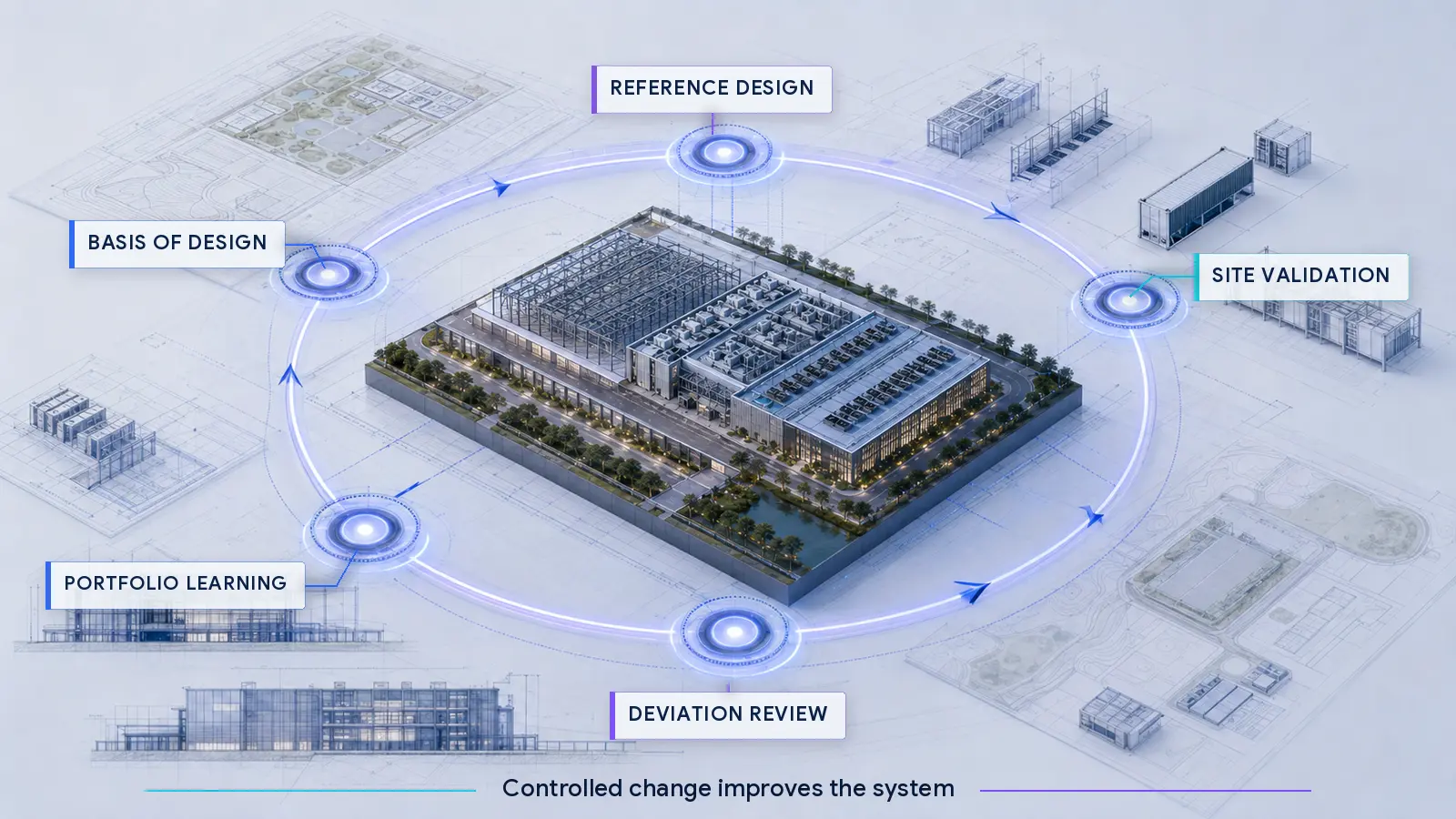
Close the learning loop after turnover
Capture factory-test defects, field clashes, installation productivity, startup failures, controls tuning, spare usage, energy and water performance, alarm burden, maintenance access, and operator feedback against the exact product release. Prioritize improvements by fleet impact rather than by the loudest single project. A multi-site system compounds value only when lessons return to the standard before the next site repeats the same decision.
Early screening checklist
What to verify before advancing this site.
- Owner requirements are measurable and linked to verification methods
- Stable product rules are separated from climate, utility, code, and site adaptations
- Every project issues a configuration record tied to a named product release
- Critical physical, electrical, controls, commercial, and data interfaces have named owners
- Deviation decisions record cost, schedule, reliability, safety, operational, and fleet impacts
- Field and operating lessons are traceable to the exact design release and fed back into the product
What DCFR would flag
Risks surfaced at the screening stage.
DCFR would flag a so-called reference design that is only a copied drawing set, has no configuration envelope, no interface-control documents, no release authority, and no method for converting project deviations into fleet learning.
Professional confirmation required
Items requiring licensed validation.
Confirm requirements, code basis, equipment ratings, system topology, interfaces, software and controls, fire and life safety, structural and environmental loads, product substitutions, verification, version control, intellectual property, warranties, and operating procedures with the owner, licensed design professionals, authorities, vendors, contractors, commissioning authority, operator, insurer, and counsel.
Final takeaway
Repeatability does not mean identical buildings; it means identical decision logic, controlled variants, protected interfaces, and a product that improves with every site.
Screen up to 20 candidate sites before selecting one for the full DCFR report.
Each DCFR Report Package includes a preliminary 20-site comparison PDF / export package plus one selected planning-grade feasibility report.