
DCFR Insight 105 / Industrialized Delivery + Reference Design
Prefabricated Data Center Architecture: What Should Be Standardized and What Must Remain Site-Specific?
A textbook framework for separating repeatable modules from the site conditions, approvals, interfaces, and operating constraints that cannot be copied blindly.

Prefabrication Is a Delivery System, Not a Shape
A skid, container, panelized enclosure, or volumetric module is not automatically a repeatable solution. Industrialized delivery succeeds when the factory product, transport envelope, field interfaces, sequence of installation, commissioning method, and operating access are designed as one system.
The most common category error is to standardize the visible object while leaving the interfaces to be resolved in the field. That transfers risk from design to site logistics, trade coordination, inspection, and commissioning.
The correct question is not ‘what can be fabricated off site?’ It is ‘which decisions can be controlled once, evidenced once, and reproduced without forcing each project to rediscover the engineering logic?’
Classify the Platform Into Core, Variant, and Adaptation
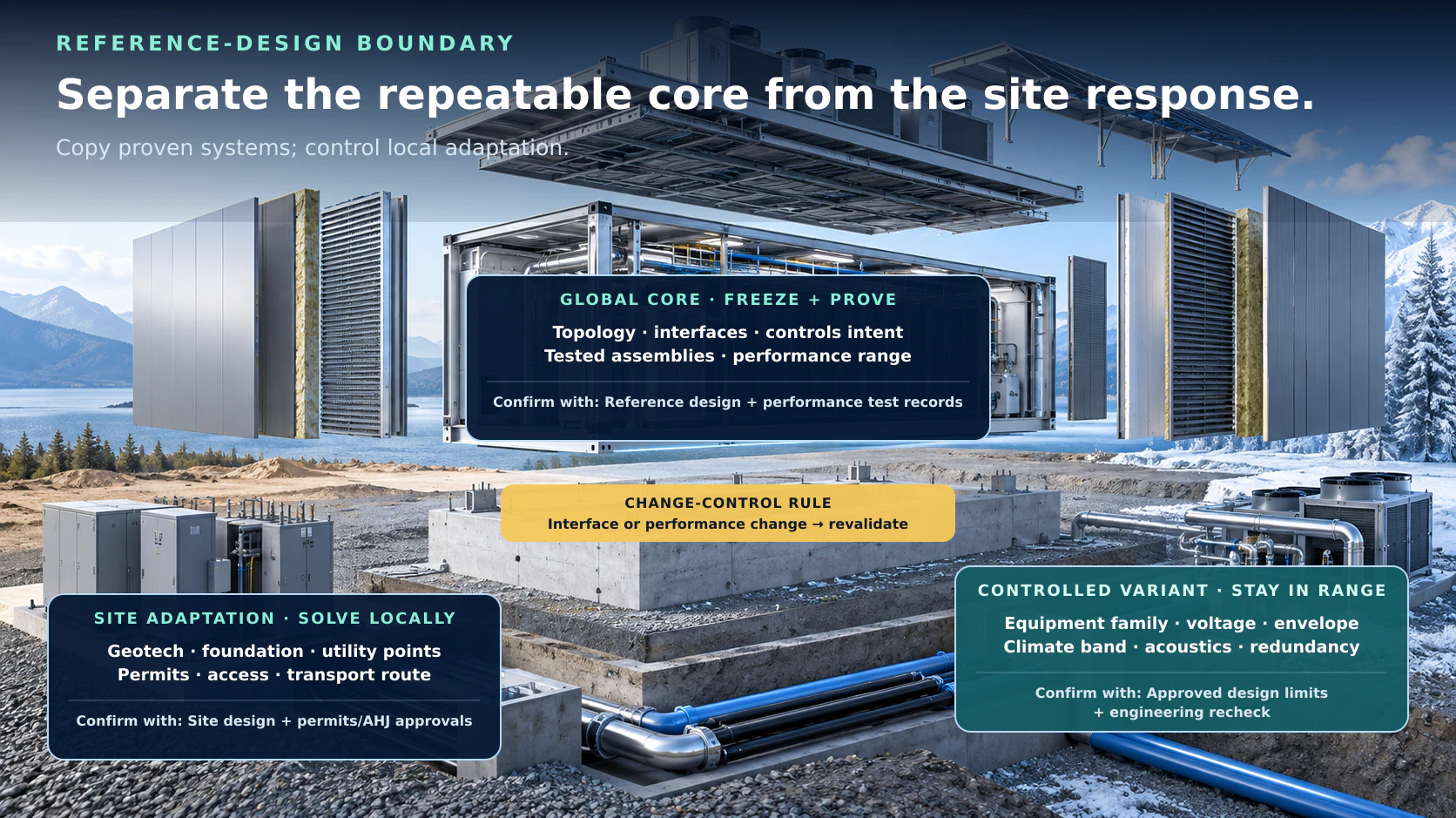
A resilient reference platform has three layers. The global core preserves performance intent and stable interfaces. Controlled variants solve recurring but bounded conditions. Site adaptation responds to the actual parcel, utility, climate, code, logistics, and approvals.
Typical global-core candidates include data-hall module logic, protection philosophy, principal electrical and cooling topology, tested assemblies, controls intent, equipment connection zones, acceptance tests, and configuration controls.
Voltage, heat-rejection method, envelope exposure, seismic or wind design, equipment family, and local code pathway may be controlled variants. Civil grading, utility point of connection, drainage, soil, road geometry, crane setup, local fire review, and construction staging are site adaptations.
Design the Factory Boundary Deliberately
The factory boundary should fall where work benefits from controlled labor, repeatable tooling, protected inspection, testability, and stable interfaces. It should not be selected solely to maximize off-site percentage.
A good boundary minimizes handoffs and concealed field work. It makes dimensions, lifting points, shipping restraints, access panels, preservation, test ports, termination limits, fire compartment interfaces, and commissioning connections explicit.
A bad boundary creates a module that is finished enough to be difficult to change but incomplete enough to need trade improvisation after delivery. The resulting field work can erase the schedule and quality advantages used to justify prefabrication.
Transport, Lifting, and First-Fit Are Engineering Requirements
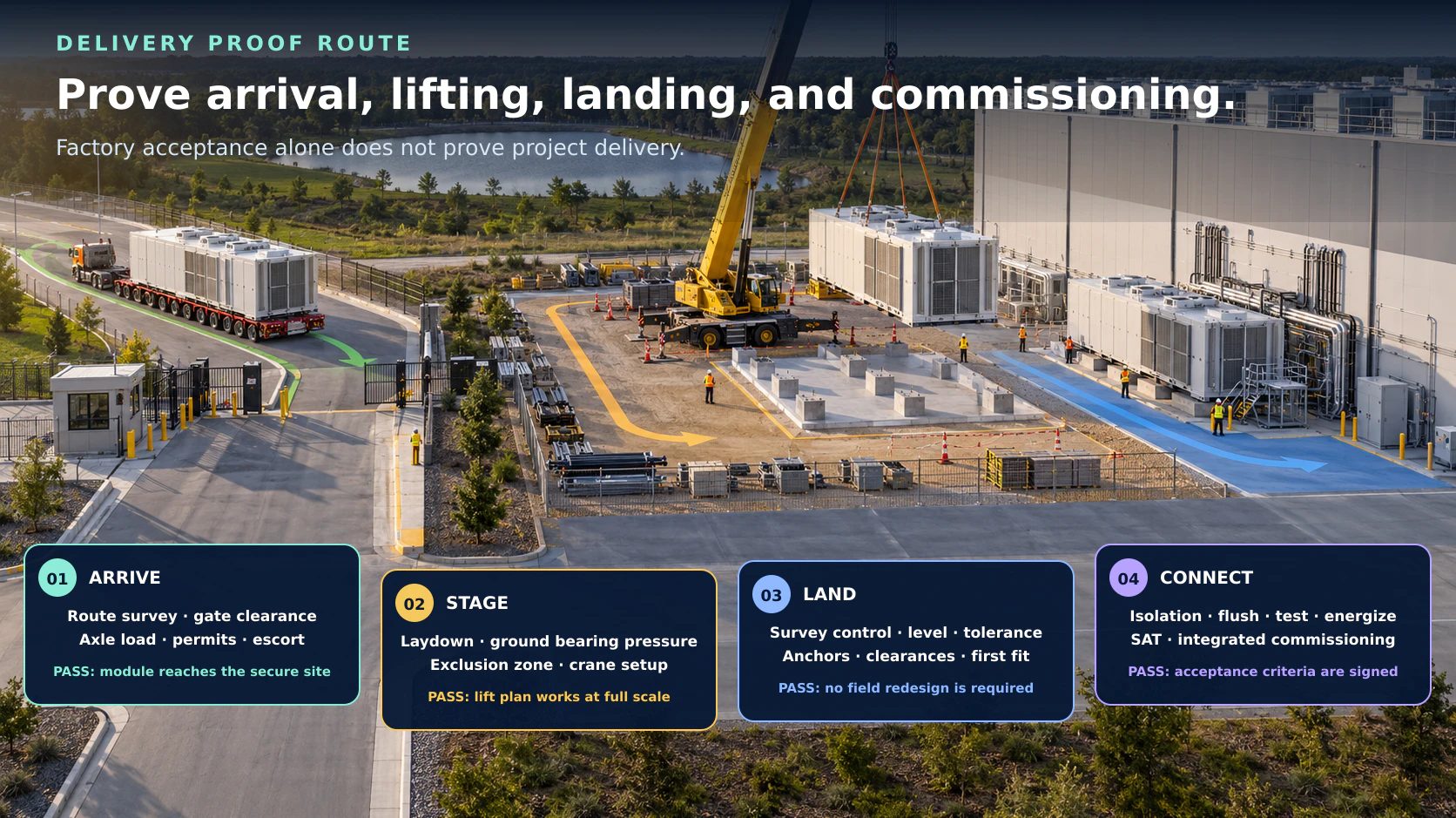
Transport and installation are not contractor means-and-methods afterthoughts. Module mass, center of gravity, route limits, permits, vibration, weather protection, staging, crane radii, outrigger loads, temporary stability, connection sequence, and site tolerance all influence what should be prefabricated.
First-fit must be tested as a measurable outcome. A module that geometrically fits only after field grinding, pipe offsets, cable rework, or late support steel is not a repeatable module.
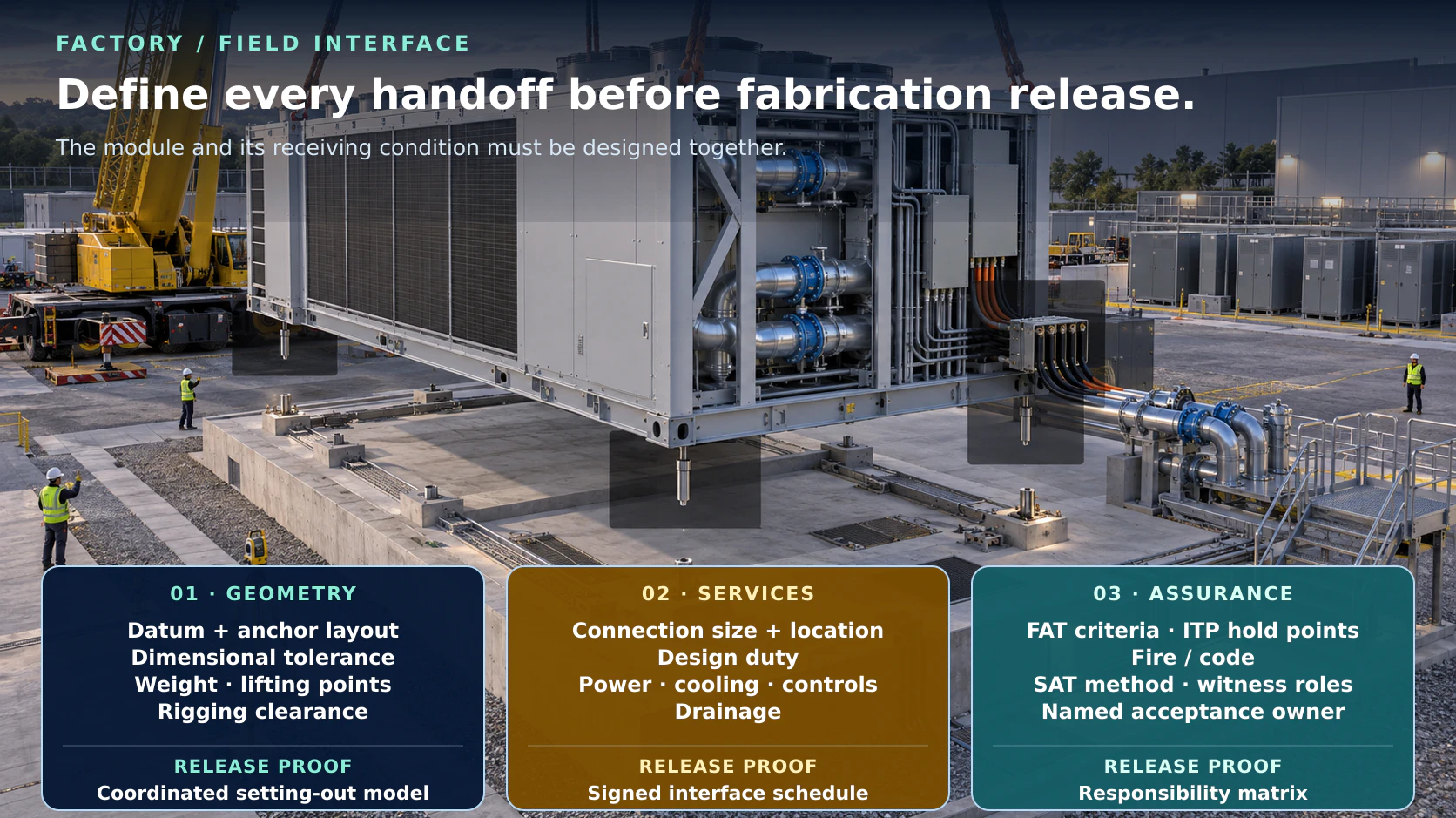
For every critical module, record the maximum shipping envelope, lifting configuration, required site datum, allowable foundation and connection tolerance, inspection hold points, preservation interval, and no-go conditions.
Treat Interfaces as Technical Contracts
Most industrialized-delivery failures arise at boundaries: utility-to-campus, factory skid-to-field distribution, module-to-structure, enclosure-to-fire compartment, cooling-to-controls, and tested assembly-to-real mixed-service penetration.
Each interface needs an owner on both sides, geometry, tolerance, capacity range, operating limits, signals, failure behavior, isolation method, inspection requirement, test, and change-notification rule.
The interface passport should be governed like a product requirement. When a supplier, region, or project changes one side, the team must know which assumptions and tests on the other side are affected.
Owner-Side Decision Matrix
| Decision | What must be defined | Evidence before release |
|---|---|---|
| Performance basis | Required operating outcome, capacity range, failure and maintenance states | Requirement trace, calculation, test method, acceptance threshold |
| Physical interface | Geometry, tolerance, access, ownership, safety and sequence | Coordinated model/detail, manufacturer data, constructability review |
| Variant boundary | What may vary and what must remain controlled | Applicability matrix, deviation approval, configuration record |
| Lifecycle outcome | Inspection, maintenance, replacement, recovery and future phase implications | Operations review, replacement-path test, commissioning and handover plan |
Release Only After Factory, Site, and Operations Evidence Converge
Factory acceptance proves controlled fabrication. It does not prove site delivery, code acceptance, integrated controls, safe maintenance, or operations recovery. A repeatable product needs evidence across all of them.
Use a pilot to measure fabrication hours, delivery damage, first-fit success, installation duration, nonconformance, rework, commissioning anomalies, and maintenance access. Then update the reference design before scale.
A second qualified team should be able to use the release package without relying on the original designers’ memory. That is the practical test of whether learning has moved from people into the product.
Early screening checklist
What to verify before advancing this site.
- Global core, controlled variants, and site adaptations are explicitly separated.
- Factory boundary and field interfaces are complete and testable.
- Transport, lifting, staging, and first-fit constraints are engineered.
- Critical interfaces have owners, limits, tests, and change rules.
- Pilot outcomes update the controlled reference before replication.
- Operations validates isolation, access, replacement, and recovery.
What DCFR would flag
Risks surfaced at the screening stage.
DCFR should calculate early whether the parcel and access network can support module transport, crane setup, staging, service access, and future replacement before calling prefabrication schedule acceleration credible.
Professional confirmation required
Items requiring licensed validation.
Planning-grade guidance only. Final strategy requires manufacturer, structural, transportation, civil, electrical, mechanical, fire-protection, controls, commissioning, code, insurer, utility, AHJ, and operations confirmation.
Final takeaway
The scalable asset is not the prefabricated box. It is the controlled system that lets qualified teams deliver, connect, test, operate, and improve that box across different sites.
Screen up to 20 candidate sites before selecting one for the full DCFR report.
Each DCFR Report Package includes a preliminary 20-site comparison PDF / export package plus one selected planning-grade feasibility report.