
DCFR Insight 108 / Materials + Resilience
Low-Carbon Concrete for Mission-Critical Facilities: Performance Before Claims
How to lower embodied-carbon exposure without converting foundations, slabs, equipment pads, and structural systems into untested schedule or reliability risks.
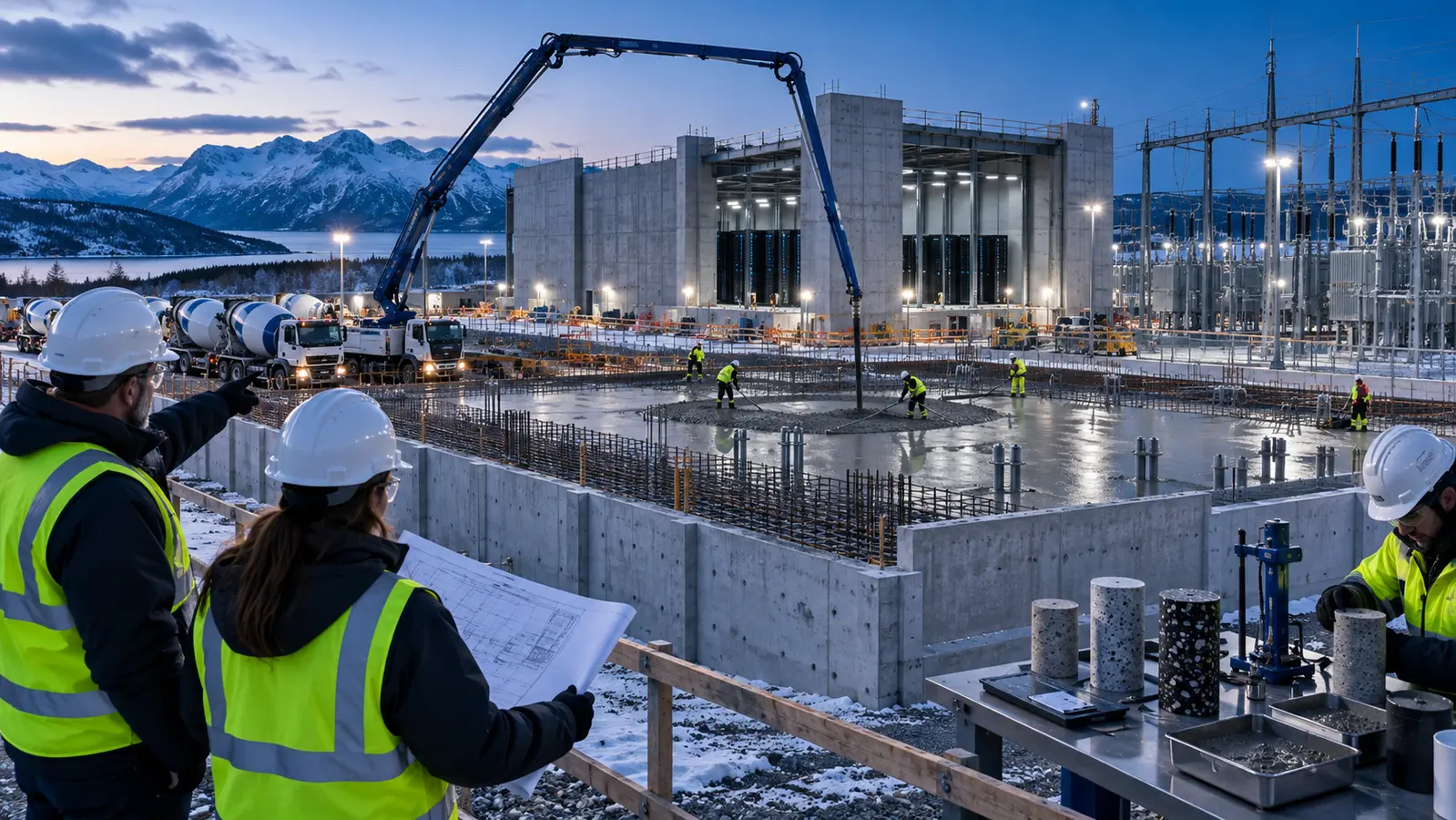
Carbon Is an Outcome of a Concrete System
Concrete-carbon decisions cannot be reduced to a single cement-replacement percentage. The relevant outcome depends on structural demand, durability exposure, mixture design, cement type, supplementary cementitious materials, aggregate, transport, placement, curing, strength development, finish, testing, and the project’s actual environmental product data.
Mission-critical projects have unusually consequential concrete: foundations supporting sensitive electrical assets, equipment pads, generator and fuel systems, slabs carrying rolling loads, structural frames, underground structures, and exterior pavements. A material claim that ignores those functions is not decision-grade.
The right starting point is a hierarchy: reduce unnecessary volume, optimize the structural system, select a performant mixture, verify it with the project’s supplier data, and protect the required construction and operational outcomes.
Define Performance Requirements Before Selecting the Mix
Write the performance basis first: specified strength and age, early-strength needs, modulus where relevant, shrinkage and cracking risk, permeability, freeze-thaw or sulfate exposure, abrasion, heat of hydration, electrical grounding interfaces, finish, curing, allowable placement temperatures, and sequencing constraints.
High supplementary-cementitious-material content can reduce embodied carbon but may change early-strength gain, set time, temperature sensitivity, finishability, curing dependence, and supply consistency. Those shifts may be entirely acceptable—or they may conflict with critical-path turnover and equipment installation.
A prescriptive recipe hides this trade-off. Performance specifications and early trials make it visible.
PERFORMANCE BEFORE CARBON
Carbon reduction begins with a complete performance basis.
Do not trade untested reliability for a lower declaration value.
STRUCTURAL
Strength, stiffness, cracking, durability
DELIVERY
Placement, finish, cure, temperature, schedule
EXPOSURE
Freeze-thaw, sulfate, moisture, service life
STUDY NOTE — EVIDENCE + FAILURE MODE
Study point: lower embodied carbon is a design and delivery choice, not a material claim. Structural performance, durability, placement, curing, schedule, and availability must be defined before mix selection.
Treat Early Age as a Project-System Risk
A mix that meets 28- or 56-day strength may still create operational schedule risk if forms cannot be stripped, floors cannot accept loads, embeds cannot be stressed, equipment cannot be installed, or weather protection must continue longer than planned.
The team should model the construction sequence around actual acceptance ages and temperatures. Where early access is critical, define required strength milestones and test methods rather than assuming a standard schedule.
Curing is part of performance. Low-carbon mixtures may be more sensitive to moisture and temperature control; a weak curing plan can erase both durability and carbon benefits through repair, delay, or replacement.
Verify the Claim With Project-Specific Evidence
Environmental product declarations can support procurement decisions, but they describe defined products and declared boundaries. They do not automatically represent the installed mix, transport distance, waste, placement, or project quantity.
Request product-specific documentation where available; compare equivalent functional units and system boundaries; record supplier, plant, mix, quantity, placement location, and approved substitutions. Avoid comparing incompatible declarations as if they were a single score.
The strongest claim is traceable: the structural element, the actual mixture, the approved performance evidence, and the environmental documentation are linked.
MIX DECISION EVIDENCE
Compare complete concrete systems—not marketing claims.
The same material can perform differently by placement and curing.
BINDER
Cement reduction and SCM availability
TRIAL MIX
Workability, set time, strength development
CONSTRUCT
Pumpability, finish, curing, weather response
STUDY NOTE — EVIDENCE + FAILURE MODE
Evidence required: compare EPD scope, cement/SCM content, trial-batch performance, field workability, strength development, curing requirements, transport distance, and the project’s actual batch records.
Coordinate Supply and Contingency Before Commitment
Alternative binders and supplementary materials can have regional availability, storage, quality-control, and allocation constraints. A project must not discover at a critical pour that the preferred mixture cannot be supplied consistently.
Qualify backup sources and define whether they are equivalent in performance and declared carbon data. Changes in supplier or cementitious content may require renewed trial evidence, curing review, and environmental recalculation.
The same discipline applies to admixtures, aggregates, and batching capacity. Availability is part of feasibility.
Owner-Side Decision Matrix
| Decision | What must be defined | Evidence before release |
|---|---|---|
| Performance basis | Required operating outcome, capacity range, failure and maintenance states | Requirement trace, calculation, test method, acceptance threshold |
| Physical interface | Geometry, tolerance, access, ownership, safety and sequence | Coordinated model/detail, manufacturer data, constructability review |
| Variant boundary | What may vary and what must remain controlled | Applicability matrix, deviation approval, configuration record |
| Lifecycle outcome | Inspection, maintenance, replacement, recovery and future phase implications | Operations review, replacement-path test, commissioning and handover plan |
Use Pilot Pours to Make Trade-Offs Explicit
Pilot slabs, pads, or representative elements should validate placing, finishing, curing, thermal behavior, testing, early access, appearance where relevant, and the actual carbon documentation path.
Record expected versus actual production, transport, temperature, placement duration, labor, finish, strength, defects, and rework. This converts a material aspiration into a controlled project decision.
If the pilot reveals a conflict, choose deliberately: alter the design, change the mixture, add curing or schedule protection, reduce the target, or retain the baseline. Do not leave the trade-off hidden in the field.
ACCEPTANCE RECORD
Release the actual structure with field evidence.
Embodied-carbon claims need the same rigor as performance claims.
01 TICKET
Batch source, mix ID, delivery time
02 VERIFY
Temperature, samples, cure, placement record
03 ACCEPT
Strength, defects, repair, final evidence
STUDY NOTE — EVIDENCE + FAILURE MODE
Failure to avoid: accepting a low-carbon mix that causes schedule loss, repair, premature cracking, or a change back to conventional cement. Rework can erase the claimed carbon benefit.
Early screening checklist
What to verify before advancing this site.
- Structural and durability performance basis is explicit.
- Early-age milestones match the actual construction sequence.
- Supplier EPDs and material trace are comparable and recorded.
- Curing, weather, and testing plans support the selected mixture.
- Supply and substitution boundaries are qualified.
- Representative trial evidence precedes scale.
What DCFR would flag
Risks surfaced at the screening stage.
DCFR can identify carbon-sensitive concrete scope and early feasibility risks, but cannot certify embodied carbon or structural performance without project-specific quantities, mixture data, environmental documentation, and engineering review.
Professional confirmation required
Items requiring licensed validation.
Planning-grade guidance only. Final materials strategy requires structural engineer, geotechnical engineer, concrete supplier, contractor, testing laboratory, sustainability lead, owner, insurer, and AHJ confirmation.
Final takeaway
For mission-critical concrete, the best low-carbon decision is the one whose performance, supply, construction sequence, and evidence are as credible as its reduction claim.
Screen up to 20 candidate sites before selecting one for the full DCFR report.
Each DCFR Report Package includes a preliminary 20-site comparison PDF / export package plus one selected planning-grade feasibility report.