
DCFR Insight 51 / Sustainable Data Centers
Sustainable Data Center Development: Site Selection Through Carbon-Free Operations
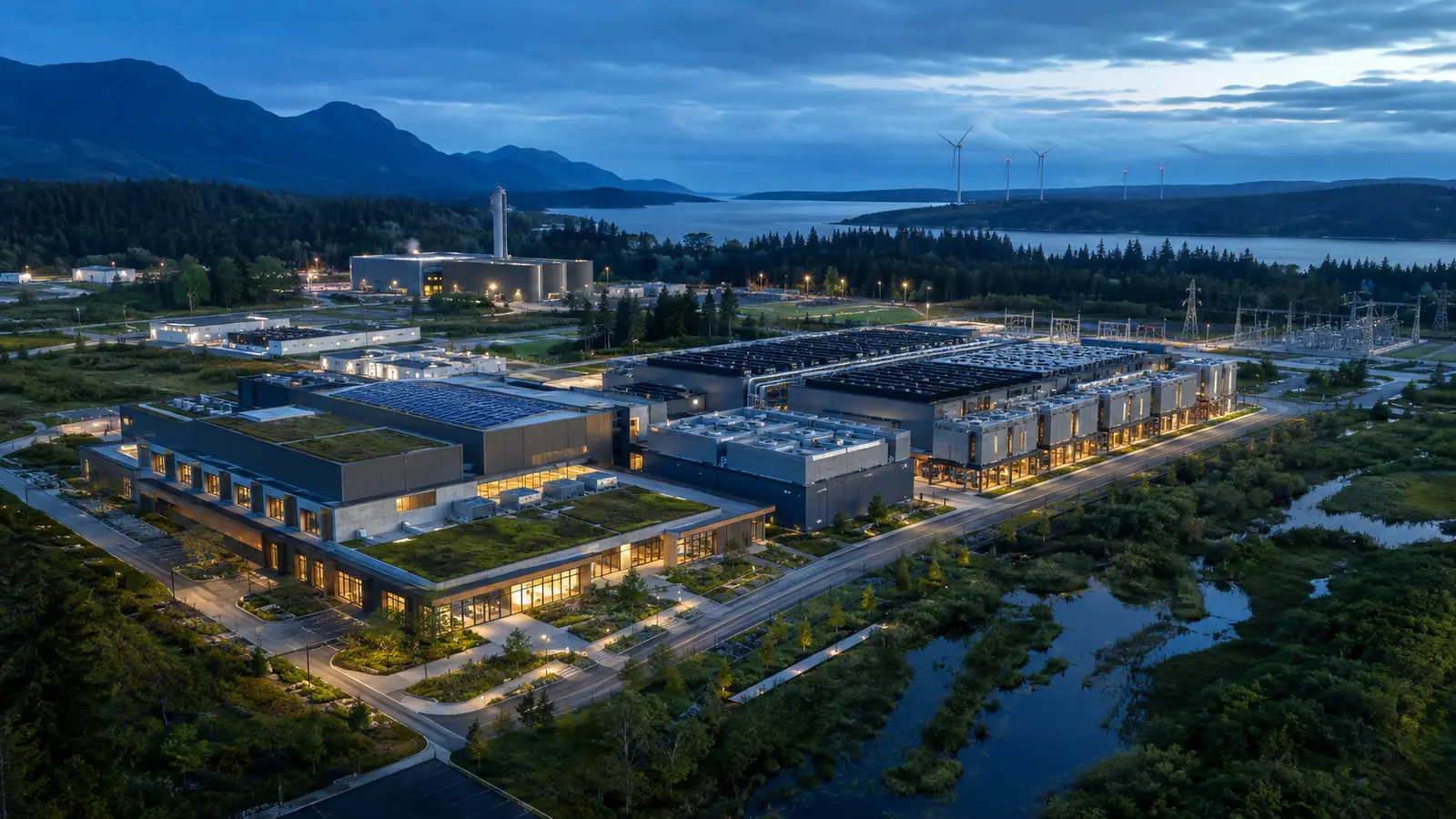
A sustainable data center is not defined by a low annual Power Usage Effectiveness value or a renewable-energy contract. It is a whole-life infrastructure system that reduces demand, matches electricity by time and place, protects water, limits embodied carbon, enables circularity, restores ecology, and proves its performance in operation.
Start with a performance budget before selecting the site
Define the service the facility must deliver, then establish budgets for electricity, hourly carbon, water withdrawal and consumption, embodied carbon, land disturbance, waste, refrigerants, local air emissions, noise, and biodiversity. State initial, committed, and ultimate information-technology capacity; rack-density cohorts; availability; climate horizon; and construction phases. Give every metric a numerator, denominator, geography, time interval, baseline, owner, evidence source, and decision threshold. Without these boundaries, a project can improve one attractive ratio while increasing its total impact through rapid growth.
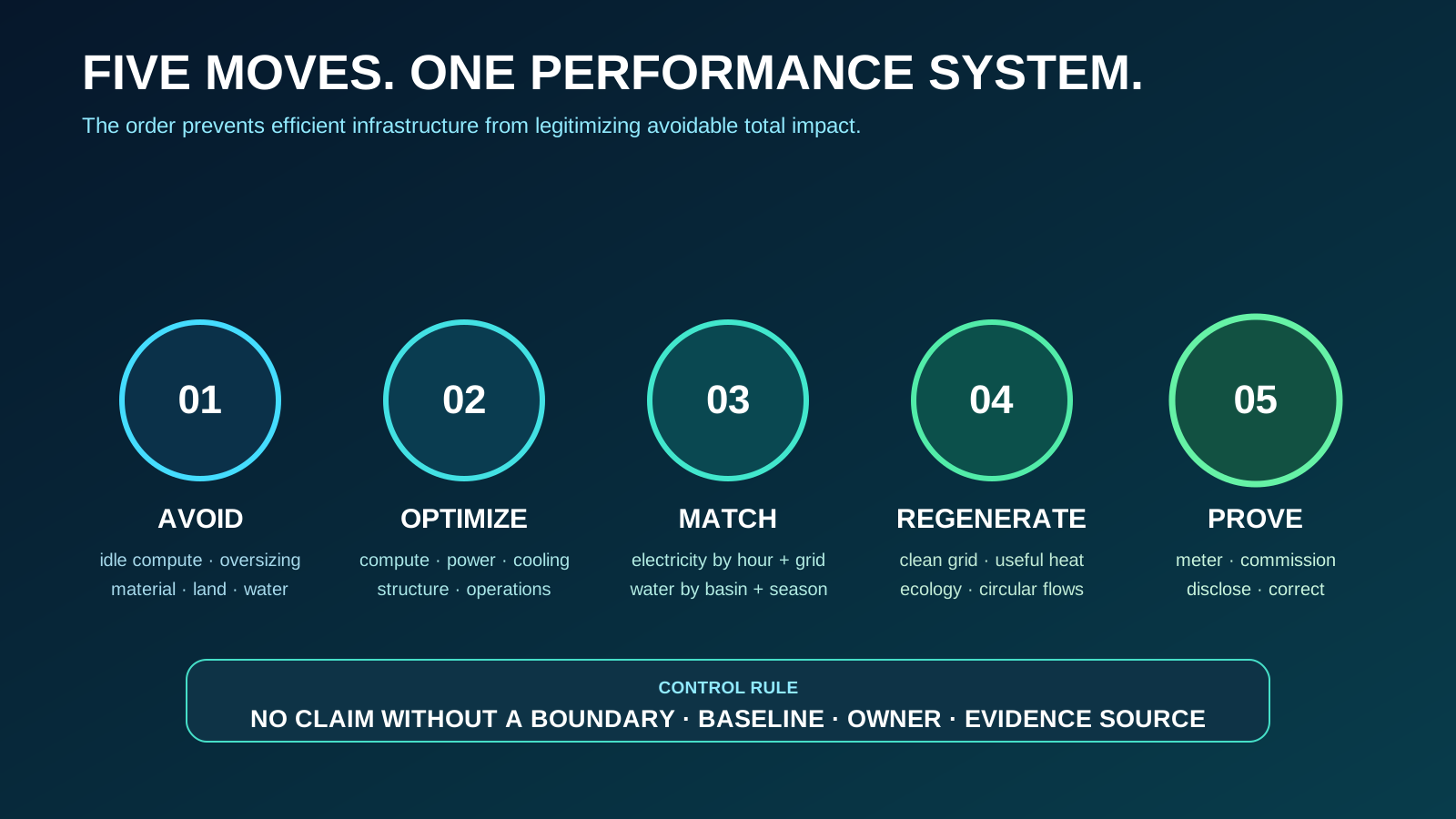
Use five moves: avoid, optimize, match, regenerate, and prove
First avoid unnecessary computation, idle capacity, oversized infrastructure, water use, material, and land take. Then optimize the remaining information-technology, electrical, cooling, structural, and operating systems as one architecture. Match electricity and water strategies to the hours and places where impacts occur. Regenerate value through clean-grid investment, heat recovery, land restoration, circular material flows, and useful community infrastructure when those outcomes are technically and contractually credible. Finally, prove results through metering, commissioning, disclosure, and corrective action. Procurement claims cannot substitute for physical and operational evidence.
Select the site through a carbon-water-grid-community screen
Evaluate deliverable grid capacity, marginal and average grid emissions, clean-energy development path, transmission constraints, hourly resource profile, water-basin stress, future climate, flood and heat exposure, habitat, land condition, heat-reuse offtakers, transportation, housing, emergency services, and cumulative community burden. Compare greenfield, brownfield, and existing-campus expansion alternatives. A cool climate may reduce mechanical cooling but offer a carbon-intensive grid; a low-carbon grid may coincide with scarce water or limited capacity. Use scenario weights and disclose tradeoffs instead of declaring one universal best location.
Sustainability Basis of Design
| Domain | Minimum design question | Evidence at acceptance | Claim to avoid |
|---|---|---|---|
| Useful compute | How much useful service is delivered per unit of resource? | Workload, utilization and facility telemetry on one boundary | A low Power Usage Effectiveness value proves total efficiency |
| Electricity and carbon | When and where are load and clean supply matched? | Hourly load, generation, storage, grid and contract records | Annual renewable matching means carbon-free every hour |
| Water | What is consumed, in which basin, under which climate condition? | Metered water balance, source quality and drought-mode test | Low site Water Usage Effectiveness means low total water impact |
| Materials | What whole-life impact is built, replaced, and recovered? | Quantity ledger, verified product data and custody records | Recyclable means it was recycled |
| Heat and community | Who receives value and who carries burden? | Metered delivery, binding commitments and monitored impacts | Technical potential equals realized benefit |
Metrics must be reported with scope, boundary, period, location, capacity, and absolute totals. No single indicator establishes whole-project sustainability.
Reduce computational and infrastructure demand before buying clean supply
Build a workload model covering utilization, idle power, training and inference profiles, scheduling, checkpointing, data movement, hardware refresh, and useful output. Align server admission, virtualization or orchestration, storage, network, voltage architecture, cooling temperatures, free-cooling opportunities, heat capture, redundancy, and part-load control. Track facility energy and energy per useful computational output where the workload can be defined consistently. Power Usage Effectiveness remains useful for infrastructure overhead, but it does not measure computational productivity, grid carbon, water, embodied impact, or absolute growth.
Move from annual renewable matching to hourly carbon-free operation
Model electricity consumption and carbon-free supply by hour and grid region. Separate on-site generation, contracted resources, unbundled instruments, grid mix, storage charging source and losses, curtailment, backup generation, and workload shifting. Evaluate additionality, deliverability, commissioning date, contract duration, and counterfactual impact. Report annual market-based accounting and the physical hourly operating picture without conflating them. The strongest plan combines demand reduction, locally relevant new clean supply, storage, grid-interactive load, and transparent treatment of unmatched hours.
Create a watershed-based water budget
Account separately for withdrawal, consumption, discharge, potable water, reclaimed water, process make-up, humidification, domestic use, construction, and the water associated with electricity generation where decision-relevant. Model normal, design-day, drought, poor-water-quality, maintenance, and emergency conditions under future climate scenarios. Select air, evaporative, hybrid, and liquid-cooling systems by annual energy-water-carbon tradeoff, not Water Usage Effectiveness alone. Protect environmental flows and other users, establish drought operating modes, monitor chemistry and blowdown, and avoid calling replenishment projects an offset for local operational risk.
Set a whole-life carbon and circularity plan
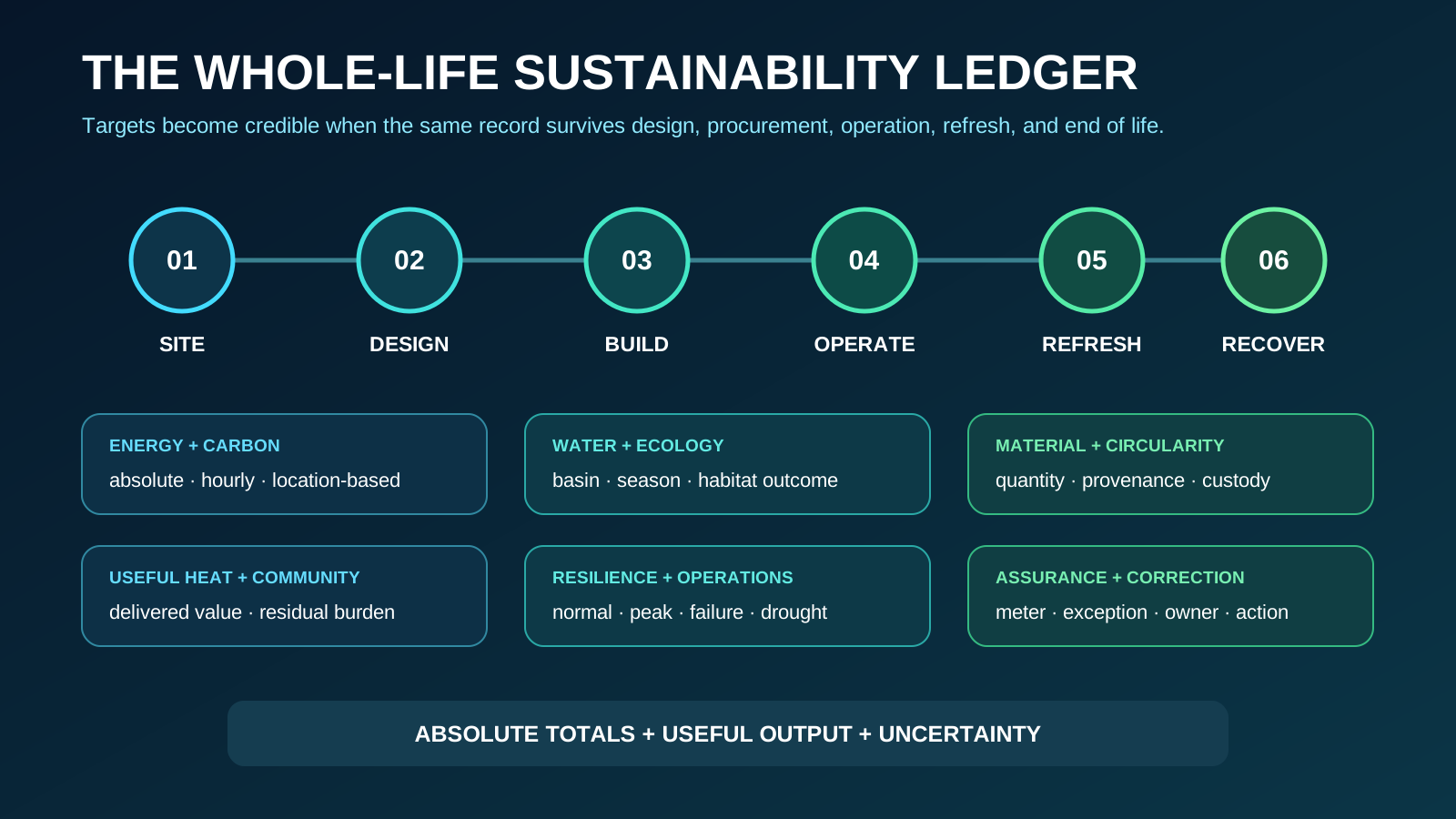
Develop life-cycle modules for site work, concrete, steel, envelope, electrical equipment, cooling plant, generators, batteries, refrigerants, information-technology hardware, replacements, maintenance, transport, construction energy, operational energy, and end of life. Establish a comparable baseline and carbon budget at concept design, then maintain a quantity-based ledger through procurement and construction. Prioritize structural and infrastructure efficiency, low-carbon specifications, verified product data, design for disassembly, standardized modules, repair, remanufacture, redeployment, material recovery, and responsible data-bearing equipment disposal. Do not double-count avoided impacts or treat unverified future recycling as achieved benefit.
Design heat reuse around a real offtaker and temperature cascade
Map the quantity, temperature, timing, reliability, and distance of recoverable heat against specific users such as district networks, industrial processes, greenhouses, pools, or buildings. Define heat pumps, thermal storage, backup supply, seasonal rejection, water chemistry, metering, ownership, tariff, easements, maintenance, service level, and failure allocation. Use a temperature cascade so higher-value uses receive suitable heat first. Heat reuse is not a sustainability credit until an offtaker, connection, operating agreement, and measured useful delivery exist; a future-ready stub is valuable but should be reported as readiness, not recovered energy.
Make land, biodiversity, and community outcomes part of capacity planning
Establish the ecological baseline before disturbance and map wetlands, habitat connectivity, soils, tree canopy, stormwater, heat island, lighting, noise, views, cultural resources, and neighboring uses. Apply avoid-minimize-restore-compensate in that order. Compact the campus, reuse disturbed land, protect corridors, use native planting and dark-sky controls, and design stormwater as functioning habitat where appropriate. Engage communities early with specific evidence about power, water, air emissions, noise, traffic, employment, tax, emergency response, and benefit commitments. A project is not sustainable if environmental gains depend on transferring unpriced burden to its neighbors.
Commission sustainability like a life-safety system
Create an Owner's Project Requirements document linking every sustainability target to design response, submittal, meter, test, operator, and reporting rule. Commission electrical and thermal performance at minimum, normal, peak, transient, failure, and maintenance states; verify water balances, heat recovery, renewable and storage controls, grid interaction, refrigerant management, embodied-carbon records, and landscape establishment. Calibrate the digital measurement boundary against utility and equipment meters. Require seasonal testing, a post-occupancy review, unresolved-issue ownership, and automatic alerts when operating conditions invalidate the claimed performance.
Sustainability Decision Gates
| Gate | Decision question | Minimum proof | Capital released |
|---|---|---|---|
| Site option | Can this location meet capacity without unacceptable transferred impact? | Grid, carbon, watershed, ecology, climate and community screen | Controlled land diligence |
| Concept | Is there a credible whole-life performance pathway? | Budgets, baseline, scenarios, system concept and tradeoffs | Design development |
| Procurement | Will purchased systems preserve the budgets? | Metered performance, product data, controls and contractual remedies | Manufacture and construction |
| Operational acceptance | Does the integrated facility perform across real modes? | Commissioning, calibrated meters, workload and seasonal evidence | Protected production load |
| Continued operation | Are claims still true after growth and change? | Audited ledger, exceptions, corrective action and periodic recommissioning | Renewed public claims and expansion |
Operate one auditable sustainability ledger
Maintain a controlled record of absolute energy, Power Usage Effectiveness, water withdrawal and consumption, Water Usage Effectiveness, carbon emissions, hourly carbon-free-energy match, generator use, refrigerant loss, useful heat exported, embodied carbon, construction and operational waste, hardware disposition, land and biodiversity commitments, and community obligations. Show target, actual, uncertainty, exception, corrective action, and accountable owner. Normalize only alongside absolute totals and useful output. Independent assurance should focus on high-consequence claims and material changes. Sustainability is not a certification event; it is a governance system that makes adverse performance visible early enough to act.
Early screening checklist
What to verify before advancing this site.
- Absolute budgets and normalized metrics have clear boundaries, baselines, periods, and owners
- Initial, committed, and ultimate capacity are tested against total environmental impact
- Site selection compares grid carbon, water stress, climate, ecology, heat reuse, and community burden
- Useful computational output and information-technology utilization accompany Power Usage Effectiveness
- Electricity is modeled by hour and grid region, including storage losses and unmatched hours
- Water accounting separates withdrawal, consumption, discharge, source, basin, and drought modes
- Whole-life carbon includes site, structure, systems, hardware, refrigerants, replacement, and end of life
- Circularity claims are supported by custody and actual recovery, reuse, or remanufacture records
- Heat reuse has a real offtaker, temperature match, connection, contract, meter, and fallback mode
- Land and biodiversity commitments begin with an ecological baseline and measurable outcomes
- Community impacts and benefits are specific, monitored, and assigned to accountable parties
- Commissioning and the operating ledger can invalidate a claim and trigger corrective action
What DCFR would flag
Risks surfaced at the screening stage.
DCFR would flag a sustainable-data-center claim based mainly on annual renewable procurement, a design Power Usage Effectiveness target, future heat-reuse potential, or water replenishment without absolute impact budgets, hourly and local evidence, whole-life carbon, commissioned performance, and accountable treatment of residual burden.
Professional confirmation required
Items requiring licensed validation.
Confirm energy and carbon accounting, water rights and basin impact, life-cycle assessment, product data, refrigerants, heat reuse, ecology, community commitments, reporting obligations, commissioning, and assurance requirements with the owner, utility, suppliers, licensed professionals, regulators, authorities, local stakeholders, and qualified environmental and accounting specialists.
Final takeaway
A truly sustainable data center does not merely consume resources more efficiently; it reduces total burden, matches impact to time and place, creates verified local value, and remains accountable as capacity grows.
Screen up to 20 candidate sites before selecting one for the full DCFR report.
Each DCFR Report Package includes a preliminary 20-site comparison PDF / export package plus one selected planning-grade feasibility report.