
DCFR Insight 48 / Grid-Interactive Campuses
Grid-Interactive Data Centers: On-Site Generation, Storage, and Flexible Load
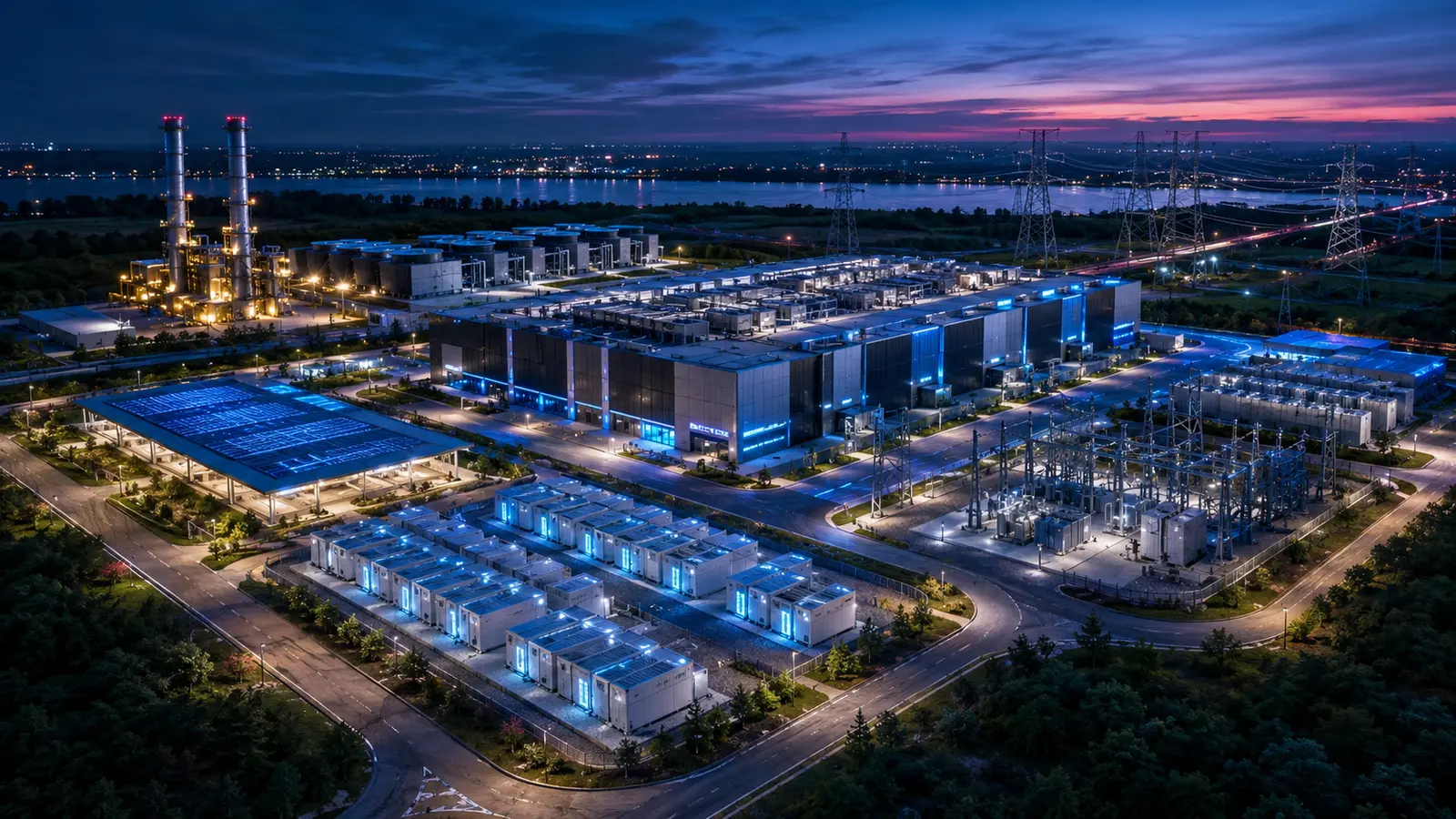
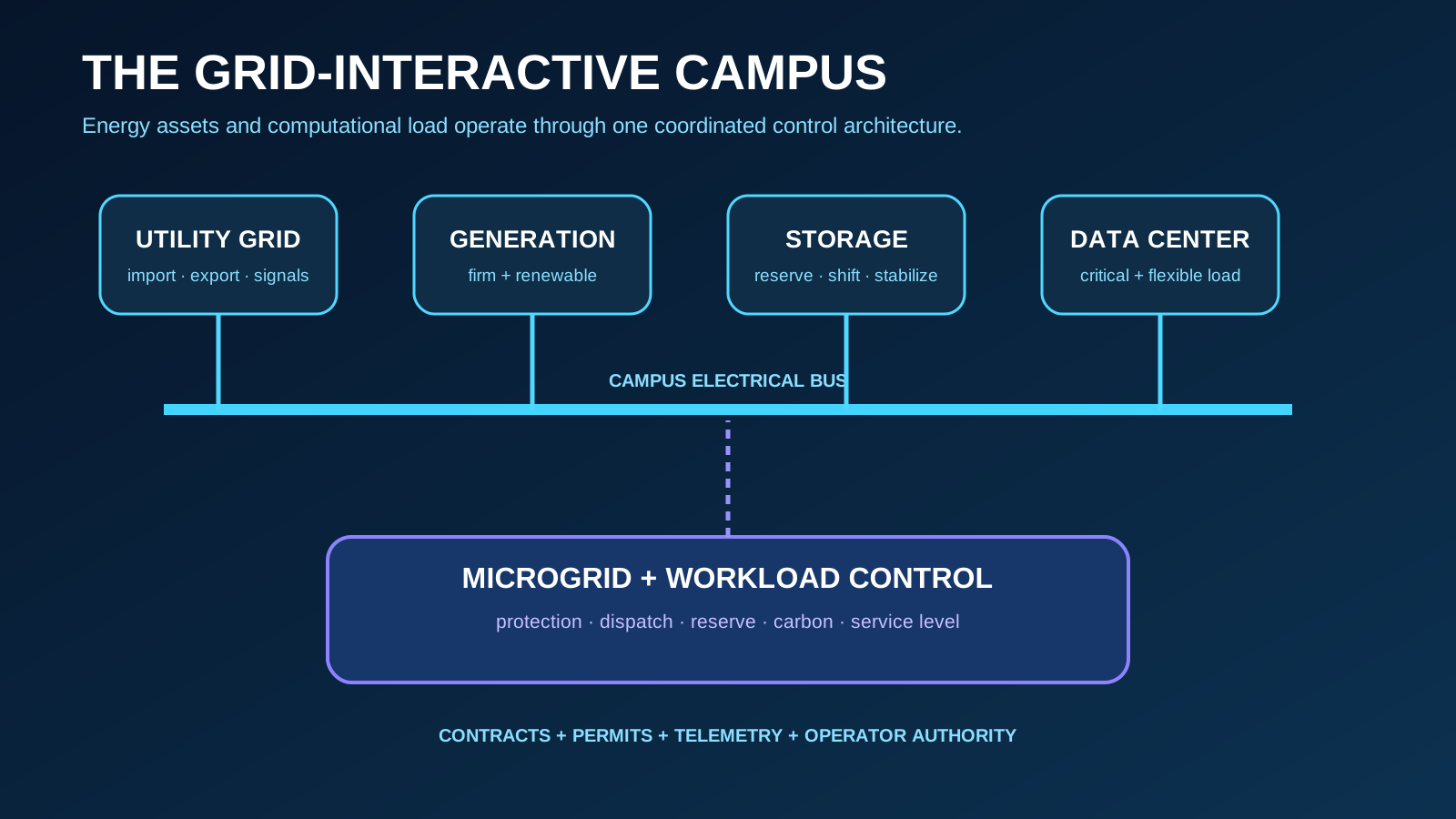
A self-powered data center is rarely an island. The stronger model is a grid-interactive campus that coordinates utility supply, on-site generation, storage, flexible workload, and resilient operation under one control and commercial architecture.
Start with the power problem the campus must solve
Separate capacity shortage, connection delay, resilience, power quality, energy cost, hourly carbon performance, and revenue from grid services. Each objective produces a different asset mix and operating policy. Define the initial and ultimate load, ramp, diversity, critical and flexible portions, outage tolerance, island duration, fuel constraints, emissions limits, utility milestone, and expansion sequence. Do not call a site self-powered until energy balance, firm capacity, restart, maintenance, and seasonal resource availability have been demonstrated.
Design a portfolio—not a single miracle technology
Evaluate utility supply alongside firm generation, variable renewables, batteries or other storage, thermal storage, uninterruptible power, and workload flexibility. Distinguish energy from capacity: solar or wind may contribute substantial annual energy while providing limited firm output during a specific system peak. Storage shifts energy and stabilizes transitions but has finite duration. Firm generation brings fuel, emissions, water, maintenance, and permitting consequences. The portfolio should meet each operating mode with explicit reserve and degradation assumptions.
Make the interconnection and market path an early design package
Confirm utility service options, study process, queue position, network upgrades, metering, import and export limits, protection, anti-islanding, telemetry, curtailment rights, demand charges, power-quality requirements, and participation rules for demand response or ancillary services. Define ownership and operational authority at the point of interconnection. A technically capable microgrid may still be commercially or legally unable to export, island, or respond as planned. Align the electrical one-line with the signed tariff and operating agreement.
Power Objective to Design Response
| Objective | Primary levers | Proof required | Common error |
|---|---|---|---|
| Accelerate connection | Phased grid service, firm generation, storage, flexible load | Firm capacity and permitted operating hours through every phase | Annual energy is mistaken for available capacity |
| Improve resilience | Independent sources, islanding, reserves, fuel, black start | Tested transitions and sustained critical operation | Many assets share one control or fuel failure |
| Reduce hourly carbon | Clean supply, storage, workload timing and location | Time- and location-matched accounting | Annual certificates hide carbon-intensive hours |
| Support the grid | Demand response, storage and controlled workload | Metered response, duration and rebound performance | Information-technology flexibility is assumed, not contracted |
Resource adequacy, tariffs, market rules, emissions, and permits are location-specific and change over time.
Coordinate protection, controls, and cybersecurity as one system
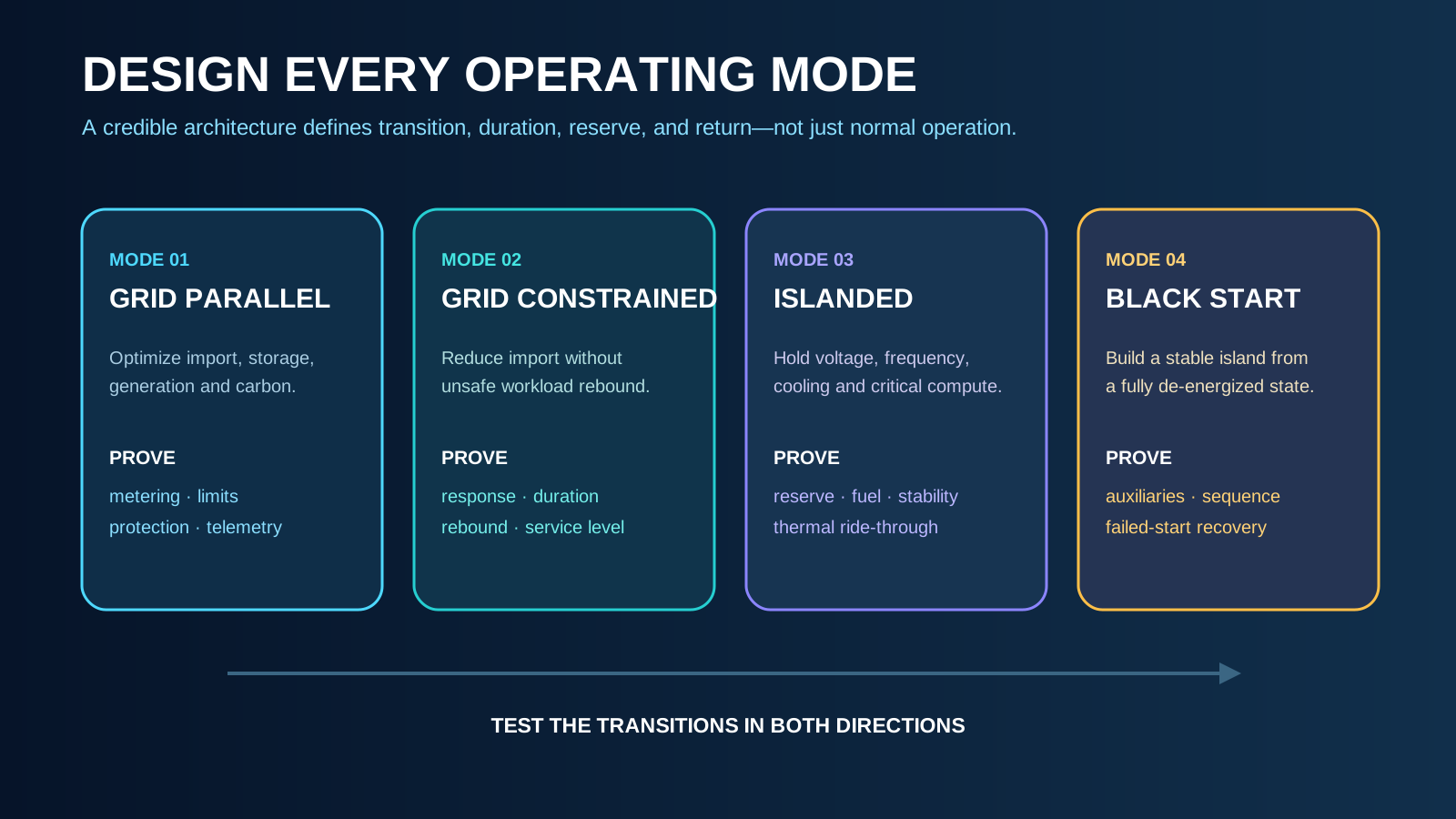
Build a mode-and-transition matrix covering normal grid parallel, grid-constrained, utility outage, islanded operation, black start, resynchronization, maintenance, and emergency shutdown. Coordinate relays, breakers, inverters, governors, energy-management systems, building controls, UPS, workload orchestration, and utility commands. Establish deterministic priority and safe fallback if communications fail. Segment operational technology, authenticate commands, log changes, synchronize time, and rehearse manual control. A microgrid controller must not become a single opaque failure domain.
Treat workload flexibility as an engineered service
Classify workloads that can pause, shift in time, migrate, reduce performance, or move to another location, and protect those that cannot. Quantify notice time, response rate, duration, rebound, data-transfer limits, checkpoint loss, service-level impact, and cybersecurity constraints. Connect facilities forecasts and grid signals to the scheduler through an approved policy layer. Flexibility should be measured at the utility meter and verified at the job level; a promised load reduction that merely reappears as an uncontrolled rebound can worsen the grid event.
Design credible islanding and black-start behavior
List loads required to form and sustain the island: controls, protection, pumps, cooling, network, security, life safety, fuel systems, and the information-technology capacity to be retained. Model sequence, motor starting, inverter grid-forming behavior, voltage and frequency control, spinning or fast reserve, thermal ride-through, battery state of charge, fuel logistics, emissions permits, and operator intervention. Black start is a separate capability from islanding; demonstrate how a dark campus establishes stable auxiliary power, restarts generation and cooling, then admits computing load in controlled blocks.
Use an hourly operating and carbon model
Annual renewable-energy matching does not show whether the facility is powered by carbon-free sources in the hours it consumes electricity. Build an hourly model using location-specific grid emissions, contracted supply, on-site production, storage charging source, losses, curtailment, generator dispatch, maintenance, and workload movement. Report both market-based contractual claims and the physical operating picture transparently. Keep embodied carbon, water, local air quality, land, fuel, and community impact in the decision so an operational carbon improvement does not simply transfer burden elsewhere.
Commission the microgrid under transitions—not just steady state
Progress from equipment and protection tests to controller hardware-in-the-loop simulation, staged energization, grid-parallel dispatch, demand response, forced curtailment, island separation, load rejection, reserve deployment, black start where required, resynchronization, and failed-communications scenarios. Use realistic computing and cooling dynamics. Verify utility telemetry and settlement data. Capture controller versions, setpoints, permissions, battery condition, fuel availability, and operator actions at acceptance. Repeat critical tests after material software or asset changes.
Microgrid Operating Modes
| Mode | Control priority | Minimum evidence | Release condition |
|---|---|---|---|
| Grid parallel | Efficient dispatch within import and export limits | Metering, protection and utility telemetry | Normal commercial operation |
| Grid constrained | Reduce import without unsafe rebound | Verified workload and storage response | Utility or market signal cleared |
| Islanded | Maintain voltage, frequency, cooling and critical compute | Reserve, fuel, thermal and stability tests | Grid is safe and resynchronization approved |
| Black start | Establish auxiliaries, generation, cooling, then compute | Cold-start sequence and failed-start recovery | Stable island or restored grid supply |
| Maintenance | Retain required resilience with assets unavailable | Approved seasonal and contingency plan | Asset returned and configuration verified |
Build the operating model and commercial accountability
Assign authority among data-center operations, energy management, generator and storage providers, utility, market operator, and workload scheduler. Define dispatch hierarchy, minimum reserves, maintenance windows, emissions and noise limits, fuel replenishment, warranty constraints, revenue allocation, and who bears non-performance penalties. Track capacity availability, energy balance, state of charge, fuel, carbon, curtailed compute, failed-work loss, grid-service delivery, and transition performance. The control philosophy must remain aligned with contracts throughout the campus life.
Early screening checklist
What to verify before advancing this site.
- Capacity, connection, resilience, cost, grid-service, and carbon objectives are separated
- Hourly energy and firm-capacity models cover seasonal and maintenance conditions
- The one-line matches the utility interconnection and commercial agreement
- Every operating mode has a transition, reserve, duration, and recovery rule
- Protection, microgrid controls, building controls, and workload scheduling are coordinated
- Operational-technology commands are authenticated, logged, segmented, and recoverable
- Flexible workloads have verified response, duration, rebound, and service-level limits
- Islanding and black start include cooling, auxiliaries, fuel, and operator actions
- Hourly carbon accounting separates contractual claims from physical operation
- Commissioning exercises failures, transitions, communications loss, and resynchronization
What DCFR would flag
Risks surfaced at the screening stage.
DCFR would flag a self-powered or grid-interactive claim based on annual energy totals without firm-capacity proof, utility-approved interconnection, mode-and-transition controls, workload-flexibility evidence, hourly carbon accounting, and commissioned island or restart behavior.
Professional confirmation required
Items requiring licensed validation.
Confirm interconnection, market participation, tariffs, generation and storage performance, emissions, fuel, protection, controls, cybersecurity, permitting, workload policy, commissioning, and carbon accounting with the utility, owner, licensed professionals, technology providers, regulators, market operators, and authorities.
Final takeaway
A grid-interactive campus succeeds when electricity assets and computational workloads operate as one tested, contracted, and observable system across every grid condition.
Screen up to 20 candidate sites before selecting one for the full DCFR report.
Each DCFR Report Package includes a preliminary 20-site comparison PDF / export package plus one selected planning-grade feasibility report.