
DCFR Insight 62 / Extreme Climate + Water Resilience
Can a Data Center Run at 122°F Without Potable Cooling Water?
Yes—but 122°F is an outdoor design condition, not a server-inlet target. The viable architecture begins by reducing water demand, raising useful liquid temperatures, engineering the last degrees of heat rejection, derating every exposed asset, and proving the complete system during peak summer.
Define the 122°F claim at the correct boundary
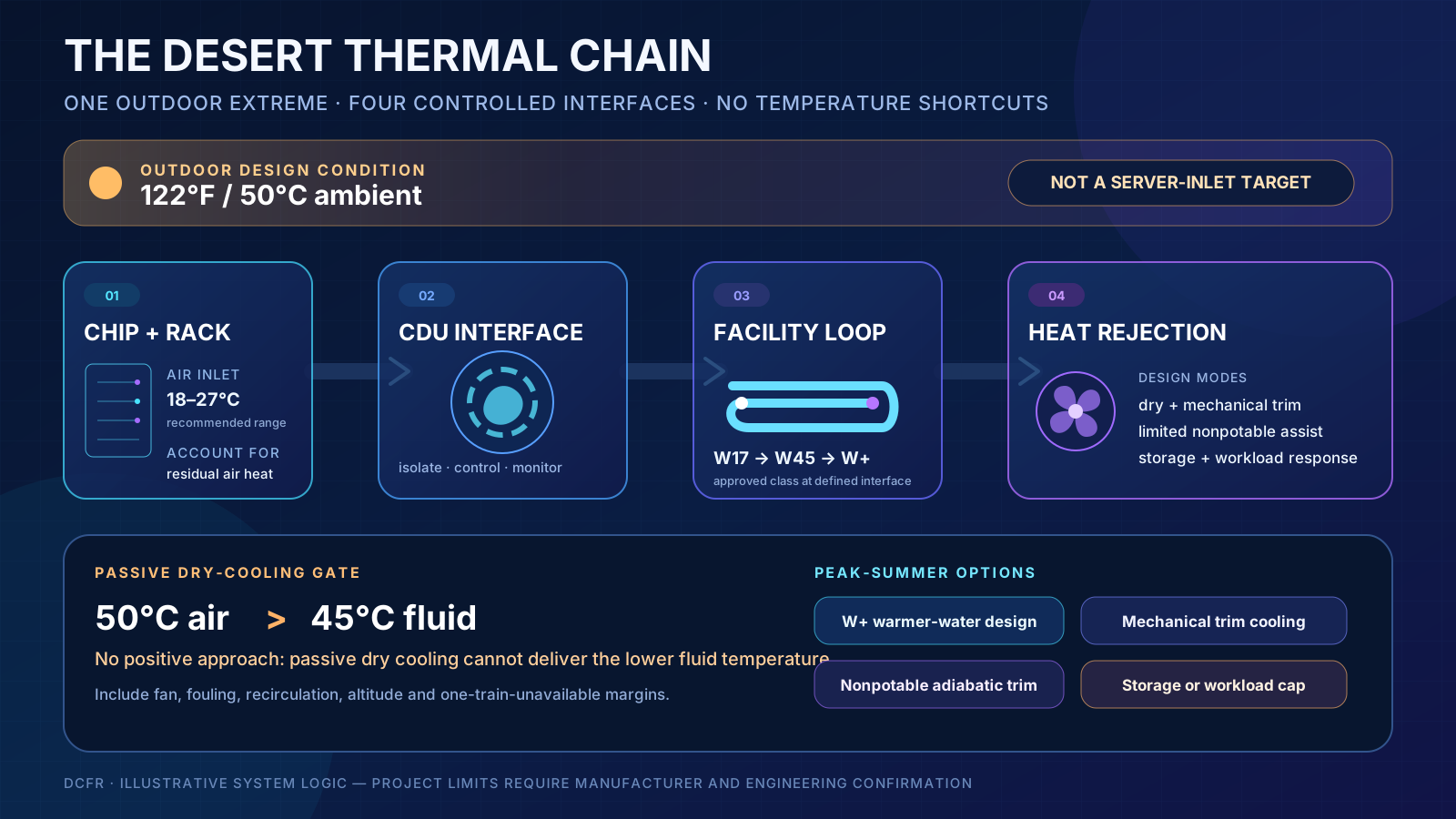
A data center can be engineered for a 122°F (50°C) outdoor ambient condition, but that does not mean servers should receive 122°F air. ASHRAE's commonly cited recommended air-inlet range is 64.4–80.6°F (18–27°C), while the A4 allowable envelope reaches 113°F (45°C) only for equipment approved for that class and within its other limits. Allowable is a bounded equipment envelope, not an everyday operating target. Liquid classes likewise describe facility-water temperatures at a defined interface: current ASHRAE guidance spans W17 through W45 and W+ equipment designed for supply water above 45°C. State outdoor dry bulb and wet bulb, server-air inlet, technology-cooling-system fluid, facility-water supply and return, component ambient, and duration separately. Also state the water claim precisely: no potable water consumed for normal cooling is not the same as a zero-water data center, because initial fill, domestic use, cleaning, fire protection, humidification, maintenance, or emergency operation may remain.
Build a climate design basis from coincident extremes
Use a multi-year hourly weather file and a climate-adjusted extreme case covering dry bulb, wet bulb, dew point, solar radiation, diurnal swing, wind, dust and sand, salt where relevant, precipitation intensity, and flood route. Model initial, committed, and ultimate information-technology load plus heat-rejection trains unavailable for maintenance. Test coincident conditions that annual averages conceal: peak heat with weak grid voltage, a dust storm with loaded filters, high ambient during a generator run, loss of reclaimed water during drought, and an intense storm after months of dry soil. The World Meteorological Organization reports accelerating heat and intensifying climate impacts across the Arab region; a design based only on historical maximum temperature or a generic city file may therefore understate both thermal and civil exposure. Freeze the actual site elevation, microclimate, air recirculation, roof and yard solar gain, and nearby heat sources before equipment selection.
Move heat into a warm, closed liquid architecture
Direct-to-chip liquid cooling can capture most high-density information-technology heat at a higher and more useful temperature than room air. Define the rack technology-cooling system, coolant distribution unit, facility-water interface, supply and return temperatures, flow, pressure, water chemistry, materials compatibility, filtration, leak detection, drainage, redundancy, isolation, flushing, and maintainability as one chain. Quantify the residual heat still released to air by memory, power supplies, network equipment, storage, and room systems; liquid cooling does not eliminate the air-side load automatically. Higher return temperatures improve heat-rejection options, but supply temperature remains bounded by approved equipment and workload conditions. Microsoft's newer closed-loop chip-level design illustrates the direction: after initial fill, it is intended to circulate water without evaporating cooling water during normal operation. That is a first-party design claim, not proof that every liquid-cooled architecture or site can make the same claim.
Engineer the last degrees of heat rejection
A dry cooler rejects heat only when the outdoor air is cooler than the returning or supplied fluid by a positive approach temperature. At 122°F (50°C) ambient, a dry cooler cannot passively deliver 113°F (45°C) facility water; the temperature relationship runs in the wrong direction before fan, fouling, recirculation, and altitude losses are considered. A viable peak-summer design may combine W+-compatible information-technology equipment and warmer loops, mechanically assisted dry cooling or chillers, limited nonpotable adiabatic trim, thermal storage, temporary workload capping, or a firm alternate rejection path. Model annual hours in each mode, transition logic, simultaneous maintenance, parasitic power, water quality and consumption, plume and drift, noise, refrigerant, and failure response. The correct answer may be predominantly dry rather than dry-only. Reject any design that reaches its rating only with clean coils, full water supply, perfect airflow, and every train available.
Derate electrical and standby assets at the installed condition
Transformers, switchgear, circuit breakers, busway, cable, UPS modules, batteries, inverters, generators, radiators, fuel systems, controls, and communications equipment all have ambient, altitude, solar, ventilation, and enclosure limits. A product family name or indoor nameplate is not an installed-capacity guarantee. Public manufacturer data illustrates the spread: one Caterpillar C175-16 package is described with cooling designed for 50°C ambient, while a Cummins QSK60 generator set lists a standard radiator capability at 40°C; Schneider Electric notes common breaker current-rating bases at 40°C. These examples do not select equipment for a project. Obtain manufacturer-certified curves for the exact configuration, enclosure, airflow, altitude, fuel, emissions system, and duty. Then test continuous output, transient load acceptance, battery life, protection coordination, room temperatures, exhaust and intake recirculation, black start, and replenishment when the yard and intake air are at design extreme—not at a comfortable factory condition.
122°F Thermal-Architecture Release Gates
| Gate | Required evidence | Release decision | Stop condition |
|---|---|---|---|
| Climate boundary | Hourly and extreme dry bulb, wet bulb, solar, wind, dust, flood and climate adjustment | Freeze site design cases | A city maximum or annual average substitutes for coincident extremes |
| IT + liquid interface | Approved equipment class, air residual, supply/return temperature, flow, chemistry and fault modes | Select rack, CDU and facility loop | 122°F outdoor ambient is represented as an allowable server inlet |
| Heat rejection | Approach temperatures, derating, annual modes, N-1 case, water and parasitic energy | Release cooling plant | A 45°C loop depends on passive dry cooling at 50°C ambient |
| Electrical + standby | Exact installed ambient curves, enclosure airflow, altitude, transients and black-start test | Release equipment and capacity | Nameplate output is assumed to persist at site extreme |
| Envelope + dust | Particle basis, pressure zones, dirty-filter duty, leakage and maintainable access | Release intake and enclosure design | IP rating or clean-filter test is treated as site proof |
| Integrated operation | Peak-summer fault matrix, workload response, seasonal test and recovery gates | Accept extreme-climate service | Only normal-mode component tests have passed |
The temperature and capacity at every interface must remain inside the approved envelope during normal, maintenance, drought, dust, utility-loss, and recovery states.
Keep dust outside without starving the building
Characterize particle size, concentration, mineral and salt content, seasonal duration, wind direction, electrostatic behavior, and post-storm deposition rather than designing to a generic 'dusty' label. Use a sealed and pressure-zoned envelope, protected louvers, staged prefiltration and final filtration, vestibules, door discipline, monitored pressure, redundant air paths, cleanable coils, accessible filter banks, and safe maintenance routes. Size fan energy and cooling capacity for the agreed dirty-filter pressure drop. Locate intakes away from roads, generators, cooling discharge, and sand accumulation; protect rooftop equipment, cable entries, sensors, fire systems, rotating equipment, and maintenance openings. An IEC IP rating verifies specified enclosure tests but does not by itself prove performance against site-specific wind-driven sand, filter bypass, open-door events, or long-term abrasion. Commission leakage, airflow, pressure, alarms, and recovery after a simulated loaded-filter condition.
Reduce water demand before choosing a new source
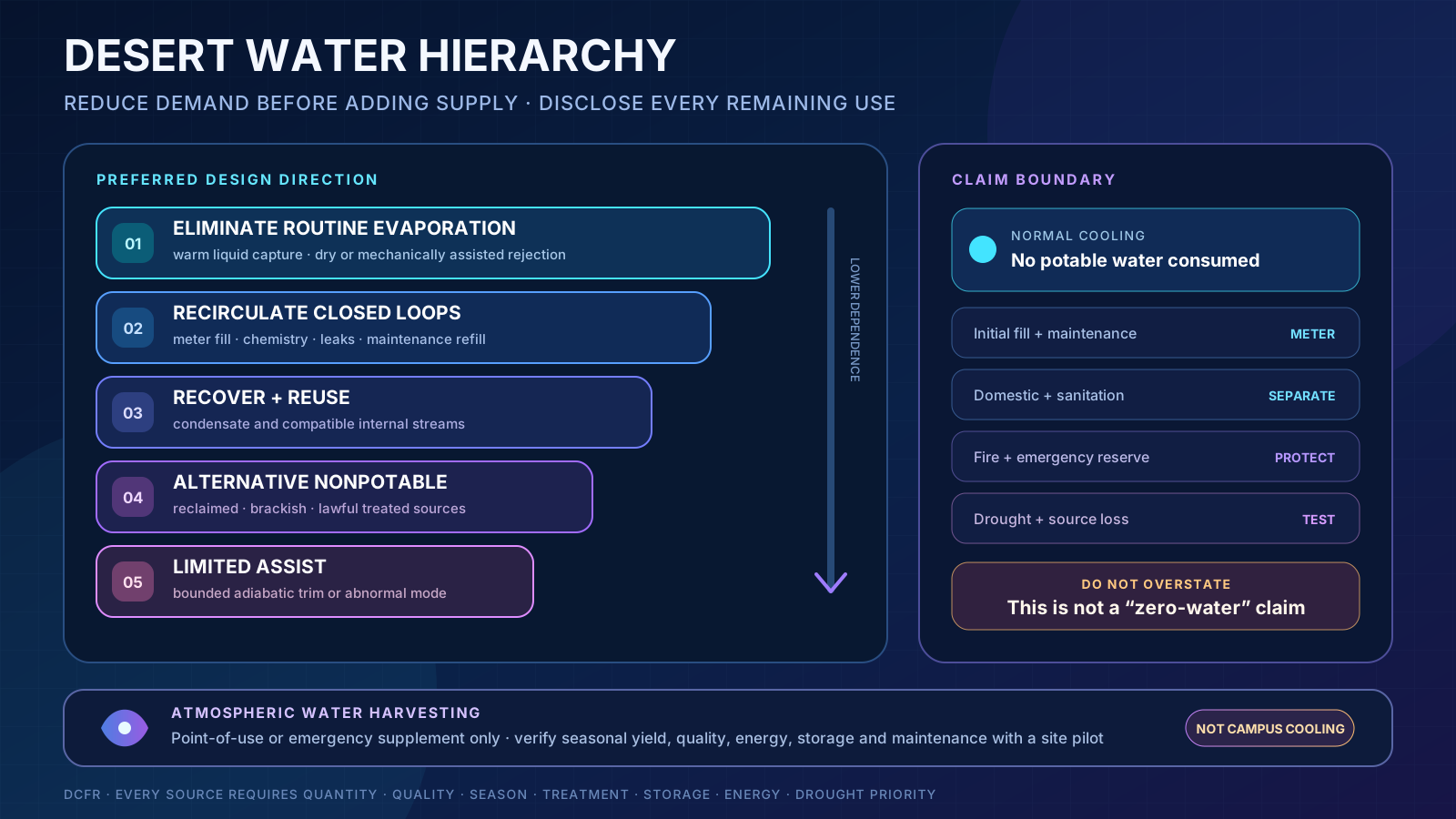
Apply the hierarchy in order: remove routine evaporation through architecture; recirculate closed information-technology and facility loops; recover condensate and other compatible streams; use reclaimed, treated municipal, brackish, or other lawful nonpotable sources where water remains; reserve potable supply for health, safety, and explicitly defined emergencies. DOE guidance treats direct liquid cooling and recirculating systems as water-efficiency opportunities and recommends evaluating alternative sources with their quality, treatment, infrastructure, energy, reliability, regulation, and cost. Establish separate balances for withdrawal, consumption, discharge, blowdown, initial fill, maintenance, domestic use, fire water, and abnormal operation. Microsoft's design estimate of more than 125 million liters of cooling water avoided per facility each year shows the potential scale, while the company also notes a nominal energy increase compared with evaporative cooling. Water and energy must therefore be optimized together, with drought triggers and source loss tested—not traded invisibly.
Treat atmospheric-water systems as point-of-use infrastructure
Solar atmospheric-water harvesting is real, but reported production remains highly dependent on humidity, temperature, irradiance, device design, regeneration cycle, and reporting boundary. A Nature Communications field demonstration in Saudi Arabia reported 2.0–3.0 liters per square meter per day during summer and 1.0–2.8 during fall; a separate outdoor experimental system reported 3.5–8.9 liters per square meter per day under its tested conditions. These are research results, not a guaranteed commercial yield. Even 10,000 square meters operating at 3 liters per square meter per day would produce an idealized 30 cubic meters per day before collection losses, treatment, storage, downtime, and seasonal variation. That can be valuable for drinking-water points, remote maintenance stations, or emergency reserves, but it is not a credible substitute for eliminating campus-scale evaporative cooling demand. Require a site pilot, water-quality treatment plan, sanitary storage, maintainability, energy balance, and independently measured seasonal yield before incorporating it into a resilience claim.
Design the site for heat, drought, dust, and flash flood together
Orient and shade buildings, reduce solar absorption, isolate hot yards from intakes, provide maintainable equipment spacing, and keep critical routes usable when surfaces are hot or dust-obscured. Treat rare rainfall as a high-consequence hydraulic event: preserve natural flow paths where possible, model debris and blocked inlets, grade away from critical rooms, provide exceedance routes, and place substations, generators, fuel, batteries, controls, network entries, and emergency access above the design flood. Separate clean stormwater from fuel, chemical, fire-water, and process contamination. Solar generation can reduce daytime grid exposure, but panels, inverters, batteries, and cleaning systems require temperature, dust, fire, water, and storm design of their own; midday energy does not assure a summer evening or islanded supply. Coordinate utilities, fuel, reclaimed-water delivery, waste, emergency response, worker heat safety, and community water expectations as one operating system.
Desert Water Hierarchy and Claim Boundary
| Priority | Permitted role | Evidence required | Claim limit |
|---|---|---|---|
| 1 — Eliminate | Avoid routine evaporation through warm liquid loops and dry or mechanically assisted rejection | Hourly mode model and peak-summer capacity test | Do not call predominantly dry operation dry-only |
| 2 — Recirculate | Closed IT and facility loops after initial fill | Balance, chemistry, leaks, maintenance refill and lifecycle plan | Closed loop is not zero water across the entire facility |
| 3 — Recover + reuse | Condensate and compatible internal sources | Quantity, quality, treatment, storage, season and permits | Potential recovery is not measured reuse |
| 4 — Alternative source | Reclaimed, municipal effluent, brackish or other lawful nonpotable water | Firm supply, drought priority, treatment, discharge, energy and cost | Nonpotable does not mean impact-free or unlimited |
| 5 — Limited assist | Short-duration adiabatic trim or abnormal cooling mode | Annual hours, consumption cap, source-loss response and alarms | Emergency use must be disclosed separately from normal cooling |
| Protected potable | Health, safety and defined emergency reserve | Separated meter, backflow protection, quality and governance | Claim no potable water for normal cooling—not zero-water data center |
| Atmospheric water | Point-of-use, remote station or emergency supplement | Site pilot, measured seasonal yield, quality, energy and storage | Experimental output is not a campus cooling-water strategy |
Commission at the summer edge—and preserve the evidence
Build an integrated test matrix for full representative heat load at design ambient, one heat-rejection train unavailable, dirty filters, loss of nonpotable assist, facility-water temperature excursion, CDU and pump failure, stuck valve, leak alarm, utility loss and generator transfer, battery and inverter operation, load cap or workload migration, and controlled return to normal. Verify temperatures, approaches, flows, pressures, fan and pump margins, electrical capacity, water consumption, air cleanliness, alarm chronology, manual controls, safe access, and recovery time. Where outdoor conditions cannot be guaranteed during acceptance, use validated simulation and temporary load, then require a witnessed seasonal test before final performance release. Trend actual peak-summer operation, filter loading, water balance, equipment derating, degraded modes, and near misses. Retest after firmware, controls, cooling chemistry, rack type, density, envelope, or heat-rejection changes. A desert design is complete only when its hottest, dustiest, driest credible state is operable, maintainable, and recoverable.
Early screening checklist
What to verify before advancing this site.
- 122°F is defined as outdoor ambient; server air, rack coolant, facility water, and equipment ambient have separate limits
- The climate basis covers hourly heat, wet bulb, solar, wind, dust, flood, climate adjustment, maintenance, and coincident utility stress
- Rack, CDU, facility loop, heat rejection, residual air, chemistry, leaks, drains, and controls are designed as one thermal chain
- Heat-rejection approach and capacity are proven at 50°C with fouling, recirculation, altitude, and one train unavailable
- Transformers, breakers, UPS, batteries, generators, cables, controls, and network assets use exact installed-condition derating curves
- Dust particle data, pressure zoning, staged filtration, dirty-filter duty, sealing, access, and cleaning are commissioned
- Routine evaporation is removed before reclaimed, nonpotable, adiabatic, potable, or atmospheric-water sources are considered
- Withdrawal, consumption, discharge, fill, domestic, fire, maintenance, and emergency water are separately metered and disclosed
- Atmospheric-water equipment has a site pilot, measured seasonal yield, treatment, storage, energy, and point-of-use purpose
- Solar gain, flash flood, debris, contamination, emergency access, worker heat, fuel, and community water impacts are integrated
- Peak-summer testing includes full heat load, degraded cooling, dirty filters, source loss, utility loss, workload response, and recovery
- Public claims distinguish no potable water for normal cooling from zero water, water positive, annual matching, and emergency operation
What DCFR would flag
Risks surfaced at the screening stage.
DCFR would flag any desert data-center claim that treats 122°F outdoor ambient as an acceptable server inlet, assumes a 45°C loop can reject heat passively to 50°C air, carries nameplate equipment capacity through extreme heat without derating, uses an IP rating as proof against wind-driven sand, or calls a facility zero-water because normal cooling avoids potable consumption.
Professional confirmation required
Items requiring licensed validation.
Confirm environmental classes, rack and coolant limits, heat-rejection approach, manufacturer derating, water rights and quality, discharge, drought priority, atmospheric-water treatment, flood criteria, dust loading, fire and life safety, battery and fuel requirements, grid and solar operating modes, worker heat protection, commissioning hazards, public claims, and permit conditions with the owner, operator, IT vendors, utility, water and wastewater authorities, qualified mechanical, electrical, civil, fire, controls and environmental engineers, equipment manufacturers, commissioning authority, emergency responders, counsel, insurer, and authority having jurisdiction.
Final takeaway
A data center can operate when the outdoor air reaches 122°F without consuming potable water for normal cooling—but only if every thermal degree, liter, particle, derated ampere, failure mode, and public claim is engineered at the correct boundary and proven at the summer edge.
Screen up to 20 candidate sites before selecting one for the full DCFR report.
Each DCFR Report Package includes a preliminary 20-site comparison PDF / export package plus one selected planning-grade feasibility report.