
DCFR Insight 14 / Construction Technology
Robotics and Prefabrication in Data Center Construction
Robotic layout, automated drilling, digital reality capture, electrical modules, mechanical skids, multi-trade racks, panelized systems, and factory-tested infrastructure can materially change data center delivery—but only when design maturity, repetition, logistics, tolerances, procurement, and commissioning are planned around them.
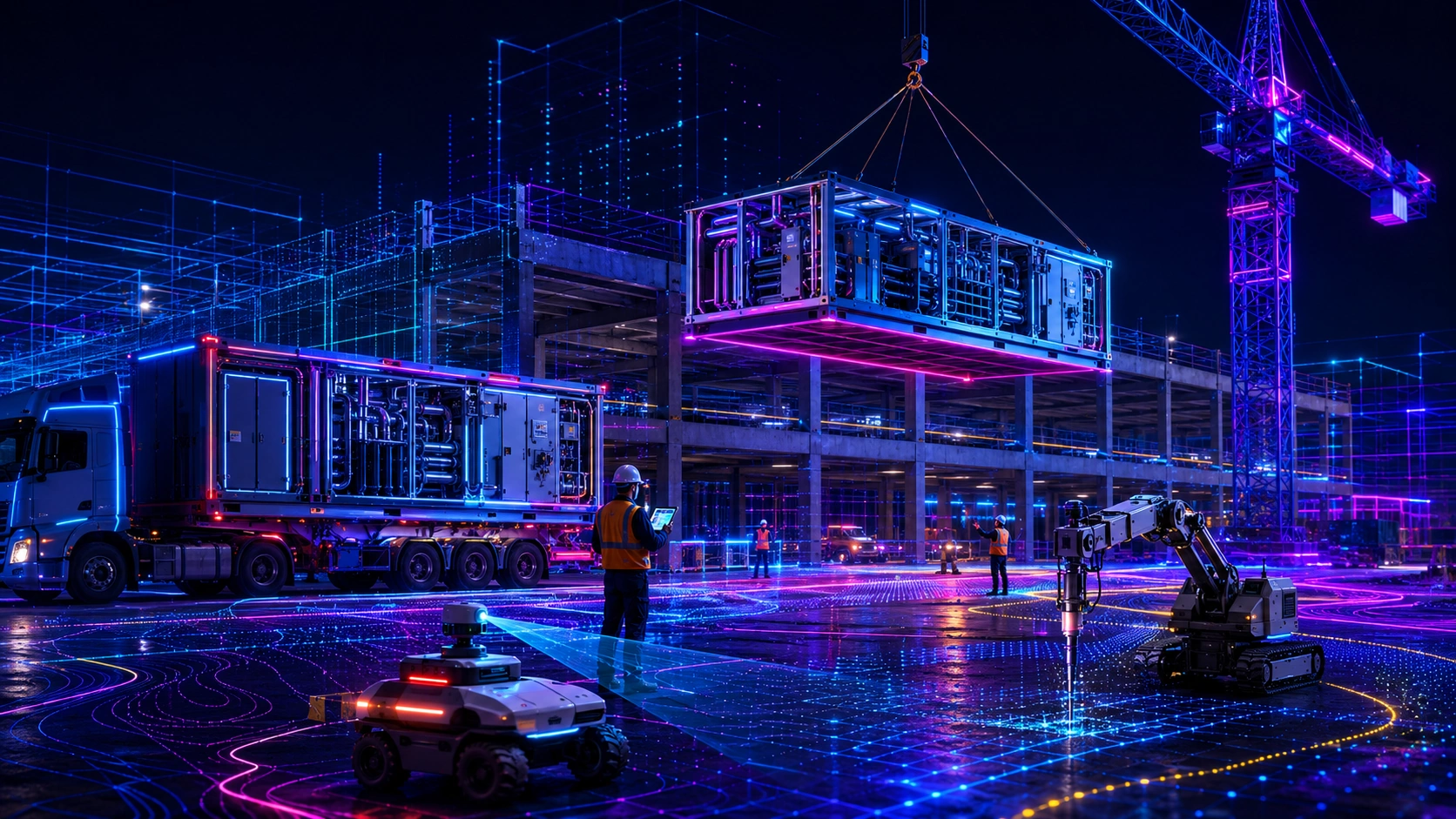
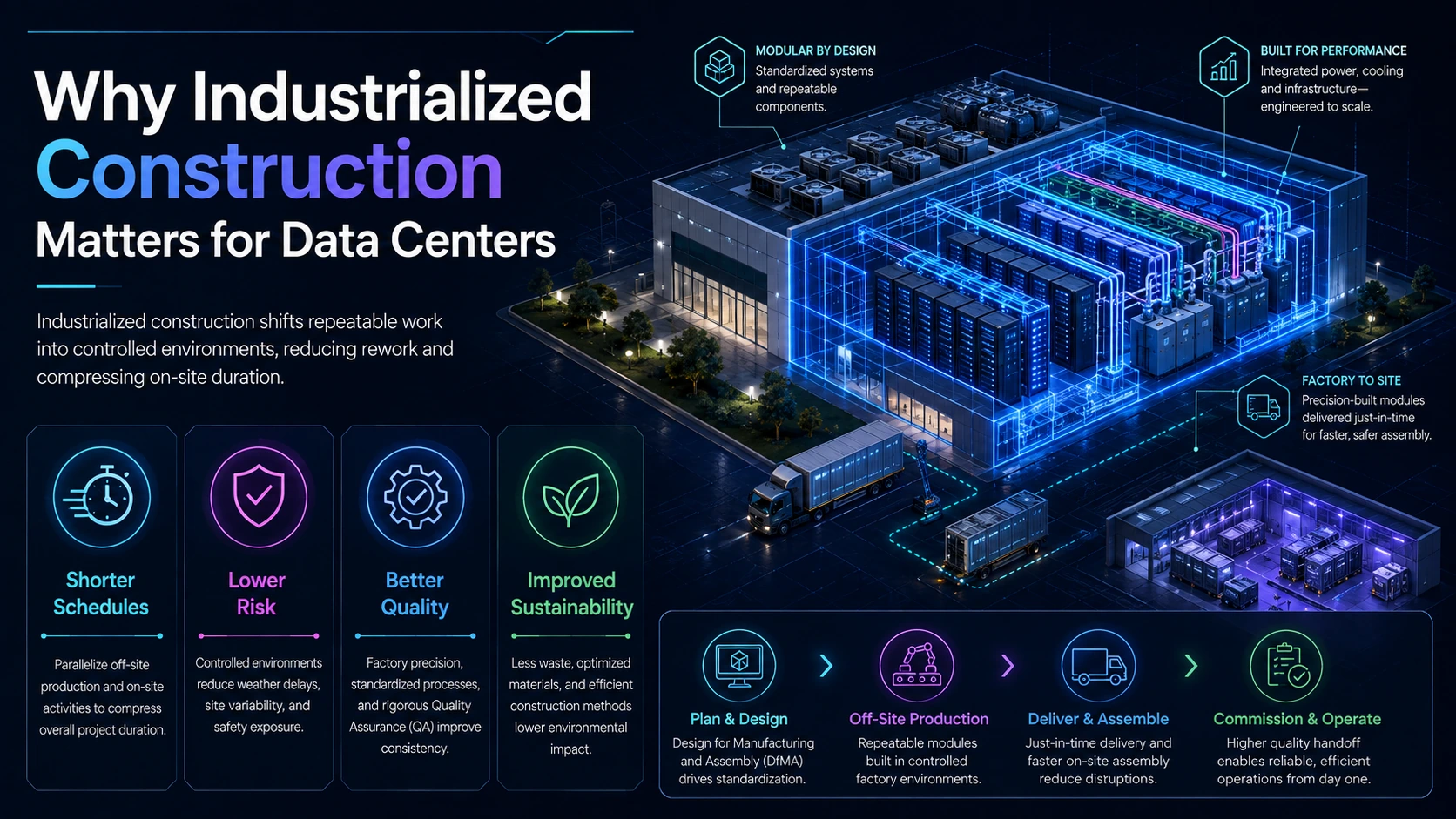
Why Industrialized Construction Matters
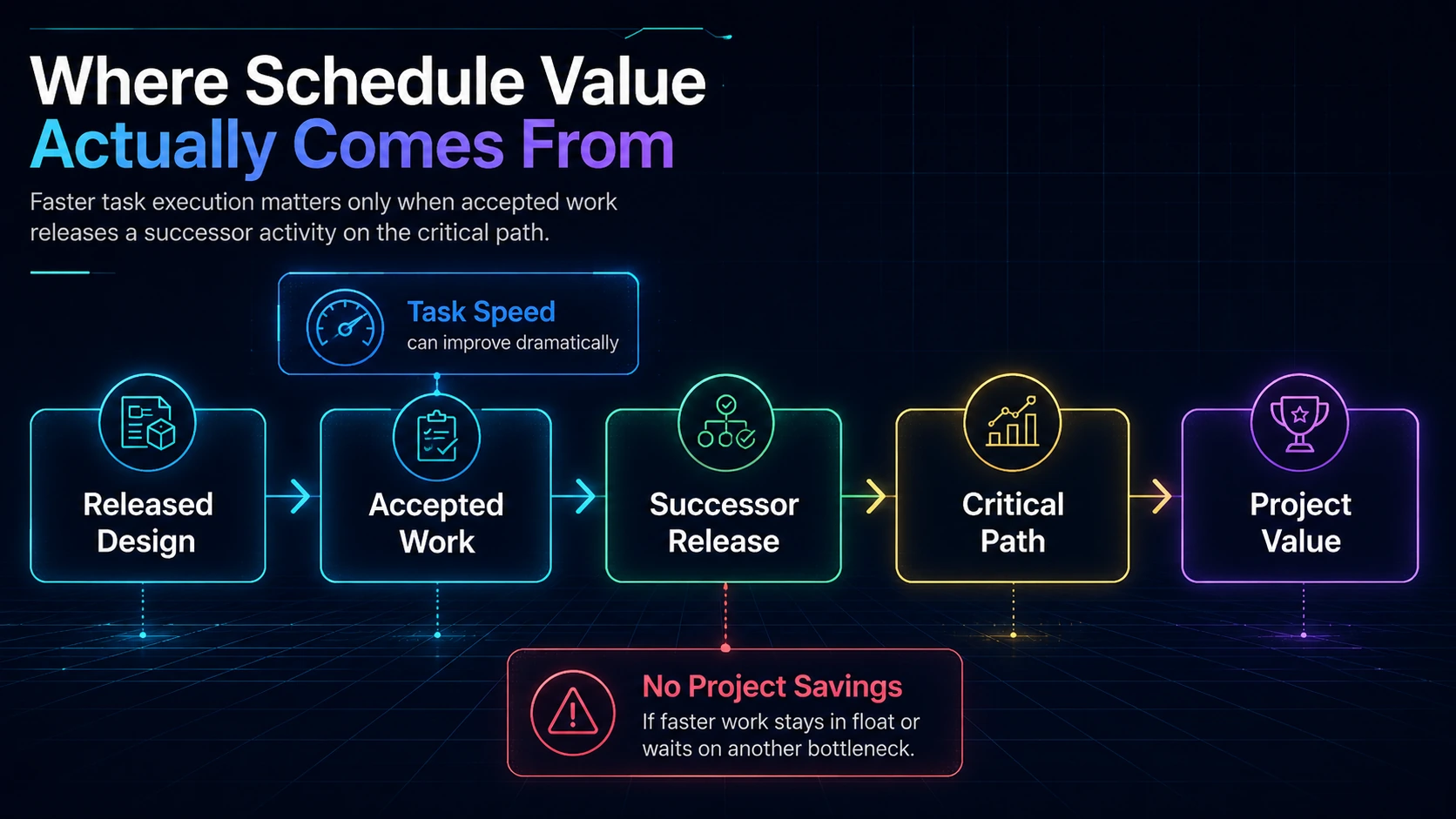
Industrialized construction is not principally about replacing craft workers with humanoid robots. Its practical purpose is to move repeatable work into controlled production systems and give field teams better information, safer workfaces, and assemblies that arrive ready to connect and test. Practical applications available now include controlled off-site fabrication, digital layout, machine-assisted drilling, machine-controlled civil work, factory fabrication automation, modular electrical and mechanical systems, multi-trade prefabrication, automated reality capture, scan-to-model quality verification, and standardized repeatable interfaces. Data centers suit these methods because halls, support grids, power trains, cooling trains, and campus buildings repeat—but only if the developer preserves that repetition through design and procurement. A machine completing a task faster does not automatically shorten the project. Project value exists only when the complete workflow reduces critical-path duration, field labor, rework, safety exposure, site congestion, commissioning uncertainty, or portfolio variability. The owner should therefore distinguish task productivity from project schedule impact from the first business-case review.
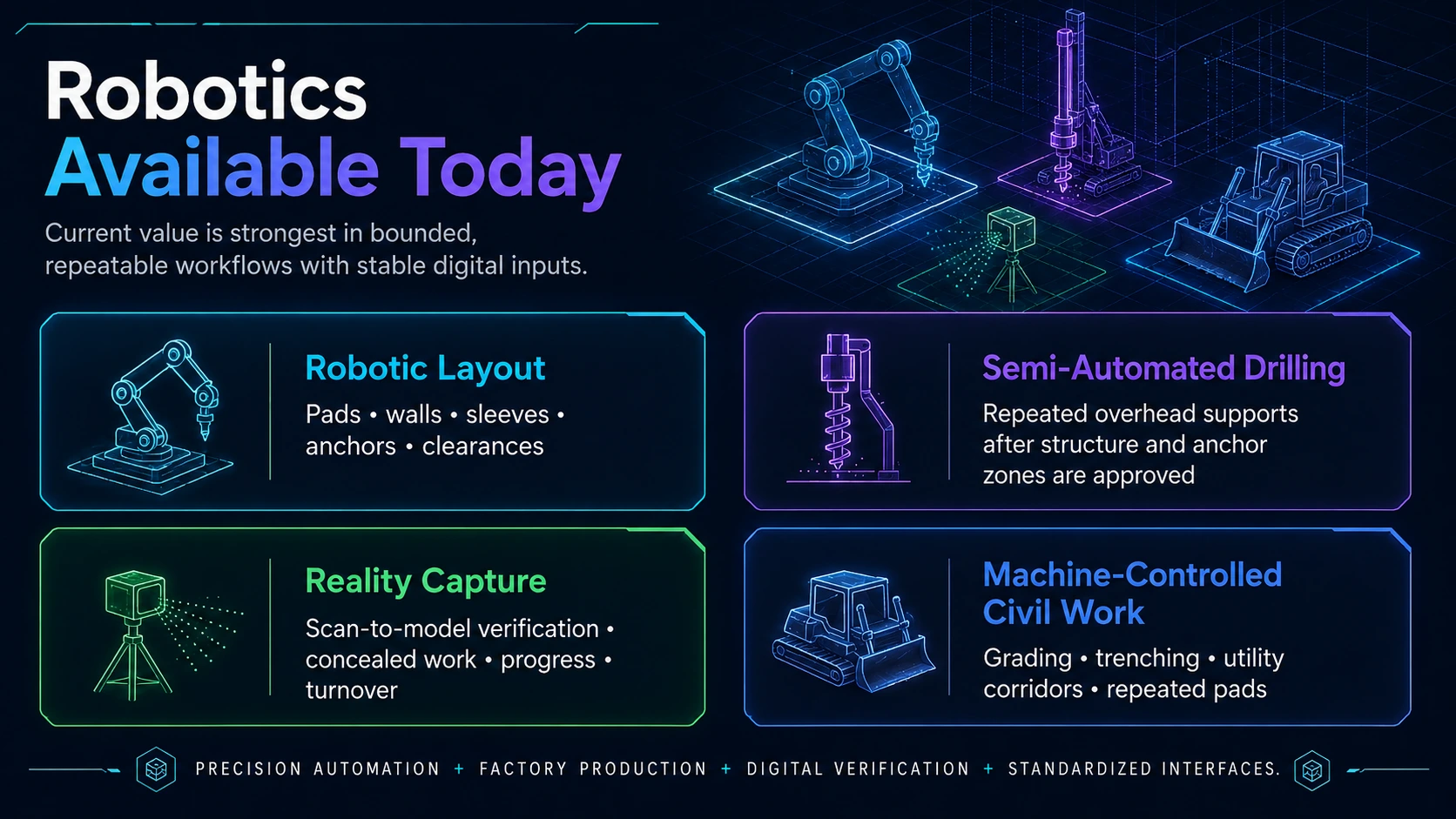
Robotics Available Today
Robotic layout includes Dusty Robotics FieldPrinter, HP SitePrint, robotic total stations, and model-to-field workflows for equipment pads, partitions, rated walls, sleeves, penetrations, anchors, mechanical, electrical, and plumbing support points, equipment clearances, and service zones. Automated drilling includes Hilti Jaibot-type Building Information Modeling-driven workflows for repeated cable-tray, busway, piping, ductwork, lighting, and seismic-bracing supports. Reality capture includes laser scanning, autonomous or semi-autonomous mobile capture, drones, photogrammetry, and model-to-field comparison. Factory automation includes computer numerical control cutting, robotic welding, automated pipe and steel fabrication, panel manufacturing, cable assembly, and module production. Civil automation includes machine-controlled grading, excavation, trenching, repeat utility corridors, and selected semi-autonomous equipment workflows. These are bounded tools with defined inputs and operating conditions. General-purpose humanoid robot construction is not the primary current data-center productivity strategy and should not be represented as one.
Technologies Available Now — and Where They Fit
Maturity is use-case-specific. High maturity means commercially available and repeatedly deployed for a bounded scope—not that every vendor, site, or configuration will perform equally. Pilot / project-specific technologies require validation under the actual design, labor, safety, and workface conditions. The table below is a selection framework, not a promise of readiness.
Robotic Layout + Survey
Robotic layout should start from one released coordination set and a total-station control network tied to the site coordinate system. Dusty Robotics FieldPrinter and HP SitePrint are current model-to-field tools; robotic total stations remain essential for control and verification. In repeated bays they can mark equipment pads, partitions, rated walls, sleeves, penetrations, anchors, support points, clearances, service zones, and underground references. The surveyor defines control density and check frequency; Architects and Engineers of Record approve relevant tolerances; trades confirm whether each mark denotes a line, center, face, elevation, or clearance. Start and end checks against known points must stop work if drift exceeds the agreed threshold. Common failures include an incorrect origin or transformation, obsolete files, conflicting trade models, poor slab condition, obstructions, and premature release. Measure digital preparation, setup, calibration, relocation, obstruction handling, independent checks, corrections, and accepted downstream installation—not printed points per hour alone.
Robotics + Industrialized Construction Technologies Available Now
| Technology | Data-center application | Current maturity | Primary value | Main dependency |
|---|---|---|---|---|
| Robotic layout | Pads, walls, sleeves, anchors, supports, clearances | HIGH | Consistent model-to-field transfer | Released files, survey control, clear floor |
| Robotic overhead drilling | Repeated overhead supports and bracing | MEDIUM-HIGH | Production consistency and reduced overhead exposure | Approved structure, anchor zones, open workface |
| Drone capture | Roof, civil, façade, logistics, and progress records | MEDIUM-HIGH | Rapid repeat coverage | Flight rules, access, registration, review owner |
| Laser scanning / reality capture | Dimensional QA, progress, concealed work, turnover | HIGH | Objective model-to-field evidence | Defined tolerance and closure workflow |
| Machine-controlled civil equipment | Grading, excavation, trenching, utility corridors | HIGH | Repeat grade and excavation control | Stable civil model, survey, utilities, separation |
| Factory computer numerical control fabrication | Steel, pipe, panels, supports, module parts | HIGH | Repeatable precision and factory throughput | Fabrication-ready data and design freeze |
| Robotic welding | Frames, structural assemblies, pipe where qualified | HIGH | Repeatable controlled fabrication | Qualified procedures, inspection, repetition |
| Rebar fabrication / tying automation | Cages, mats, repeated foundations | MEDIUM | Reduced repetitive labor | Stable design, geometry, access, supplier capability |
| Electrical skids / E-houses | Power trains, switchgear, uninterruptible power supplies, batteries, controls | HIGH | Parallel work, factory test, fewer site interfaces | Early equipment and connection freeze |
| Mechanical skids | Pumps, coolant distribution units, treatment, hydronic packages | HIGH | Controlled assembly and package testing | Stable loads, connections, transport |
| Multi-trade racks | Pipe, conduit, tray, selected duct and supports | MEDIUM-HIGH | Reduced trade stacking and congestion | Early coordinated model and tolerance zones |
| Prefabricated piping spools | Hydronic, fuel, and process distribution | HIGH | Less field welding and controlled QA | Final routing, weld maps, closure strategy |
| Panelized envelope | Repeated walls, roofs, and screened enclosures | HIGH | Faster dry-in and controlled finishes | Structure, openings, seals, logistics |
| Precast utility structures | Vaults, trenches, pads, and utility rooms | HIGH | Less formwork and weather exposure | Weight, embeds, bearing, delivery access |
| Volumetric support pods | Office, toilet, security, and service spaces | MEDIUM-HIGH | Parallel fit-out and rapid set | Ratings, dimensions, lifting, connections |
| Prefabricated white-space / information technology modules | Integrated rack, containment, power, cooling | PILOT / PROJECT-SPECIFIC | Repeat deployment and integrated testing | Early vendor lock, capacity basis, code, commissioning |
Robotic / Automated Drilling
Hilti Jaibot-type Building Information Modeling-driven drilling fits repeated overhead anchors for cable tray, busway, piping, ductwork, lighting, and seismic bracing when support geometry and structure are stable. Before release, the structural engineer and trades must resolve anchor type, loads, approved and prohibited zones, reinforcement conflicts, post-tensioning, embeds, edges, and drilling depth. A test bay should prove positional and depth accuracy, dust collection, inspection, exclusion zones, and recovery. Field relocation requires approval, a recorded deviation, patching of abandoned holes, and specified repair; operators should not improvise. Measure full setup, moves, accepted holes, downstream support installation, repair, downtime, crew exposure, and schedule logic. Faster holes create rework rather than value if the support design changes afterward.
Campus-Scale Civil Automation
Open workfaces and repeated infrastructure can make machine control more valuable at campus scale than interior robotics. Screen mass grading, cut and fill, excavation, trenching, duct banks, pile grids, foundations, stormwater, roads, yards, fencing, and utility corridors. Deployment requires reliable topography and subsurface information, mapped utilities, stable civil design, weather and slope limits, haul plans, geofenced separation from people and trucks, equipment recovery, human supervision, and independent survey hold points before excavation or backfill. Compare moved quantity with the entire cycle: survey, idle time, rehandling, dewatering, spoil disposal, inspections, and release of building-enabling milestones. Large volume does not justify automation when permits, utilities, groundwater, traffic, or design change govern progress.
Factory Automation + Prefabrication
Factories use computer numerical control cutting, automated pipe fabrication, robotic welding, automated steel fabrication, panel lines, cable assembly, and repeatable module production. This can shift electrical skids, modular power rooms, cooling modules, pump packages, pipe racks, utility modules, panels, platforms, supports, and service corridors away from congested field conditions. Modularization does not eliminate coordination; it moves it earlier. Require Design for Manufacturing and Assembly, frozen connection points, shipping envelope and route survey, lifting points and center of gravity, temporary bracing, tolerance analysis, Factory Acceptance Testing, preservation, storage, weather protection, field connections, and commissioning requirements. Digitally verify both factory output and receiving foundations or openings before shipment. The business case must include engineering, factory and site labor, transport, cranes, laydown, protection, connection, testing, and repeat orders.
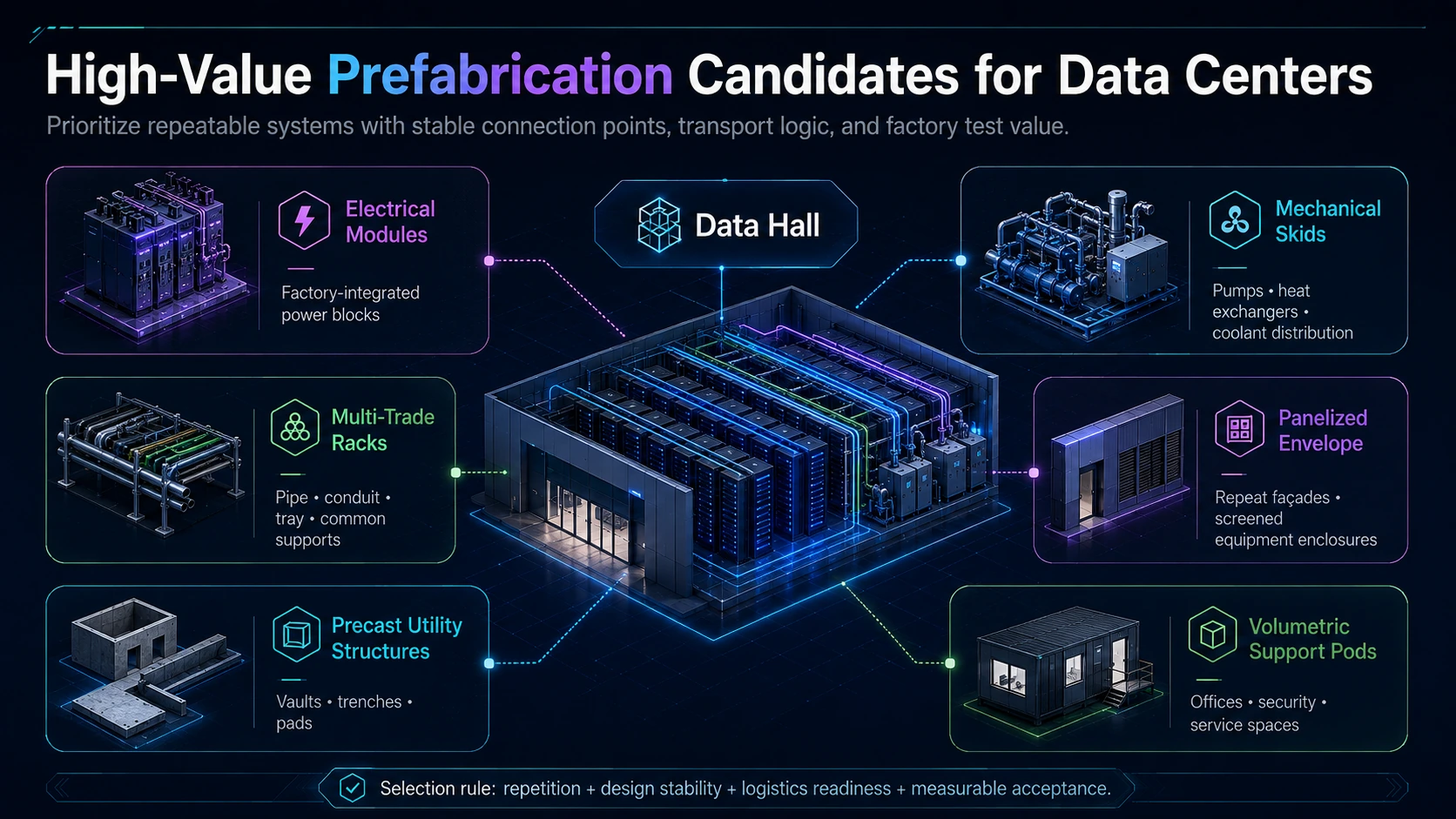
High-Value Prefabrication Candidates for Data Centers
The following systems are candidates for project-specific evaluation. Their value depends on measured conditions; this is not a claim of universal or highest financial return.
A. Electrical skids / E-houses
Medium- and low-voltage switchgear, uninterruptible power supply equipment, batteries, controls, module cooling, and complete power modules can create value where dense coordination and repetitive topology support factory assembly and testing. Fewer site interfaces, parallel factory and site execution, controlled placement, and controlled turnover are the opportunity; released one-lines, equipment selections, fault duties, protection, ventilation, code access, transport, and connection details are prerequisites.
B. Mechanical skids
Pumps, heat exchangers, coolant distribution units, water treatment, hydronic distribution, valves, instrumentation, and controls benefit from controlled welding, flushing, pressure testing, and repeatable connections.
C. Multi-trade racks
Piping, conduit, cable tray, selected duct, and common supports can reduce trade stacking, ceiling congestion, field welding, individual hangers, and rework, but demand early federated coordination and tolerance zones.
D. Prefabricated piping spools
Work where routing, weld maps, materials, cleaning, testing, and field closure pieces are controlled.
E. Panelized envelope systems
Accelerate repeat façades when structure, openings, fire performance, drainage, and seals are coordinated.
F. Precast utility structures and equipment pads
Reduce formwork and weather exposure when weights, bearing, embeds, and utility entries are stable.
G. Volumetric support spaces
Can package offices, toilets, security, and service rooms, subject to transport, lifting, ratings, accessibility, and final connections.
H. High-density prefabricated information technology / white-space modules
Can integrate racks, containment, busway, cooling, controls, and monitoring, but require the earliest capacity, vendor, code, and commissioning decisions.
Project teams should compare each candidate with a conventional baseline. Repetition, standardized interfaces, early design freeze, predictable logistics, and reuse across later buildings can improve the case, but financial value must be measured for the project.
Autonomous Reality Capture + Digital QA
Laser scanning, drones, photogrammetry, and autonomous or semi-autonomous mobile capture can support installed-versus-model comparison, progress, concealed-condition records, clearances, pads, penetrations, firestop records, module readiness, commissioning, and turnover. Define routes, frequency, resolution, names, coordinate registration, access, retention, and the tolerance that creates an issue. Assign every valid finding to a design or construction owner with a due date and closure evidence. Data collection is not Quality Assurance and Quality Control unless it drives accountable action. Track capture-to-review time, valid and false findings, closure time, rework avoided, successor work released, and records reused—not terabytes collected.
Architectural + Life-Safety Controls
Architectural control is essential where automation affects rated-wall layout, egress paths, doors, penetrations, firestop documentation, equipment clearances, replacement routes, façade tolerances, louvers, roof curbs, weather barriers, accessible clearances, and fire-barrier continuity. Released trade models must preserve design intent and identify where tolerance can compromise a rating, drainage plane, or service route. Digital records can connect a penetration, listed system, installer, photograph, and location, and dimensional checks can flag a panel or module before enclosure. They do not replace Architect or Engineer of Record judgment, special inspection, qualified installation, listed-system selection, or Authority Having Jurisdiction acceptance. Contracts and inspection plans must name exception reviewers and acceptance authority; a machine-generated pass cannot override approved documents.
Where Schedule Value Actually Comes From
Activity-level speed does not equal project-level schedule savings. A layout robot can complete its bounded activity faster without changing substantial completion when design is late, equipment is unavailable, downstream trades are not ready, commissioning remains critical, or the activity carries float. Schedule value exists only when accepted work releases successor work that affects the critical path. Evaluate the complete workflow—including setup, procurement, logistics, inspections, connections, testing, rework, and commissioning—against the integrated project schedule.
Cost Comparison: Conventional vs Prefab / Robotic
Package purchase cost and total installed cost answer different questions. Prefabrication can add engineering, detailing, factory fabrication, transport, cranes, module protection, and early procurement while reducing field labor, field welding, rework, congestion, temporary works, general conditions, weather exposure, commissioning defects, and schedule risk. The commercial decision is TOTAL INSTALLED COST + SCHEDULE VALUE + RISK—not factory purchase price alone. The qualitative comparisons below are evaluation prompts, not bids, guarantees, quantified savings, or universal benchmarks; validate them against local labor, tax, logistics, escalation, vendor capacity, and schedule logic.
| Delivery Strategy | Direct Package Cost | Field Labor Cost | Site Overhead / General Conditions | Rework Risk | Schedule Benefit | Likely Total Installed Cost |
|---|---|---|---|---|---|---|
| Conventional — Baseline | Baseline | Baseline | Baseline | Baseline | Baseline | Baseline |
| Light Prefabrication | Project-specific; may add factory scope | Potentially lower; measure complete workflow | Potentially lower if site duration changes | Lower | Mild | Measure against the conventional baseline |
| Moderate Prefabrication + Digital Layout | Project-specific; includes digital preparation | Potentially lower; measure accepted output | Potentially lower if critical work is released | Lower | Moderate | Measure against the conventional baseline |
| High-Repeatability Prefabrication Program | Project-specific; includes program setup | Potentially lower with repeatable scope | Potentially lower if site duration changes | Much Lower | Strong | Measure across representative buildings |
Conventional — Baseline
- Direct Package Cost
- Baseline
- Field Labor Cost
- Baseline
- Site Overhead / General Conditions
- Baseline
- Rework Risk
- Baseline
- Schedule Benefit
- Baseline
- Likely Total Installed Cost
- Baseline
Light Prefabrication
- Direct Package Cost
- Project-specific; may add factory scope
- Field Labor Cost
- Potentially lower; measure complete workflow
- Site Overhead / General Conditions
- Potentially lower if site duration changes
- Rework Risk
- Lower
- Schedule Benefit
- Mild
- Likely Total Installed Cost
- Measure against the conventional baseline
Moderate Prefabrication + Digital Layout
- Direct Package Cost
- Project-specific; includes digital preparation
- Field Labor Cost
- Potentially lower; measure accepted output
- Site Overhead / General Conditions
- Potentially lower if critical work is released
- Rework Risk
- Lower
- Schedule Benefit
- Moderate
- Likely Total Installed Cost
- Measure against the conventional baseline
High-Repeatability Prefabrication Program
- Direct Package Cost
- Project-specific; includes program setup
- Field Labor Cost
- Potentially lower with repeatable scope
- Site Overhead / General Conditions
- Potentially lower if site duration changes
- Rework Risk
- Much Lower
- Schedule Benefit
- Strong
- Likely Total Installed Cost
- Measure across representative buildings
Prefabrication is not automatically cheaper to purchase. Its economic advantage comes from total installed cost, schedule compression, repeatability, reduced field labor, and lower execution risk.
The comparisons are evaluation prompts, not quantified savings or universal benchmarks. Measure project results against the conventional baseline; actual results depend on repetition, labor rates, fabrication volume, logistics distance, crane requirements, module dimensions, vendor capacity, procurement timing, and the percentage of design frozen before fabrication.
Sustainable Materials That Work Well with Prefab
PREFAB ≠ AUTOMATICALLY LOW CARBON. A prefabricated solution earns sustainability value only when it measurably improves material quantity, embodied carbon, construction waste, rework, transportation impact, service life, replacement, reuse, disassembly, or total lifecycle performance. Compare the conventional and proposed assemblies on the same scope, service life, structural and fire criteria, factory yield, transport distance, replacement strategy, and end-of-life boundary. Product- and mix-specific data should replace generic assumptions as procurement advances.
Sustainable Materials That Work Well with Prefabrication
| System | Material strategy | Prefab compatibility | Availability | What should be specified / measured |
|---|---|---|---|---|
| Structural / skid frames | Electric Arc Furnace (EAF) steel; high recycled content; optimized tonnage; bolted demountable connections | VERY HIGH | HIGH in many United States markets | Product-specific Environmental Product Declaration (EPD); kilograms of carbon dioxide equivalent per ton (kgCO2e / ton); structural tonnage; mill / fabricator source |
| Precast concrete / equipment pads | Reduced-clinker concrete; Supplementary Cementitious Materials (SCMs); optimized mix | HIGH | MEDIUM-HIGH, regional | Mix-specific Global Warming Potential (GWP); volume; strength; curing; schedule impact |
| Rebar | Recycled-content steel; prefabricated cages | HIGH | HIGH | Product-specific Environmental Product Declaration (EPD); kilograms of carbon dioxide equivalent per ton (kgCO2e / ton); tonnage; source; waste |
| Envelope panels | Insulated metal panels; mineral-wool systems; suitable lower-carbon insulation; replaceable panels | VERY HIGH | HIGH | Kilograms of carbon dioxide equivalent per square foot (kgCO2e / ft²) of assembly; thermal, fire, and moisture performance; service life; replaceability |
| Mechanical skids | Optimized frames; reduced pipe length; replaceable equipment; bolted connections | VERY HIGH | HIGH | Frame and pipe quantity; product carbon; leakage; service access; replacement path |
| Multi-trade racks | Optimized common supports; fewer duplicate hangers; recycled-content steel | VERY HIGH | MEDIUM-HIGH | Steel tonnage; duplicated supports avoided; waste; transport; adaptability |
| Electrical modules | Optimized enclosure steel; durable replaceable equipment; design for disassembly | VERY HIGH | HIGH | Material quantities; product declarations; efficiency; service life; replacement and recovery |
| Cable / support systems | Reusable cable trays; bolted supports; standardized components | VERY HIGH | HIGH | Material quantity; recycled content; reuse; connection type; future capacity |
Where Robotics + Prefabrication Can Fail
Industrialized delivery amplifies unresolved decisions. Its failure modes should be explicit in the risk register and assigned before release.
LATE DESIGN FREEZE
Factory fabrication begins before interfaces are stable. Control: staged release gates, configuration ownership, and a priced change protocol.
POOR COORDINATION
Modules arrive accurately built—but coordinated to obsolete geometry. Control: federated-model sign-off, revision lock, and pre-shipment field verification.
TIGHT TOLERANCES WITHOUT A QA PLAN
Factory and field tolerances accumulate and modules no longer fit. Control: tolerance stack analysis, survey checkpoints, trial assemblies, adjustable connections, and closure pieces.
LOGISTICS + CRANE ACCESS NOT PLANNED
Shipping envelope, turning radius, staging, laydown, pick radius, or structural lifting conditions block installation. Control: route survey, lift plan, delivery sequence, weather limits, and approved temporary conditions.
LOW REPETITION
Engineering and factory setup costs are spread over too few modules. Control: quantify repeat count and reuse before committing to tooling or bespoke modules.
PROCUREMENT DELAY
Long-lead systems are engaged after the schedule benefit has been lost. Control: release design-assist, capacity reservation, and critical equipment at decision gates tied to the master schedule.
SCOPE CHANGES MIDSTREAM
Late owner or equipment changes create costly factory rework. Control: configuration freeze, substitution rules, and transparent cost and schedule ownership.
FACTORY / SITE INTERFACE GAP
No clear responsibility exists for shipping damage, site readiness, field connections, weather protection, commissioning, or warranty. Control: one interface matrix with inspection, handoff, preservation, testing, and acceptance owners.
Recommended Robotics Deployment Roadmap by Phase
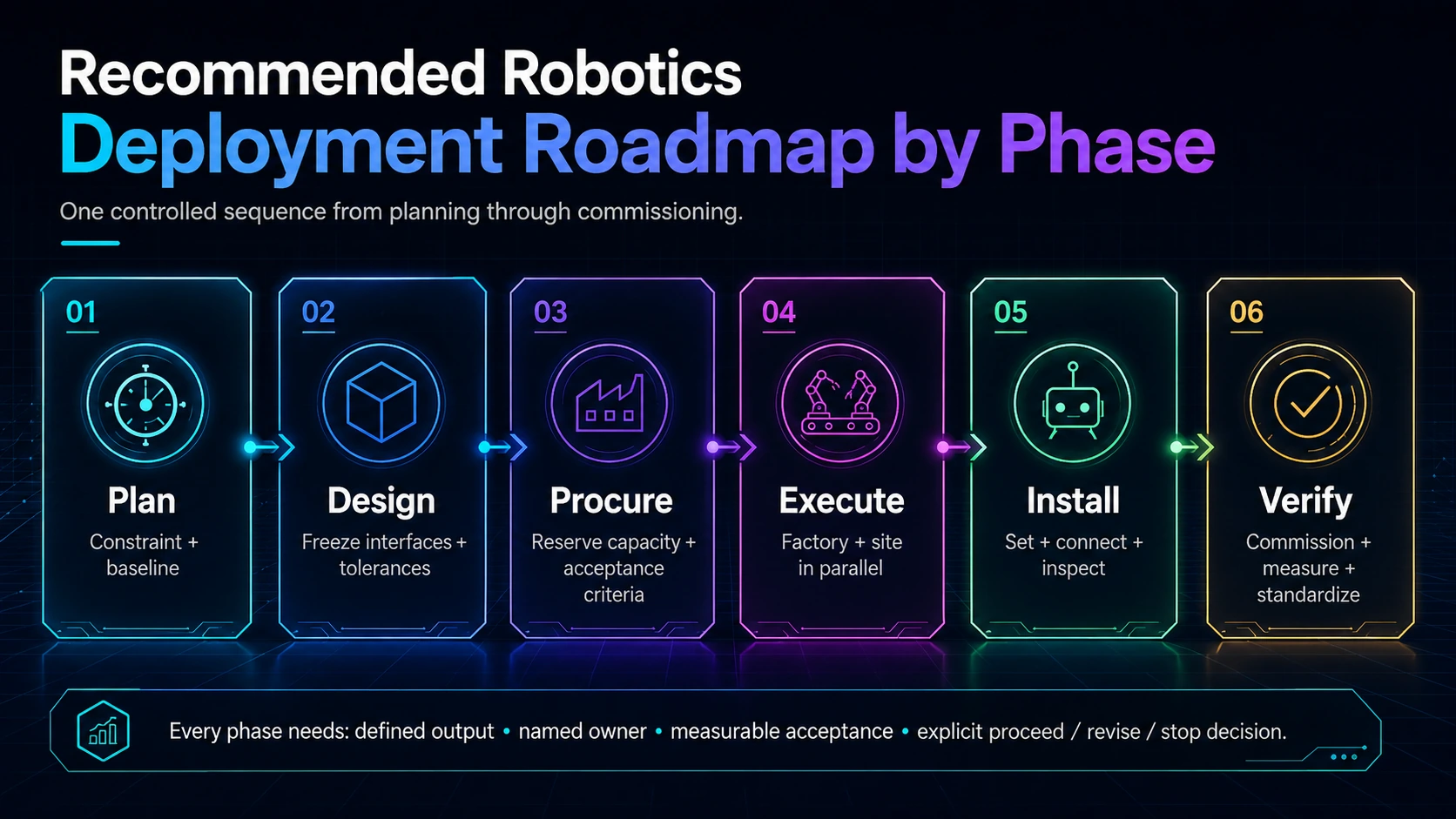
Use one six-phase framework. Every phase begins with a bounded scope and ends with a required output, accountable ownership, and a decision gate.
Phase 1 — Plan
Identify the production constraint, quantify repetition, establish the conventional baseline, and select bounded candidate workflows. Required output: Industrialization opportunity register + conventional baseline. Primary owner: Developer / Delivery Lead. Decision gate: Proceed only where the workflow can create measurable project-level or repeatable portfolio value.
Phase 2 — Design
Apply Design for Manufacturing and Assembly, freeze connection points, coordinate tolerance stacks, establish authoritative coordinates, and resolve transport, lifting, access, replacement, testing, and commissioning. Required output: Fabrication-ready coordinated design package. Primary owner: Design Lead + Trade / Fabrication Partners. Decision gate: Do not automate unresolved design.
Phase 3 — Procure
Engage robotics and prefabrication partners early, reserve manufacturing capacity, lock long-lead equipment, allocate interface responsibility, and define Factory Acceptance Testing, preservation, warranty, data, and acceptance requirements. Required output: Procurement + manufacturing release package. Primary owner: Procurement Lead + Construction Manager. Decision gate: Release only when commercial responsibility and interface ownership are explicit.
Phase 4 — Execute
Run factory fabrication and site enabling work in parallel under synchronized releases. Track factory production, foundations, utilities, logistics readiness, receiving conditions, and quality evidence against one integrated schedule. Required output: Verified factory readiness + verified site readiness. Primary owner: Construction Manager + Fabrication Lead. Decision gate: Do not ship to an unverified receiving condition.
Phase 5 — Install
Deliver assemblies in installation order. Inspect, lift, set, connect, protect, survey, and verify interfaces using predetermined hold points and recovery plans. Required output: Installed and interface-verified assemblies. Primary owner: General Contractor + Installation Trades. Decision gate: Release successor work only after geometry, connections, protection, and required inspections are accepted.
Phase 6 — Verify
Complete Quality Assurance and Quality Control, Site Acceptance Testing, commissioning, turnover, and lessons learned. Compare accepted results against the conventional baseline before approving reuse. Required output: Accepted system + measured performance record. Primary owner: Commissioning Lead + Owner. Decision gate: Standardize only methods that demonstrate repeatable value under representative project conditions.
Example — 40 MW Data Center Robotics Pilot
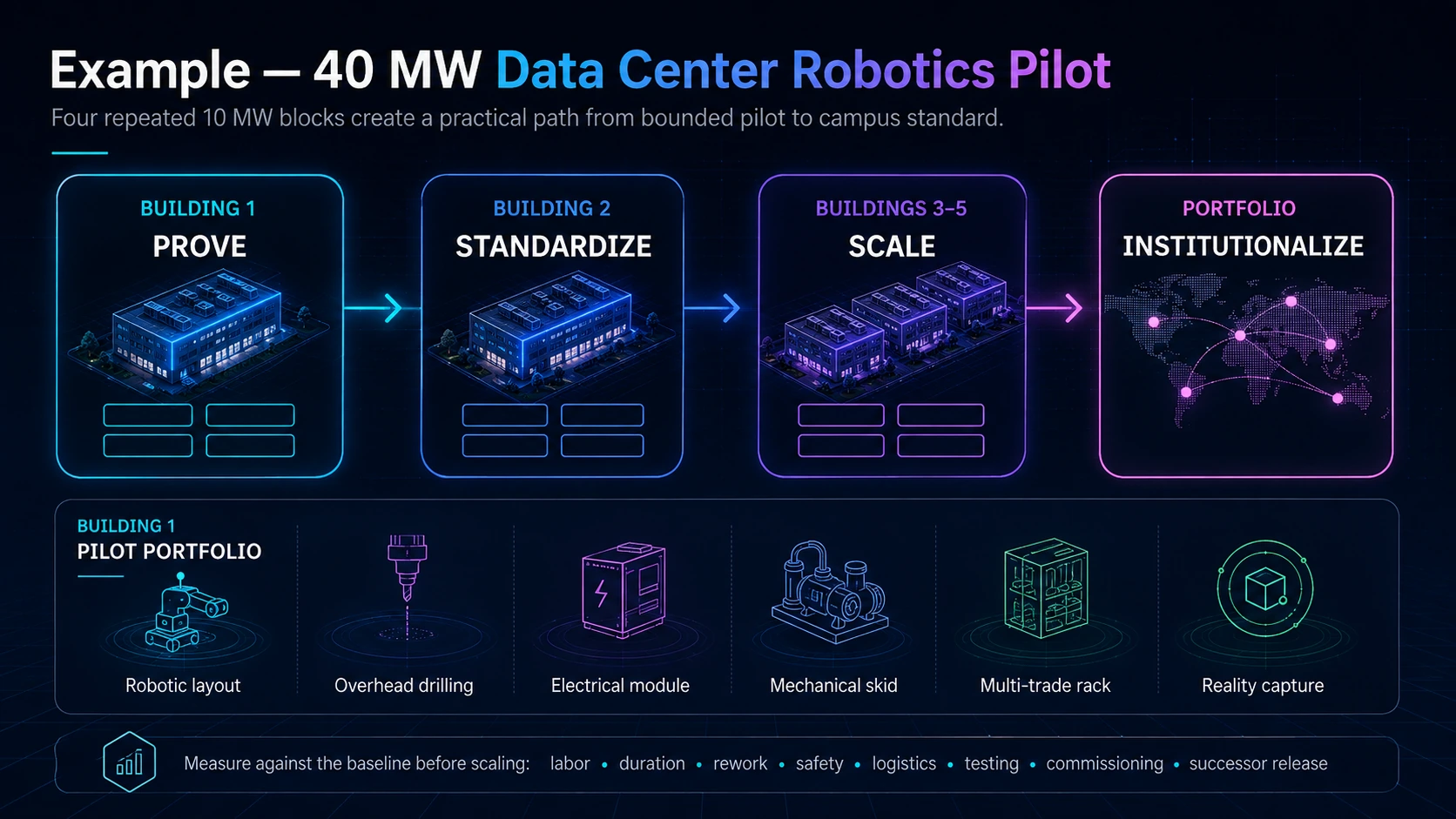
Use a 40 MW total information technology capacity program with four repeated 10 MW blocks to test bounded workflows before scaling. Pilot robotic layout, repeated overhead drilling, one standardized electrical power-module type, one mechanical / Coolant Distribution Unit skid type, one multi-trade rack family, and recurring reality capture. Compare each with the conventional baseline using labor-hours, duration, setup, downtime, errors, rework, safety exposure, logistics, testing, connection time, commissioning impact, and successor release.
Building 1 — Prove
Prove the bounded workflows under representative conditions, preserve conventional recovery options, and record the complete baseline comparison.
Building 2 — Standardize
Correct interfaces, revise model requirements, establish templates, train operators, and formalize logistics and quality requirements.
Buildings 3–5 — Scale
Reuse modules, connections, vendors, work packages, logistics, testing, and benchmarks across representative conditions.
Portfolio — Institutionalize
Maintain a reference design, standard modules, standard connections, standard tolerances, standard robotics work packages, an approved vendor ecosystem, performance benchmarks, and a lessons-learned loop.
Version every transferred requirement and retain local stop authority. The strongest business case rarely comes from one robot on one project. It comes from repeating a proven workflow across many halls, buildings, and campuses.
Developer Decision Gate / Key Takeaway
Approve scale only when the team can show: a real production constraint; a credible conventional baseline; released, repeatable design; a ready workface; resolved tolerance and factory/site interfaces; viable logistics and vendor capacity; accepted safety and quality evidence; total installed cost rather than package price; and schedule logic proving that faster work releases successors. Continue a limited pilot when evidence is promising but not representative. Stop when setup, variability, rework, downstream burden, or risk consumes the benefit. The objective is not maximum automation. It is stable, measurable production that can be repeated without increasing commissioning uncertainty.
Early screening checklist
What to verify before advancing this site.
- Production constraint and conventional baseline approved
- Task productivity separated from critical-path project impact
- Repetition and portfolio reuse quantified
- Authoritative coordinates, survey control, and model releases established
- Design freeze, connection points, and tolerance stack approved
- Workface access, power, connectivity, safety, and recovery confirmed
- Factory capacity, fabrication data, and long-lead equipment secured
- Transport route, staging, crane access, picks, and weather limits verified
- Factory/site responsibility matrix and warranty boundary approved
- Factory Acceptance Testing and Site Acceptance Testing defined
- Quality findings have owners, dates, and closure evidence
- Total installed cost includes engineering, logistics, field connection, and commissioning
- Schedule benefit is supported by successor-release logic
- Carbon and material claims use comparable, product-specific evidence
- Pilot stop, revise, repeat, and scale criteria approved
- Lessons learned and corrected templates transferred to the next building
What DCFR would flag
Risks surfaced at the screening stage.
DCFR would flag any robotics or prefabrication program launched without a verified production constraint, conventional baseline, stable design, authoritative coordinate system, tolerance plan, prepared workface, logistics plan, factory/site responsibility matrix, measurable acceptance criteria, commissioning strategy, conventional recovery method, and evidence-based pathway from pilot to campus standard.
Professional confirmation required
Items requiring licensed validation.
Final construction means and methods, survey control, model governance, structural anchorage, work-zone safety, labor requirements, module design, fire and life-safety compliance, transport, lifting, temporary conditions, field tolerances, inspections, Factory Acceptance Testing, Site Acceptance Testing, commissioning, warranty, cost, schedule, sustainability claims, and scalability require project-specific confirmation by the owner, Architect and Engineers of Record, contractors, trades, fabricators, equipment manufacturers, surveyors, safety professionals, commissioning providers, logistics and lifting specialists, insurers, and Authorities Having Jurisdiction where applicable.
Final takeaway
The strongest business case rarely comes from one robot on one project. It comes from repeating a proven workflow across many halls, buildings, and campuses. Standardize only what has demonstrated lower total installed cost, credible schedule value, reduced risk, or more predictable commissioning under representative project conditions.
Screen up to 20 candidate sites before selecting one for the full DCFR report.
Each DCFR Report Package includes a preliminary 20-site comparison PDF / export package plus one selected planning-grade feasibility report.