
DCFR Insight 38 / Risk-Adjusted Site Selection + Critical Path
Land DevelopmentRisk-Adjusted Data Center Site Comparison and Selection
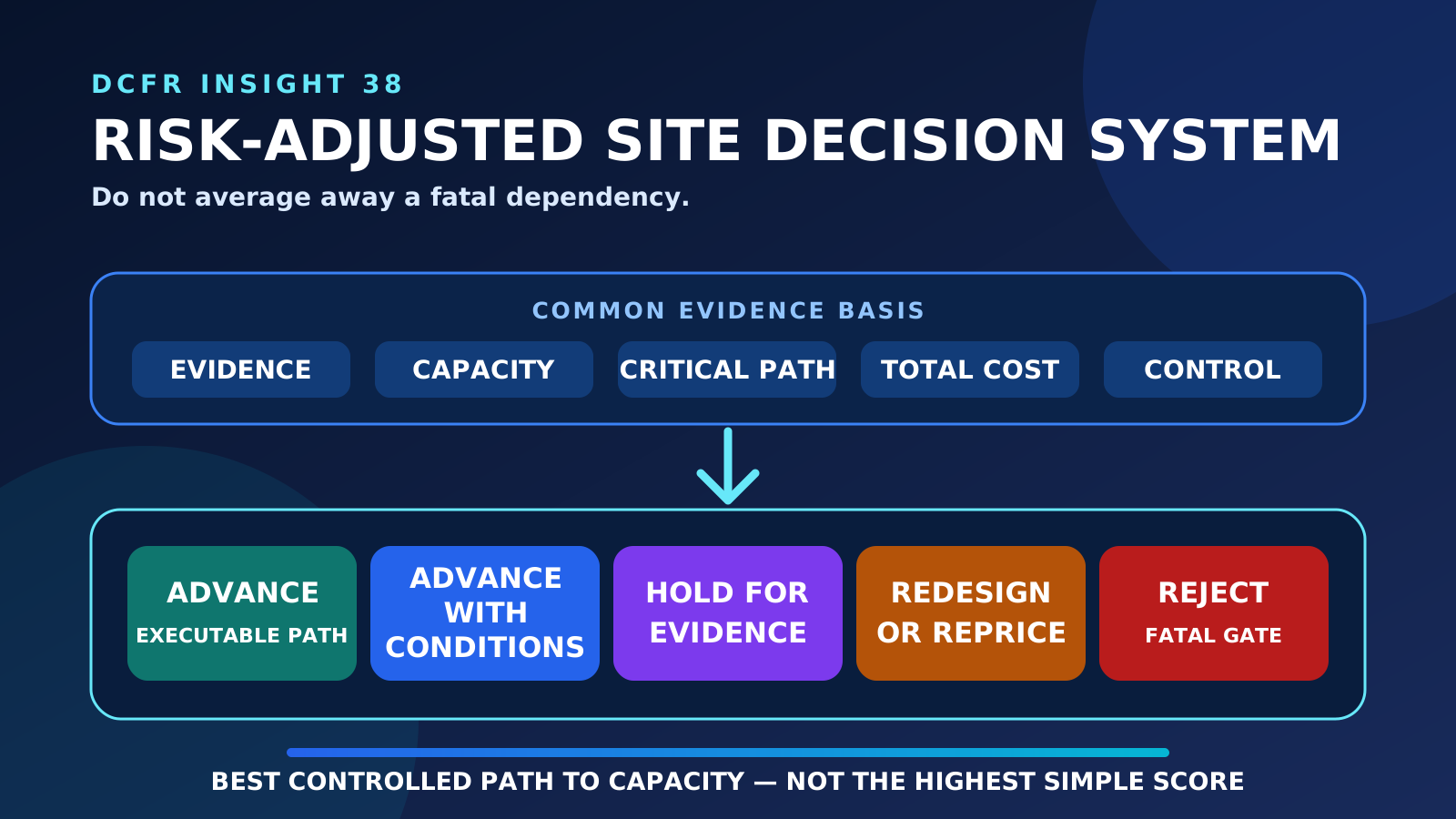
The best parcel is not the one with the highest simple score. It is the site with the strongest evidence-backed path from land control through entitlements, infrastructure, construction, energization, and operation at the required capacity and date.

A weighted score can hide the reason a site fails
A parcel can earn strong averages for acreage, price, market, power proximity, and zoning while one unresolved dependency makes delivery impossible. Separate fatal flaws, hard gates, tradeable criteria, and opportunities before applying any weighting. A missing transmission right, discretionary approval with material opposition, inaccessible outfall, unacceptable title restriction, or energization date beyond the business need should not be diluted by favorable secondary attributes.
Compare sites against one controlled development basis
Issue the same target IT capacity, phasing, reliability basis, building and yard assumptions, water and cooling strategy, access and security criteria, required-in-service date, commercial milestones, evidence definitions, and cost basis to every site team. Record allowed deviations and their effect. If one parcel is assessed at a smaller program, a looser evidence standard, or a different schedule, the ranking measures inconsistent assumptions rather than site quality.
Distinguish evidence maturity from favorable opinion
For each material criterion, classify what supports the conclusion: unverified assumption, desktop source, owner or broker statement, consultant judgment, field observation, completed study, agency or utility indication, accepted design, executed agreement, permit, recorded right, or delivered asset. Then state source, date, limitation, confidence, confirmation action, and invalidation trigger. A site with a less attractive but well-defined condition may be more valuable than a nominally superior site supported only by conversations.
Convert every risk into capacity, time, cost, and control
Risk labels such as red, amber, and green are insufficient by themselves. State the capacity or acreage affected, earliest and plausible-late resolution dates, direct and consequential cost range, approval or third-party dependency, design and operational consequences, probability basis where defensible, mitigation alternatives, responsible owner, and available commercial protection. Where probability cannot be credibly estimated, use scenarios and decision thresholds instead of invented precision.
Build the entitlement and infrastructure critical path together
Map site control, title cure, survey, environmental and geotechnical work, rezoning or use approval, subdivision and site plan, public hearings, appeal periods, road and civil approvals, utility studies and agreements, easements, transmission and substation work, water and wastewater, building and fire permits, long-lead release, construction, commissioning, and energization. Identify predecessors, decision-makers, evidence, review cycles, float, external ownership, and the capacity milestone each activity gates. Parallel schedules should be treated as connected when they compete for the same plan, study, route, right, approval, funding, or decision.
Risk-Adjusted Development-Readiness Comparison
| Decision dimension | Site A | Site B | Site C | Required interpretation |
|---|---|---|---|---|
| Usable phased capacity | Quantified range | Quantified range | Quantified range | State constraint basis and sensitivity—not gross acreage |
| Land-use pathway | By-right or discretionary; evidence | By-right or discretionary; evidence | By-right or discretionary; evidence | Show decision authority, studies, hearing, conditions and appeal |
| Power delivery | MW, phase, route, date, evidence | MW, phase, route, date, evidence | MW, phase, route, date, evidence | Separate indication, study, agreement, right and delivered capacity |
| Legal access and routes | Existing, curative or unresolved | Existing, curative or unresolved | Existing, curative or unresolved | Confirm survey, title, engineering and recordable rights |
| Environmental and ground | Mapped constraints and investigation maturity | Mapped constraints and investigation maturity | Mapped constraints and investigation maturity | Show acreage, permit, mitigation, cost and seasonal effect |
| Required-in-service path | Base / downside / recovery | Base / downside / recovery | Base / downside / recovery | Expose external ownership, float and no-later-than threshold |
| Total development exposure | Range and major unpriced items | Range and major unpriced items | Range and major unpriced items | Include off-site, delay, mitigation, capacity loss and retained duties |
| Commercial protection | Rights and unresolved gaps | Rights and unresolved gaps | Rights and unresolved gaps | Match deposits, conditions, extensions and remedies to evidence |
The table is a decision summary, not a substitute for the underlying evidence, coordinated plans, schedules, estimates, professional opinions, and transaction documents.
Model scenarios instead of one promised date
At minimum, build evidence-based base, downside, and recovery scenarios. The downside should reflect credible review cycles, appeal exposure, utility or agency delay, seasonal fieldwork, title or route cure, mitigation, procurement, and construction constraints—not arbitrary percentage padding. The recovery case should identify real actions, decision dates, cost, residual risk, and limits. Show the first capacity date, subsequent phases, and the point at which delay destroys the business case or customer commitment.
Use risk-adjusted economics without false precision
Compare purchase or option cost, off-site obligations, studies, mitigation, utility and capacity deposits, carrying cost, escalation, contingencies, schedule delay, capacity loss, and retained operational obligations. Use ranges and sensitivity where inputs remain immature. Risk-adjusted does not require assigning a questionable probability to every item; it requires making uncertainty economically visible and showing which evidence or commercial term would materially change the exposure.
Preserve option value across a portfolio
Do not collapse to one preferred site before the highest-consequence uncertainties have differentiated the candidates. Sequence low-cost screens first, keep credible alternatives alive through the relevant evidence gates, and spend deeper diligence where it buys decision-changing information. Track option expirations, deposits, exclusivity, seller cooperation, utility milestones, agency calendars, and consultant access across the portfolio. The cost of maintaining a second path may be small compared with losing the required capacity date after one site has become irreversible.
Use explicit decision gates and authorities
Each gate should identify the decision, required evidence, minimum acceptable condition, residual risks, recommendation, accountable executive, dissent, deadline, and consequence of no decision. Typical outcomes are advance, advance with conditions, hold for defined evidence, redesign, reprice, renegotiate, extend, or reject. A gate is not a presentation meeting; it is the point at which the organization knowingly changes expenditure, commitment, exclusivity, design, or schedule exposure.
Decision-Gate Logic
| Outcome | When it is justified | Required evidence | Next control |
|---|---|---|---|
| Advance | Critical paths are executable and residual exposure is within approved limits | Current studies, accepted pathways, rights and funded plan | Release the next defined scope and monitor assumptions |
| Advance with conditions | The site remains preferred if named uncertainties are commercially contained | Defined gaps, thresholds, owners, dates and remedies | Tie exposure to objective evidence milestones |
| Hold for evidence | One decision-critical question can reverse the ranking | Specific investigation, issuer, deadline and decision threshold | Preserve alternatives and avoid uncontrolled spend |
| Redesign or reprice | The site works only under a changed capacity, plan, scope, cost or obligation | Updated site fit, schedule, economics and counterparty position | Seek approval on the revised business case |
| Reject | A fatal flaw or downside exceeds capacity, date, cost, legal or operating limits | Traceable evidence and tested alternatives | Record the reason and reusable screening rule |
Issue a recommendation that can survive executive challenge
The final comparison should show why the recommended site wins, which assumptions could reverse the decision, what must be true by the next date, how the downside is contained, and why the rejected alternatives lost. Include the common basis, fatal-flaw screen, coordinated site fits, evidence register, entitlement and infrastructure critical paths, scenario dates, cost ranges, commercial controls, decision log, and post-selection work plan. Executives should be able to trace every conclusion to evidence and every residual risk to an owner.
Current Technical Basis — August 2026
Loudoun County, Virginia
Data Center Standards and LocationsOfficial example of jurisdiction-specific data-center requirements that can change entitlement, layout, mitigation, and site comparison.
U.S. Department of Energy
DOE Releases New Report Evaluating Increase in Electricity Demand from Data CentersOfficial context for the scale and timing of data-center electricity demand and the need to distinguish requested from deliverable capacity.
Federal Emergency Management Agency
FEMA Flood Map Service CenterOfficial source for flood-hazard information used as one input to site-risk comparison.
U.S. Army Corps of Engineers
Regulatory Program and PermitsOfficial federal context for regulated-water and wetland dependencies that may affect the development critical path.
Technical basis reviewed August 2026. Cooling technology, equipment capability, vendor qualification, and industry guidance continue to evolve; project decisions should use the latest applicable manufacturer data and professional engineering analysis.
Capacity-delivery review checklist
What to verify before the next release gate.
- Fatal flaws, hard gates, weighted criteria, and opportunities are separated before scoring
- Every site uses the same capacity, phasing, reliability, layout, schedule, evidence, and cost basis
- Evidence maturity, source, date, limitation, confirmation action, and invalidation trigger are recorded
- Risks show effects on capacity, time, cost, approval, operations, and commercial control
- Entitlement, land rights, infrastructure, permits, procurement, construction, and energization form one dependency network
- Base, downside, and recovery scenarios use named events and real actions rather than arbitrary padding
- Economics include off-site works, delay, escalation, mitigation, capacity loss, and retained obligations
- Portfolio alternatives remain alive through the evidence gates that can reverse the decision
- Every gate identifies required evidence, authority, residual risk, deadline, and consequence
- The recommendation states which assumptions could reverse the ranking and who owns confirmation
What DCFR would flag
Delivery risks that should be visible early.
A high weighted score can conceal a fatal dependency. DCFR would flag any recommendation that averages away land-use, power, access, environmental, legal-rights, or schedule gates—or treats low-maturity evidence as equivalent to an executable commitment.
Professional confirmation required
Items requiring project-specific validation.
Confirm land use, title, survey, easements, environmental and geotechnical conditions, utility capacity and routes, cost, schedule, commercial rights, approvals, and investment thresholds with qualified counsel, licensed consultants, utilities, authorities, counterparties, and the project owner.
Final takeaway
The strongest site is the one with the best controlled path to capacity—not the one with the most attractive unverified attributes.
Surface site, code, utility, and delivery risk before it becomes expensive.
DCFR converts early assumptions into planning-grade flags, confirmation registers, and decision-ready feasibility outputs.