
DCFR Insight 110 / Energy + Campus Interfaces
Data Center Heat Reuse: Designing the Architectural Interface Before an Off-Taker Exists
How to preserve credible heat-reuse optionality without burdening the primary data-center cooling and resilience system with an unproven external dependency.
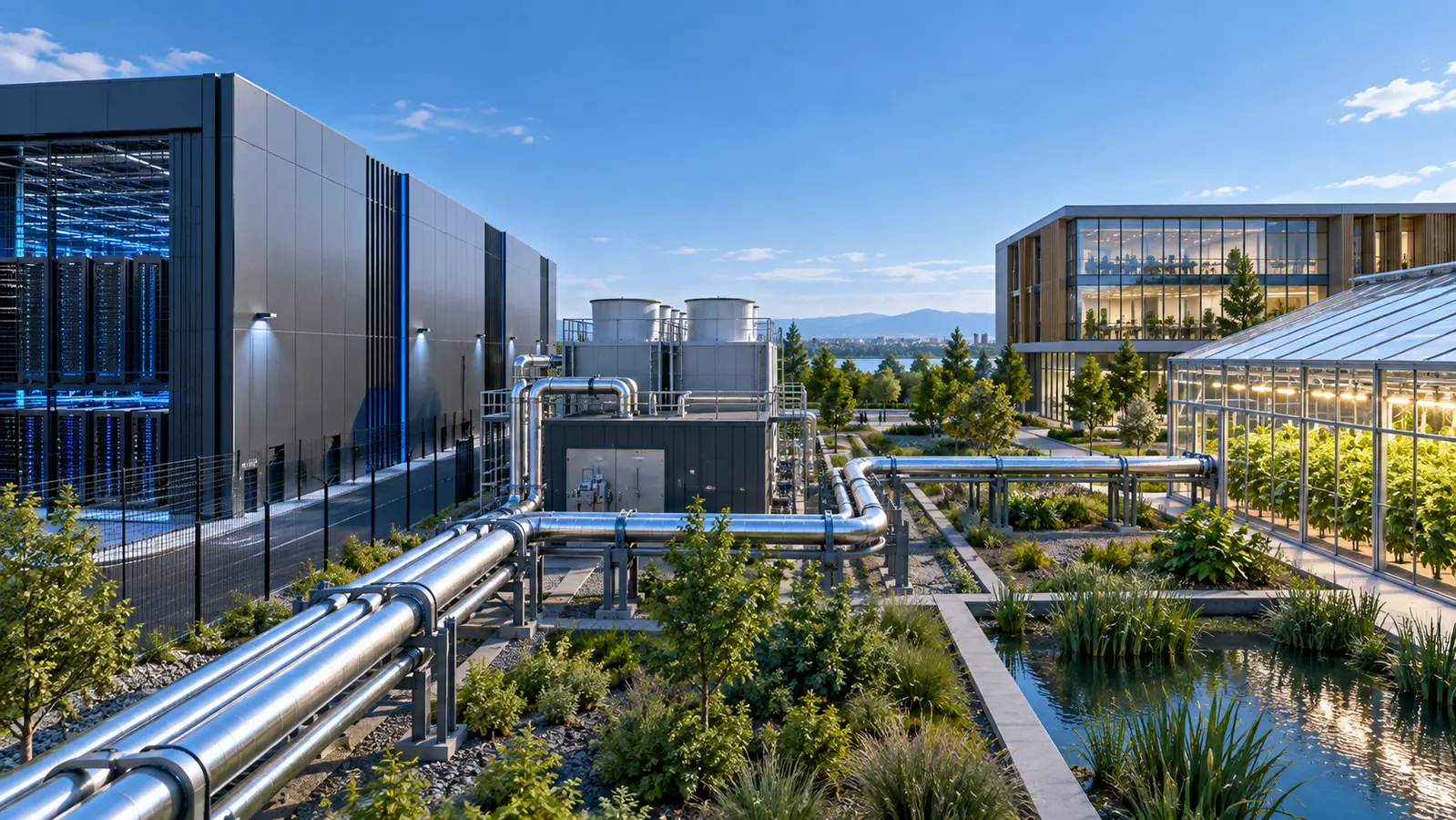
Heat Reuse Is an Interface Problem Before It Is an Energy Story
Data centers reject heat at temperatures, volumes, locations, and times that may not match a potential off-taker. The opportunity becomes real only when the technical boundary, quality, reliability, ownership, economics, routing, approvals, and operating responsibilities are designed coherently.
The primary facility must protect IT capacity and cooling resilience. External heat delivery should never create a failure path that compromises the data center. That principle drives the need for hydraulic separation, controls boundaries, isolation, metering, and clear operating priority.
A conceptual pipe on a masterplan is not enough. It can sterilize land, cross security zones, conflict with utilities, or create a later construction risk if the physical interface is not reserved deliberately.
Characterize the Actual Thermal Resource
Start with the heat source: load profile, return and supply temperatures, seasonal condition, cooling topology, redundancy state, available flow, heat-exchanger approach temperatures, water chemistry, controls, and operating restrictions.
The most important metric is useful heat at the transfer boundary, not theoretical heat inside the building. Temperature lift may be needed for district energy, buildings, industrial processes, greenhouses, or other uses; that lift changes energy, equipment, cost, and reliability.
Record base, peak, minimum, and maintenance-state availability. A heat use that only works at rare peak conditions is not an infrastructure business case.
THERMAL EXPORT INTERFACE
Create a safe boundary between the data center and future heat users.
Protect optionality without assuming an off-taker exists.
SOURCE LOOP
Recoverable heat and operating envelope
EXCHANGER
Hydraulic separation, metering, isolation
EXPORT CORRIDOR
Space, route, access, ownership boundary
STUDY NOTE — EVIDENCE + FAILURE MODE
Study point: reserve the architectural and mechanical interface before a heat customer exists. The data-center loop must remain protected from the reliability, ownership, and maintenance obligations of the export network.
Create a Protected Primary/Secondary Boundary
The heat-reuse interface should separate the data center’s critical cooling loop from the external system through properly engineered heat exchange, isolation, controls, water-quality protection, metering, and failure behavior.
Define what occurs on loss of off-taker demand, loss of secondary power, leak, overpressure, controls communication failure, poor secondary water quality, maintenance outage, and emergency operations. The default safe state must preserve primary cooling.
The boundary also clarifies ownership. The data center owner, energy-service provider, utility, and off-taker should not be able to change their systems without understanding the effect on the other side.
Reserve the Campus Path Before It Is Needed
Even where no off-taker is contracted, the masterplan can preserve optionality: an interface pad or room, pipe corridor, road crossing location, easement strategy, metering position, isolation access, construction sequence, and future connection point.
The corridor needs to avoid security conflicts, critical electrical routes, stormwater, foundations, fire access, and future building pads. It should be protected in the phase plan so a later project does not consume it.
Reserve only what has a plausible technical and market case. Overbuilding a district-energy system without a credible heat sink can increase capital, land use, and complexity with no corresponding benefit.
OFF-TAKER VIABILITY GATES
Heat reuse works only when physical and commercial conditions align.
A nearby building is not automatically a usable heat sink.
QUALITY
Temperature, load profile, reliability
DISTANCE
Pipe route, losses, crossing, easements
COMMITMENT
Demand, contract, owner, operating duty
STUDY NOTE — EVIDENCE + FAILURE MODE
Evidence required: quantify temperature, seasonal coincidence, distance, thermal losses, plant space, corridor rights, hydraulic separation, metering, controls, and the off-taker’s contractual commitment.
Test the Business Case as a Time-and-Responsibility Model
Heat reuse has a commercial system: who funds the interface and downstream network; who owns energy and environmental attributes; who guarantees availability; who pays for backup heat; how outages are measured; and what happens when the data center expands or changes cooling technology.
The off-taker must be able to use the heat when it is available. Seasonal mismatch is often decisive: data-center heat may be most plentiful when external demand is lowest, or the off-taker may need higher temperature than the source can provide economically.
Model avoided energy, auxiliary power, thermal storage, backup systems, construction timing, and contract duration. A headline carbon benefit without this model is not a bankable decision.
Owner-Side Decision Matrix
| Decision | What must be defined | Evidence before release |
|---|---|---|
| Performance basis | Required operating outcome, capacity range, failure and maintenance states | Requirement trace, calculation, test method, acceptance threshold |
| Physical interface | Geometry, tolerance, access, ownership, safety and sequence | Coordinated model/detail, manufacturer data, constructability review |
| Variant boundary | What may vary and what must remain controlled | Applicability matrix, deviation approval, configuration record |
| Lifecycle outcome | Inspection, maintenance, replacement, recovery and future phase implications | Operations review, replacement-path test, commissioning and handover plan |
Govern Change Across Both Systems
Reference-design updates, cooling changes, equipment replacement, water-treatment changes, control upgrades, and capacity phases can alter the source side. Development or tariff changes can alter the demand side. The interface needs configuration and change control.
Maintain a documented design basis, operating envelope, metering record, maintenance plan, emergency procedure, and change-approval route. Review the interface at every major data-center and off-taker modification.
This discipline protects optionality. It lets a future project connect to a known, verified boundary instead of reopening years of undocumented assumptions.
FUTURE-READY RESERVE
Build the connection points before future phases make them expensive.
Reserve defined assets; do not install speculative systems without a user.
01 SPACE
Plant bay, corridor, vault, access
02 CONNECTION
Valves, meter, flanges, controls provision
03 GOVERNANCE
Ownership, safety, maintenance, change control
STUDY NOTE — EVIDENCE + FAILURE MODE
Failure to avoid: building speculative export infrastructure without a viable user—or locating later plant and roads so that a credible connection becomes physically impossible.
Early screening checklist
What to verify before advancing this site.
- Useful heat is defined at a real transfer boundary.
- Primary cooling is protected against secondary-system failure.
- Interface, isolation, metering and controls are engineered.
- Campus corridor and connection space survive phasing.
- Thermal, commercial, ownership and backup assumptions are modeled.
- Changes on either system trigger interface review.
What DCFR would flag
Risks surfaced at the screening stage.
DCFR can identify potential corridor and interface constraints, but must not claim heat-reuse feasibility without real source, off-taker, temperature, permitting, commercial, and operational evidence.
Professional confirmation required
Items requiring licensed validation.
Planning-grade guidance only. Final strategy requires mechanical, energy, utility, controls, civil, legal, commercial, environmental, security, operations, insurer, and AHJ confirmation.
Final takeaway
The most valuable early heat-reuse move is often not construction. It is protecting a safe, measurable, buildable interface that keeps a future opportunity technically credible.
Screen up to 20 candidate sites before selecting one for the full DCFR report.
Each DCFR Report Package includes a preliminary 20-site comparison PDF / export package plus one selected planning-grade feasibility report.